Silent Letters in English: Rules, Examples and a Simple List
Learn silent letters in English with clear rules, examples and IPA. See words with silent K, W, B, G, H, L and T, plus a simple 5-minute practice routine.
In this article 8 sections
Have you ever seen the word "knife" and wondered why anyone would put a K in front of it? You're not alone. Silent letters in English confuse learners and native speakers alike. They appear in the spelling of a word but disappear when you say it.
The good news is that silent letters are more predictable than they look. In this guide you'll learn why they exist, the most common patterns, and a practical way to remember them.
Why does English have silent letters?
Silent letters are mostly a result of history. Hundreds of years ago, people really did say the K in "knee" and the W in "write." Over time, pronunciation changed, but spelling stayed the same. Printing helped freeze spelling in place while speech kept evolving.
English also borrowed many words from Greek, Latin and French. Those words brought their original spellings with them, even when the sounds didn't fit English. That's why "psychology" starts with a P you never say.
Knowing this helps in a practical way. Silent letters aren't random mistakes. Most follow patterns, and patterns can be learned.
Common silent letters with examples
Here are the silent letters you'll meet most often. The IPA symbols show how each word is actually pronounced (US English unless noted).
Silent K
The K is silent when it comes before N at the start of a word.
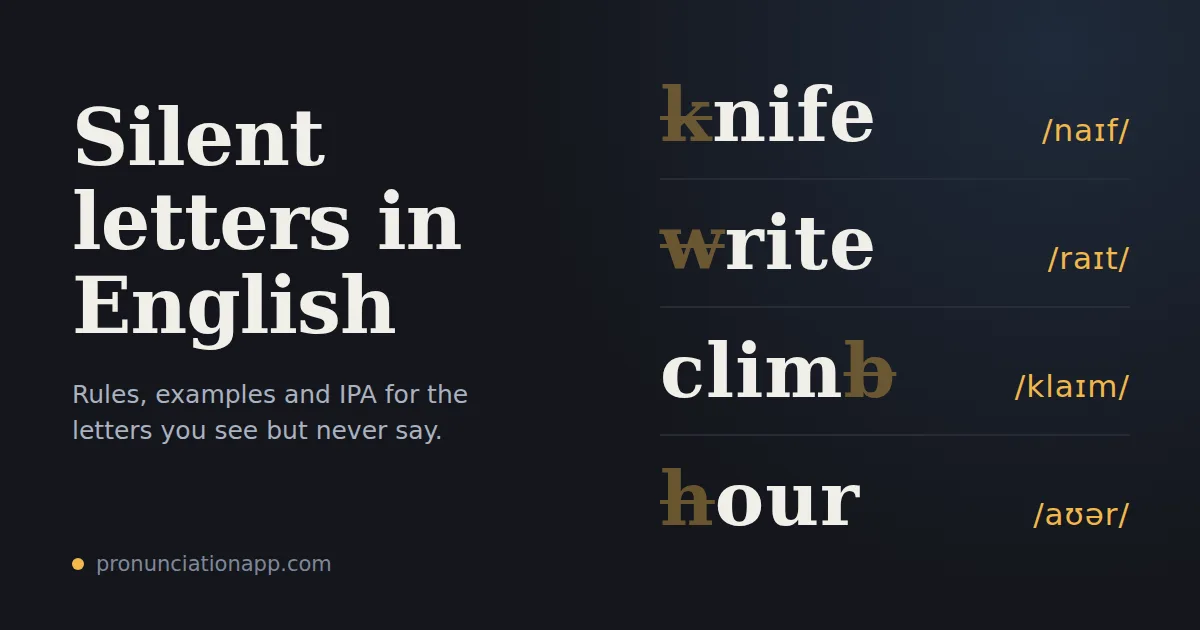
- knife /naɪf/
- knee /niː/
- know /noʊ/
- knock /nɑːk/
- knight /naɪt/
This is one of the most reliable rules in English. If a word starts with "kn," skip the K.
Silent W
The W is silent before R at the start of a word. It's also silent in a few other common words.
- write /raɪt/
- wrong /rɔːŋ/
- wrist /rɪst/
- answer /ˈænsər/
- two /tuː/
Silent B
The B is often silent after M at the end of a word, and in a few words before T.
- climb /klaɪm/
- thumb /θʌm/
- comb /koʊm/
- doubt /daʊt/
- debt /det/
Silent G
The G is silent before N, whether at the start or the end of a word.
- gnome /noʊm/
- sign /saɪn/
- design /dɪˈzaɪn/
- foreign /ˈfɔːrən/
Silent H
The H is silent in some words, usually ones that came from French.
- hour /ˈaʊər/
- honest /ˈɑːnɪst/
- honor /ˈɑːnər/
- heir /er/
Also watch for "ghost" and "rhythm," where the H is not pronounced as a separate sound.
Silent L
The L is silent in many words with "alk," "alm," or "olk," and in the helper verbs "could," "would" and "should."
- walk /wɔːk/
- talk /tɔːk/
- calm /kɑːm/
- half /hæf/
- could /kʊd/
Silent T
The T is silent in words ending in "-stle" and "-sten," and in a few others.
- castle /ˈkæsl/
- listen /ˈlɪsn/
- whistle /ˈwɪsl/
- fasten /ˈfæsn/
- Christmas /ˈkrɪsməs/
A note on "often": some speakers say the T and some don't. Both are acceptable, so don't worry about which you choose.
Silent N
The N is silent after M at the end of some words.
- autumn /ˈɔːtəm/
- column /ˈkɑːləm/
- hymn /hɪm/
Silent P
The P is silent in words that begin with "ps" or "pn," and in a few others.
- psychology /saɪˈkɑːlədʒi/
- pneumonia /nuːˈmoʊniə/
- receipt /rɪˈsiːt/
- cupboard /ˈkʌbərd/
Other silent letters worth knowing
- Silent D: Wednesday /ˈwenzdeɪ/, handsome /ˈhænsəm/
- Silent U: guitar /ɡɪˈtɑːr/, guess /ɡes/, biscuit /ˈbɪskɪt/
- Silent S: island /ˈaɪlənd/, aisle /aɪl/
- Silent C: scissors /ˈsɪzərz/, muscle /ˈmʌsl/
Quick reference table
| Silent letter | Pattern | Examples |
|---|---|---|
| K | before N | knife, knee, know |
| W | before R | write, wrong, wrist |
| B | after M | climb, thumb, comb |
| G | before N | sign, design, gnome |
| L | in "alk," "alm" | walk, talk, calm |
| T | in "-stle," "-sten" | castle, listen |
| P | before S or N | psychology, pneumonia |
Are there exceptions?
Yes, and it's worth being honest about that. English has plenty of exceptions.
- "Wednesday" is spelled with a D but said as "WENZ-day."
- Some speakers pronounce the L in "salmon" and some don't (most say /ˈsæmən/).
- Accents differ. In British English, "herb" keeps its H, while American speakers usually say "erb."
For a second opinion on tricky words, check Cambridge Dictionary or Merriam-Webster.
If you're unsure, check the word with an audio tool rather than guessing.
How to practise silent letters (a 5-minute routine)
- Pick one pattern per day. Don't try to learn everything at once. Start with silent K.
- Listen first. Type the word into the pronunciation tool and play it at 0.5× speed.
- Check the IPA. Click the word to see its phonetic spelling and notice which letters have no sound.
- Say it aloud. Use the speaking practice mode and see whether the word is recognised.
- Use it in a sentence. For example: "I know the knight left his knife by the knee-high wall."
Repeat the missed words until you can say them without thinking.
Common mistakes to avoid
- Pronouncing the K in "knife." Say "nife," not "k-nife."
- Saying the L in "walk." It's "wawk."
- Adding a B to "comb." The B is never heard.
- Learning from spelling alone. Always confirm with your ears.
Frequently asked questions
How many silent letters are in English?
There's no exact count, because it depends on how you define the word. Almost every letter of the alphabet is silent in at least one word.
Which letter is silent most often?
The final E is the most common silent letter, as in "make" and "like." Among consonants, silent K, W and B are very common.
Do silent letters differ between accents?
Sometimes. For example, "herb" and "often" vary between speakers and regions, and some accents pronounce the R in words where others drop it.
Is there a rule for silent letters?
There are patterns, such as "kn" and "wr" at the start of words, but there are also many exceptions. Learning by group is more effective than memorising single words.
Final thoughts
Silent letters look scary, but most of them fall into a handful of patterns. Learn the groups, listen to real audio, and practise a little each day. Within a few weeks, words like "knowledge," "island" and "Wednesday" will feel natural.
Ready to try it? Paste any word from this article into the free pronunciation tool, hear it in four accents, and see its IPA.
You can learn more about phonetic symbols from the International Phonetic Association.
Paste any sentence from this guide into the free tool, hear it in four accents and get instant feedback on your pronunciation.