How to Pronounce -ed Endings: 3 Easy Rules and Examples
Learn how to pronounce ed endings in English with 3 simple rules (/t/, /d/, /ɪd/), clear examples, a quick throat test and practice tips.
In this article 11 sections
- 01How to Pronounce ed Endings: The Three Sounds
- 02The quick throat test
- 03Rule 1: Say /t/ after voiceless sounds
- 04Rule 2: Say /d/ after voiced sounds
- 05Rule 3: Say /ɪd/ after /t/ and /d/
- 06Quick summary
- 07Exceptions to know
- 08A 5-minute practice routine
- 09Common mistakes to avoid
- 10Frequently asked questions
- 11Final thoughts
If you've ever heard someone say "walk-ED" with two clear syllables and wondered whether that's right, you're in good company. Learning how to pronounce ed endings is one of the biggest challenges for English learners. The spelling looks the same every time, but the sound changes.
Here's the good news: there are only three possible sounds, and one simple test tells you which to use. By the end of this guide, you'll know the rules and have a short routine to make them automatic.
How to Pronounce ed Endings: The Three Sounds
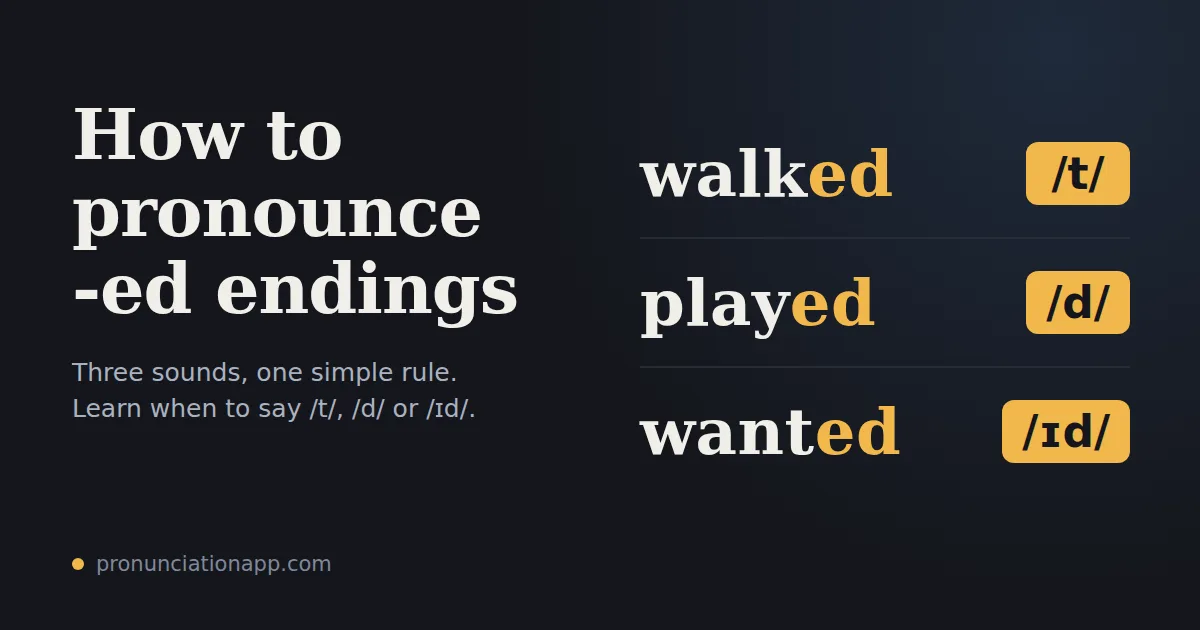
Regular past tense verbs end in -ed, but that ending can be pronounced three ways:
| Sound | Example | IPA |
|---|---|---|
| /t/ | walked | /wɔːkt/ |
| /d/ | played | /pleɪd/ |
| /ɪd/ | wanted | /ˈwɑːntɪd/ |
Notice that in "walked" and "played," the -ed does not add a syllable. Only the /ɪd/ sound does. This is the mistake we hear most often, so keep it in mind as you read on.
The quick throat test
Before the rules, here's a trick to tell voiced sounds from voiceless ones. Put two fingers on your throat and say "zzzz." You'll feel a buzz. That's a voiced sound. Now say "ssss." No buzz. That's voiceless.
You'll use this test to check the last sound of the verb, not the last letter. Try it on the base verb before you add -ed.
Rule 1: Say /t/ after voiceless sounds
If the verb ends in a voiceless sound, the -ed sounds like a quick /t/. The voiceless sounds to remember are /p/, /k/, /f/, /s/, /ʃ/ (as in "sh"), /tʃ/ (as in "ch") and /θ/ (as in "th").
- jumped /dʒʌmpt/
- walked /wɔːkt/
- laughed /læft/
- missed /mɪst/
- washed /wɑːʃt/
- watched /wɑːtʃt/
Pay attention to spelling here. "Laughed" ends in -ed, but the sound before it is /f/, so you say /t/. And "missed" ends in the /s/ sound, so the -ed is /t/ too. Always think about sound, not letters.
Rule 2: Say /d/ after voiced sounds
If the verb ends in a voiced sound, the -ed sounds like /d/. That includes all vowel sounds and most consonants, such as /b/, /g/, /v/, /z/, /m/, /n/, /l/, and /r/.
- played /pleɪd/
- called /kɔːld/
- cleaned /kliːnd/
- lived /lɪvd/
- opened /ˈoʊpənd/
- arrived /əˈraɪvd/
Here's a common trap. Words like "closed" and "used" end in a letter E, but the sound before -ed is /z/, which is voiced. So "closed" is /kloʊzd/, ending in /d/, not /t/.
Rule 3: Say /ɪd/ after /t/ and /d/
This is the only time -ed becomes its own syllable. If the verb already ends in a /t/ or /d/ sound, you need an extra vowel to make the word easy to say.
- wanted /ˈwɑːntɪd/
- needed /ˈniːdɪd/
- started /ˈstɑːrtɪd/
- decided /dɪˈsaɪdɪd/
- visited /ˈvɪzɪtɪd/
- ended /ˈendɪd/
Think about it this way: "want" plus a plain /d/ would give you "wantd," which is hard to pronounce. English adds the small vowel sound /ɪ/ to help.
Quick summary
| The verb ends with... | Say -ed as | Example |
|---|---|---|
| Voiceless sound (p, k, f, s, sh, ch, th) | /t/ | jumped, washed |
| Voiced sound (vowels, b, g, v, z, m, n, l, r) | /d/ | played, cleaned |
| /t/ or /d/ | /ɪd/ | wanted, needed |
Exceptions to know
A small group of words ending in -ed are adjectives, and they keep the full /ɪd/ sound:
- naked /ˈneɪkɪd/
- wicked /ˈwɪkɪd/
- rugged /ˈrʌɡɪd/
- crooked /ˈkrʊkɪd/
- sacred /ˈseɪkrɪd/
Some words also change depending on how they're used. "Aged" is /eɪdʒd/ as a verb ("he aged quickly") but /ˈeɪdʒɪd/ as an adjective ("the aged man"). If you're unsure, look the word up in Cambridge Dictionary and listen to the audio.
A 5-minute practice routine
- Pick one group per day. Start with /t/, then /d/, then /ɪd/.
- Listen first. Type a word like "walked" into the pronunciation tool and play it slowly.
- Check the IPA. Look at the last symbol and match it to the rule.
- Say it aloud. Repeat each word five times, keeping the ending short.
- Use a sentence. For example: "I walked, played and waited all afternoon." That one sentence uses all three sounds.
For extra listening practice, the British Council LearnEnglish site has free audio and pronunciation activities.
Common mistakes to avoid
- Adding a syllable to "walked." It's one syllable: "wawkt," not "wawk-ed."
- Saying /d/ instead of /t/ after voiceless sounds. "Jumped" ends with /t/, not /d/.
- Dropping the ending completely. "I walk yesterday" sounds like present tense. Keep that final sound, even if it's quiet.
- Reading the spelling instead of listening. The letters won't tell you the sound. The final sound of the verb will.
Frequently asked questions
How many syllables does "worked" have?
One. The -ed sounds like /t/ and doesn't add a syllable: /wɜːrkt/.
Why is "wanted" pronounced differently from "walked"?
"Want" ends in the /t/ sound. Adding another /t/ would be hard to say, so English inserts /ɪ/ and gives you /ɪd/.
Does the rule work in British and American English?
Yes, the three-sound rule is the same in both. Only the vowel sounds inside the words change slightly.
Do irregular verbs follow this rule?
No. Irregular verbs like "go" and "went" or "eat" and "ate" change in other ways. This rule is only for regular verbs ending in -ed.
Final thoughts
Once you know the pattern, -ed endings stop being scary. Check the last sound of the verb: voiceless gets /t/, voiced gets /d/, and /t/ or /d/ gets /ɪd/. That's it.
Ready to test yourself? Try ten regular verbs in the free pronunciation tool, listen in different accents, and check the IPA for each ending.
Paste any sentence from this guide into the free tool, hear it in four accents and get instant feedback on your pronunciation.