English Pronunciation for Kids: Fun Ways to Teach Sounds
Learn English pronunciation for kids with fun games, simple mouth cues and a 10-minute daily routine for parents and teachers, plus word lists.
In this article 9 sections
Your child says “fink” instead of “think,” or “wabbit” instead of “rabbit.” Or you’re teaching a class where half the children find “sh” and “ch” impossible. First, take a breath. This is completely normal, and it’s very fixable. This guide shows you how to teach English pronunciation for kids in a way that feels like play, not homework. You’ll find what to expect at different ages, simple mouth cues, eight games, a 10-minute daily routine and word lists to try.
A quick note: this is a general guide for parents and teachers. If you’re worried about a child’s speech development, a speech-language pathologist can assess it properly.
English pronunciation for kids: what to expect by age
Children learn sounds in a rough order, and there’s a wide range of normal. This is only a general guide.
| Age range | Often easy | Often still developing |
|---|---|---|
| About 3 to 4 | p, b, m, n, h, w, t, d | k, g, f, s, l, r, th |
| About 5 to 6 | k, g, f, s, z, l | r, th, sh, ch, j, v |
| About 7 to 8 | most sounds | th, sometimes r |
The “th” sound and the “r” sound are often the last ones to arrive. That’s one reason “fink” and “wabbit” are so common. For children learning English as a second language, the pattern depends on their first language, and sounds that don’t exist in it can take longer.
8 fun ways to teach pronunciation
1. Listen first, with slow audio
Children copy what they hear. Before asking a child to say a word, let them hear it a few times, slowly and clearly. A tool where you can type a word and slow the audio down works well. See pronunciation audio online for how to use it.
2. Play the mirror game
Sit in front of a mirror together. Make the mouth shape for a sound, and ask the child to copy you. “Can you stick out your tongue like a sandwich?” Seeing their own mouth helps a lot, especially for “th.”
3. Clap the syllables
Say a word and clap each beat. “Ba-NA-na” is three claps. “Hip-po-POT-a-mus” is five. This teaches rhythm and stress, which matter as much as individual sounds. See word stress in English for the grown-up version.
4. Rhyme time
Rhymes train the ear. Say “cat, hat, bat, mat...” and ask for more. Then try a silly one: “Does ‘banana’ rhyme with ‘piano’?” Nursery rhymes and children’s songs are also great, because the rhythm helps words stick.
5. “Which word did I say?”
This is a minimal pairs game. Say one of two similar words and ask the child to point to the picture. Try “ship” and “sheep,” “bat” and “pat,” or “thick” and “sick.” It trains listening without any pressure to speak. For more word pairs, see minimal pairs in English.
6. Tongue twisters
Short, silly twisters make practice fun. Keep them slow at first:
- “Six slippery snails slid slowly.”
- “Three thin thieves thought about Thursday.”
- “A big black bug bit a big black bear.”
Say it slowly, then a little faster, and laugh at the mistakes.
7. Animal sound safari
Children love animals, so use them. Walk through a “zoo” with toy animals or pictures, and say each name together. You’ll find a long list in our guide to how to pronounce animal names.
8. Sound of the week
Pick one sound each week. Put a picture on the fridge. Find five words that start with it, and spot it in everyday life. “Today’s sound is ‘sh.’ Can you find three things that start with ‘sh’?” One sound at a time is plenty.
Want to hear how this sounds right now? Type any word into the Free Pronunciation Tool and listen to it in 4 accents.
Mouth cues kids remember
Abstract instructions don’t work well with small children. Pictures and silly names do. Here are four cues you can use right away.
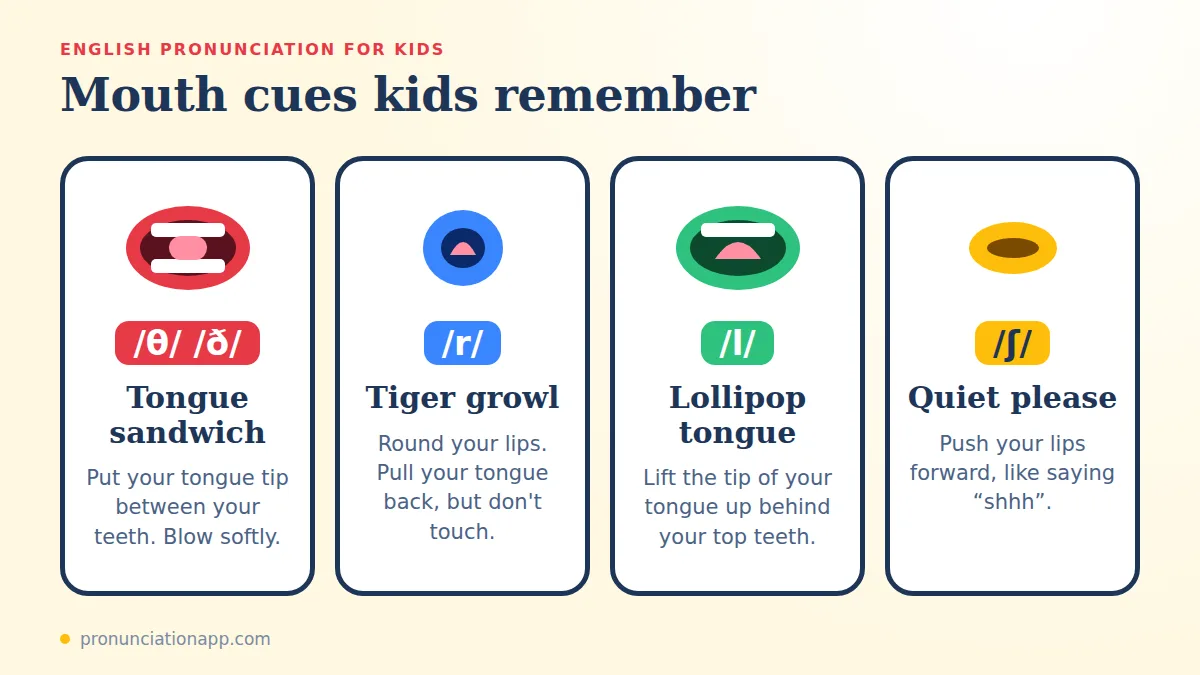
| Sound | Kid-friendly cue | What to say |
|---|---|---|
| /θ/ and /ð/ (think, this) | Tongue sandwich | “Put your tongue between your teeth and blow softly.” |
| /r/ (red, rabbit) | Tiger growl | “Round your lips and pull your tongue back, but don’t touch.” |
| /l/ (lion, lollipop) | Lollipop tongue | “Lift the tip of your tongue up behind your top teeth.” |
| /ʃ/ (ship, shoe) | Quiet please | “Push your lips forward, like saying ‘shhh.’” |
For “th,” our guide to how to pronounce th has a step-by-step version you can adapt.
Words to try with kids
These common words use the tricky sounds, so they make good practice.
| Word | IPA (US) | Tricky sound |
|---|---|---|
| orange | /ˈɔːrɪndʒ/ | r, dg |
| purple | /ˈpɜːrpl/ | r, p |
| yellow | /ˈjeloʊ/ | y, l |
| brother | /ˈbrʌðər/ | th (voiced), r |
| three | /θriː/ | th, r |
| thumb | /θʌm/ | th, silent b |
| thirsty | /ˈθɜːrsti/ | th, r |
| birthday | /ˈbɜːrθdeɪ/ | r, th |
| spaghetti | /spəˈɡeti/ | sp, stress |
| giraffe | /dʒəˈræf/ | j, r |
| library | /ˈlaɪbreri/ | l, r |
| school | /skuːl/ | sk, l |
“Thumb” has a silent B, which you can learn more about in our guide to silent letters in English.
A 10-minute daily routine for parents and teachers
- Listen (2 minutes). Play three words from this week’s sound, slowly.
- Mirror (2 minutes). Practise the mouth shape together.
- Game (4 minutes). Pick one game: rhyme time, “which word did I say?” or a tongue twister.
- Story or song (2 minutes). Read a page aloud or sing a nursery rhyme, and let the child join in.
Keep it short, light and fun. If the child is tired or frustrated, stop. Five happy minutes beat fifteen reluctant ones.
How to correct gently
How you respond matters more than which game you play. Here are some tips that work.
- Repeat it correctly, without saying “wrong.” If the child says “I see a wabbit,” you say, “Yes, a rabbit! I see a rabbit too.” This is called recasting, and it teaches without discouraging.
- Praise effort, not perfection. “I love how you tried that sound!”
- Correct one thing at a time. Too many corrections can make a child stop talking.
- Slow down and model it. Children copy your speed and clarity.
- Don’t compare. Every child learns at their own pace.
Mistakes to avoid
- Correcting every word. It can make children anxious about speaking.
- Rushing the sounds. Wait until the earlier sounds feel comfortable.
- Only drilling single words. Use sentences, stories and songs.
- Skipping the listening step. Children can’t say what they can’t hear.
- Making it feel like a test. Keep it playful.
- Waiting too long to ask for help if you’re genuinely concerned. A professional can reassure you or point you to support.
Questions people ask
At what age should a child pronounce English sounds correctly?
It varies. Most sounds are in place by about age 5 or 6, and “th” and “r” can take until 7 or 8. If you’re worried, ask a speech-language pathologist.
How can I teach a child to say “th”?
Use the “tongue sandwich” cue. Put the tongue tip between the teeth and blow softly. Practise in front of a mirror with words like “think,” “thumb” and “three.”
How do I help a child who is learning English as a second language?
Give lots of listening time, use slow clear audio, play sound games and keep correction gentle. Practise sounds that don’t exist in their first language a little at a time.
Are songs and rhymes really helpful?
Yes. They train the ear for rhythm and stress, and children enjoy repeating them.
How much should a child practise each day?
About ten minutes of playful practice is plenty. Short, happy sessions work best.
When should I see a speech-language pathologist?
If a child’s speech is very hard for family members to understand, if they seem frustrated or if you’re concerned about their progress, it’s a good idea to ask a professional. They can tell you what’s typical for your child’s age.
Start with one sound this week
Pick one sound, such as “sh.” Say it together, find five “sh” words, and play one game for ten minutes a day. Next week, choose another sound.
You can also use the tool to hear any word before you say it. For longer lists, see how to pronounce English words online, and use a word pronouncer whenever a word comes up that you’re not sure about.
Want to hear how this sounds right now? Type any word into the Free Pronunciation Tool and listen to it in 4 accents.
Paste any sentence from this guide into the free tool, hear it in four accents and get instant feedback on your pronunciation.