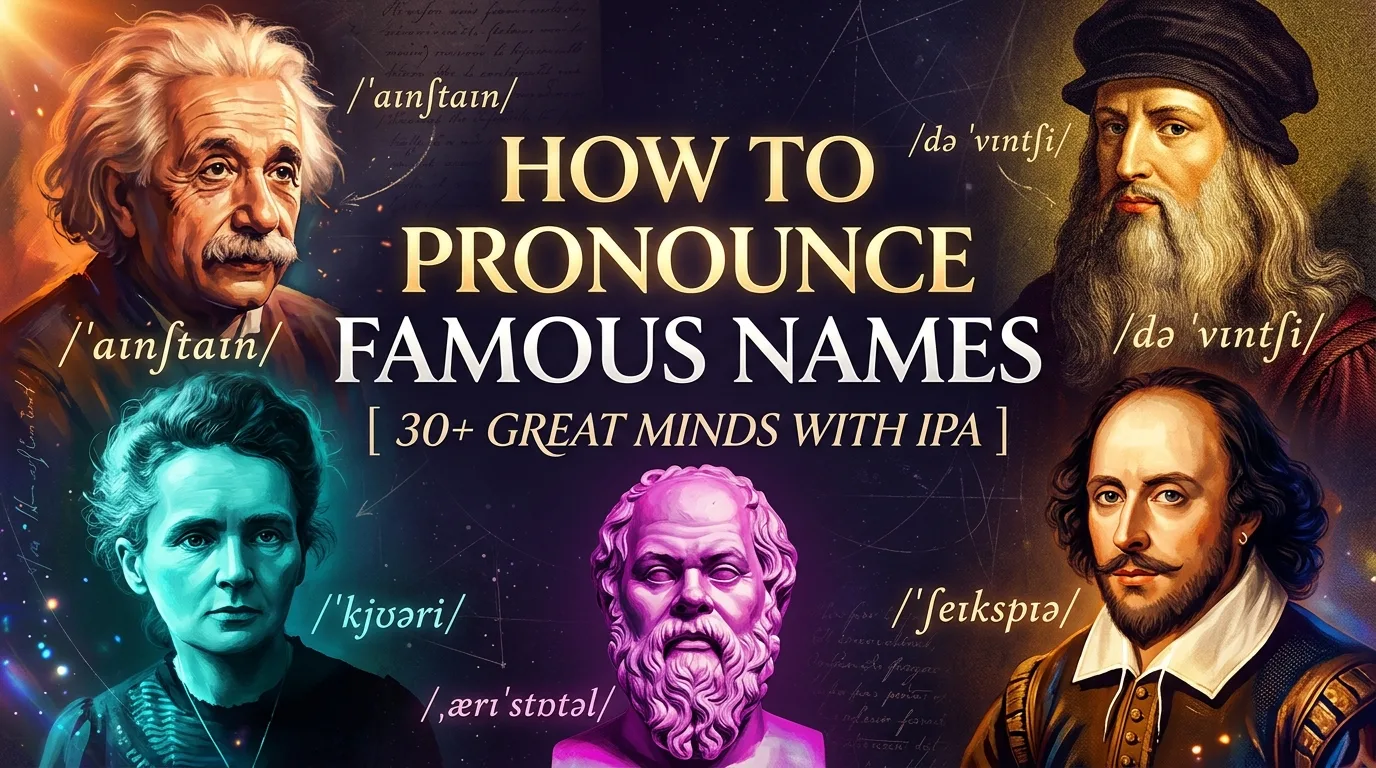
How to Pronounce Famous Names: 30+ Great Minds With IPA
Learn how to pronounce famous names like Nietzsche, Tchaikovsky, Beethoven and Galileo, with IPA, simple respellings and the language patterns behind them.
In this article 11 sections
You’re in a class, a book club or a museum, and someone mentions Nietzsche. Or Tchaikovsky. Or Descartes. Everyone nods as if the name is obvious, and you quietly wonder how it’s actually said. Famous names from other languages are hard, because they keep their original spelling but get pronounced in English. This guide shows you how to pronounce famous names, with IPA and simple respellings, for more than 30 composers, artists, writers, thinkers and scientists.
One note first. Names from other languages are often “anglicised,” which means English speakers say them a little differently from the original. I’ve given the version that’s most common in English, and mentioned the original where it helps.
How to pronounce famous names: six language patterns
Most of these names come from just a few languages. Learn the patterns, and you can guess many more.
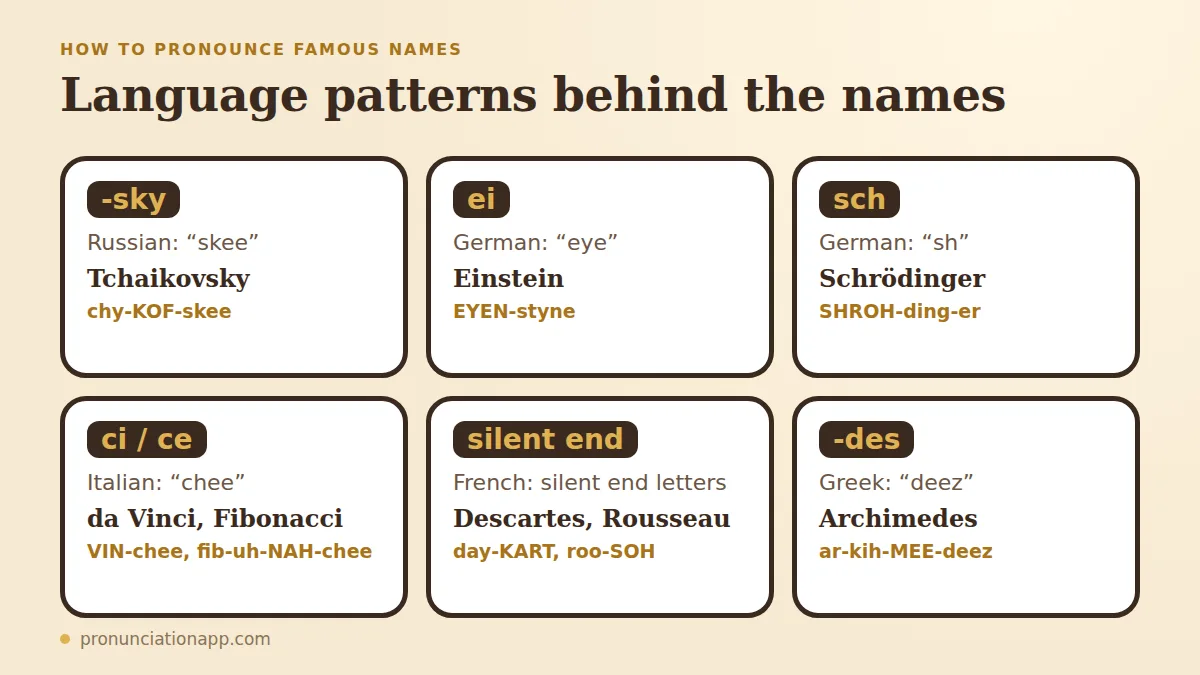
| Pattern | Language | Sounds like | Example |
|---|---|---|---|
| -sky | Russian | “skee” | Tchaikovsky, Dostoevsky |
| ei | German | “eye” | Einstein, Heisenberg |
| sch | German | “sh” | Schrödinger |
| ci / ce | Italian | “chee” / “cheh” | da Vinci, Fibonacci |
| Silent end letters | French | the last letter isn’t said | Descartes, Rousseau |
| -des | Greek | “deez” | Archimedes |
Composers
| Name | IPA (US) | Say it like |
|---|---|---|
| Beethoven | /ˈbeɪtoʊvən/ | BAY-toh-vun |
| Tchaikovsky | /tʃaɪˈkɔːfski/ | chy-KOF-skee |
| Chopin | /ʃoʊˈpæn/ | shoh-PAN |
| Dvořák | /ˈdvɔːrʒɑːk/ | DVOR-zhahk |
| Mozart | /ˈmoʊtsɑːrt/ | MOHT-sart |
| Bach | /bɑːk/ | BAHK |
| Vivaldi | /vɪˈvɑːldi/ | vih-VAHL-dee |
A few notes. “Beethoven” is “BAY-toh-vun,” not “BEE-thoh-ven.” “Mozart” starts with “MOHT,” and the Z is a “ts” sound. And “Tchaikovsky” starts with a “ch” sound, from the Russian "ч."
Artists
| Name | IPA (US) | Say it like |
|---|---|---|
| Van Gogh | /væn ˈɡoʊ/ | van GOH |
| Monet | /moʊˈneɪ/ | moh-NAY |
| Renoir | /rənˈwɑːr/ | ruh-NWAR |
| Cézanne | /seɪˈzæn/ | say-ZAN |
| Michelangelo | /ˌmaɪkəlˈændʒəloʊ/ | my-kul-AN-juh-loh |
| da Vinci | /də ˈvɪntʃi/ | duh VIN-chee |
“Van Gogh” has a famous split. Most Americans say “van GOH,” and many British speakers say “van GOKH,” with a throat sound at the end, which is closer to the Dutch original. Both are common. “Michelangelo” starts with “my” in English, not “mick.”
Writers and thinkers
| Name | IPA (US) | Say it like |
|---|---|---|
| Goethe | /ˈɡɜːtə/ | GUR-tuh |
| Nietzsche | /ˈniːtʃə/ | NEE-chuh |
| Descartes | /deɪˈkɑːrt/ | day-KART |
| Rousseau | /ruːˈsoʊ/ | roo-SOH |
| Voltaire | /voʊlˈter/ | vohl-TAIR |
| Sartre | /ˈsɑːrtrə/ | SAR-truh |
| Camus | /kæˈmuː/ | ka-MOO |
| Dostoevsky | /ˌdɑːstɔɪˈefski/ | dos-toy-EF-skee |
| Chekhov | /ˈtʃekɔːf/ | CHEK-off |
| Kierkegaard | /ˈkɪrkəɡɑːrd/ | KEER-kuh-gard |
“Nietzsche” is the one that surprises most people. It’s two syllables, “NEE-chuh,” and some speakers say “NEE-chee.” “Goethe” has no “oh” sound at all, and “Descartes” drops the final “s” and the “t” sounds, so the final sound is “kart.”
Want to hear how this sounds right now? Type any word into the Free Pronunciation Tool and listen to it in 4 accents.
Scientists and mathematicians
| Name | IPA (US) | Say it like |
|---|---|---|
| Galileo | /ˌɡælɪˈleɪoʊ/ | gal-ih-LAY-oh |
| Copernicus | /koʊˈpɜːrnɪkəs/ | koh-PER-nih-kus |
| Kepler | /ˈkeplər/ | KEP-ler |
| Pythagoras | /paɪˈθæɡərəs/ | py-THAG-uh-rus |
| Archimedes | /ˌɑːrkɪˈmiːdiːz/ | ar-kih-MEE-deez |
| Euclid | /ˈjuːklɪd/ | YOO-klid |
| Pasteur | /pæˈstɜːr/ | pas-TUR |
| Heisenberg | /ˈhaɪzənbɜːrɡ/ | HY-zun-burg |
| Schrödinger | /ˈʃroʊdɪŋər/ | SHROH-ding-er |
| Fibonacci | /ˌfɪbəˈnɑːtʃi/ | fib-uh-NAH-chee |
Two quick tips. “Pythagoras” starts with “py,” and it uses the TH sound from our guide on how to pronounce th. And “Archimedes” ends in “-deez,” like many Greek names.
Why famous names are hard to pronounce
Three reasons:
- They come from many languages. Russian, German, French, Italian, Greek and Dutch names all appear in English.
- English only partly adapts them. Some sounds, like the German “ch” in “Bach,” don’t exist in everyday English, so speakers swap in a close one.
- Spelling follows the original. Names like “Schrödinger” and “Dvořák” keep letters English doesn’t use.
The good news is that you don’t have to sound fully native. If you use the common English version, people will understand you. If you’re talking to someone who knows the language, a closer version is a nice touch.
Practise in a sentence
Say these three sentences slowly, then at normal speed:
- “Beethoven and Tchaikovsky wrote music that Chopin admired.”
- “Nietzsche and Descartes shaped modern philosophy.”
- “Galileo and Kepler studied the stars, and Einstein changed physics.”
For longer names, break them into chunks first, like “dos-toy-EF-skee.” The stress is on the “EF.” If you need help finding stress, see word stress in English.
A 10-minute practice plan
- Pick five names you want to learn.
- Listen to each in the tool, three times, then once slowly. For help with the tool, see pronunciation audio online.
- Check the IPA. If the symbols are new, see how to read IPA.
- Say each name five times, then in a sentence.
- Record yourself and compare it with the audio.
- Add five more tomorrow.
For longer lists, see how to pronounce English words online, and use a word pronouncer when you meet a new name. You might also like our guides to place names and brand names.
Mistakes to avoid
- Saying “BEE-thoh-ven.” It’s “BAY-toh-vun.”
- Saying the final “s” in “Descartes.” It’s silent.
- Reading “sch” as “sk” in “Schrödinger.” It’s “sh.”
- Saying “ei” as “ee” in “Einstein” and “Heisenberg.” It’s “eye.”
- Treating one version as the only correct one. Van Gogh, Nietzsche and others have more than one accepted pronunciation.
- Guessing instead of checking. A few seconds with the audio helps.
Questions people ask
How do you pronounce Nietzsche?
NEE-chuh, in IPA /ˈniːtʃə/. Some speakers say “NEE-chee.”
How do you pronounce Tchaikovsky?
chy-KOF-skee, in IPA /tʃaɪˈkɔːfski/.
How do you pronounce Beethoven?
BAY-toh-vun, in IPA /ˈbeɪtoʊvən/.
How do you pronounce Descartes?
day-KART, in IPA /deɪˈkɑːrt/.
How do you pronounce Van Gogh?
Most Americans say “van GOH,” and many British speakers say “van GOKH.” Both are common.
Do I have to say foreign names the original way?
No. The common English version is fine. A closer version is a nice touch if you know the language.
Try three names now
Pick three names from this page that you’ve been unsure about. Type each into the tool, listen three times and say them out loud. Then say one of the practice sentences as if you were telling a friend about a book.
Want to hear how this sounds right now? Type any word into the Free Pronunciation Tool and listen to it in 4 accents.
Paste any sentence from this guide into the free tool, hear it in four accents and get instant feedback on your pronunciation.