American vs British Pronunciation: 20 Key Differences
American vs British pronunciation explained: 20 key differences in R sounds, vowels, stress and word endings, with IPA examples and practice tips.
In this article 12 sections
- 01American vs British pronunciation: the big picture
- 02Consonant differences
- 03Vowel differences
- 04Word ending differences
- 05Stress differences
- 06Individual word differences
- 07Quick comparison table
- 08Which accent should you learn?
- 09How to practise American vs British pronunciation
- 10Common mistakes
- 11Frequently asked questions
- 12Final thoughts
Have you ever watched a British film and then an American one, and felt like you were listening to two different languages? You're not imagining it. American vs British pronunciation differs in vowels, consonants, stress and even the way whole words are built.
The good news is that the differences follow patterns. Once you spot them, you'll understand both accents much better and know which one to aim for. This guide covers 20 of the most useful differences, each with IPA so you can see exactly what changes.
A quick note before we start. "American" here means General American, the widely understood standard accent, and "British" means Received Pronunciation (RP). Neither is more correct. Both are valid, and each country has many regional accents on top of these two.
American vs British pronunciation: the big picture
Most differences fall into four groups: consonants, vowels, word stress and individual words. We'll go through each group with examples.
Consonant differences
1. The R sound
Americans pronounce the R after a vowel, which is called being rhotic. Most British speakers drop it unless a vowel follows.
- car: US /kɑːr/ · UK /kɑː/
- teacher: US /ˈtiːtʃər/ · UK /ˈtiːtʃə/
- hard: US /hɑːrd/ · UK /hɑːd/
This is the most noticeable difference between the two accents.
2. The flapped T
In American English, a T between vowels often sounds like a quick D. This is called a flap.
- water: US /ˈwɔːɾər/ (sounds like "wadder") · UK /ˈwɔːtə/
- better: US /ˈbeɾər/ · UK /ˈbetə/
- city: US /ˈsɪɾi/ · UK /ˈsɪti/
Many British speakers use a glottal stop instead in casual speech, saying "bo'le" for "bottle," but that's informal and varies by region.
3. Yod dropping
After T, D and N, Americans usually skip the /j/ sound (the "y" in "yes"). British speakers keep it.
- new: US /nuː/ · UK /njuː/
- tune: US /tuːn/ · UK /tjuːn/
- student: US /ˈstuːdənt/ · UK /ˈstjuːdənt/
4. Herb and the silent H
Americans say "herb" without the H. British speakers say it.
- herb: US /ɜːrb/ · UK /hɜːb/
This connects to what we covered in our guide to silent letters in English, where some silent letters depend on the accent.
5. Leisure and schedule
Two well-known word pairs use different consonant sounds.
- leisure: US /ˈliːʒər/ · UK /ˈleʒə/
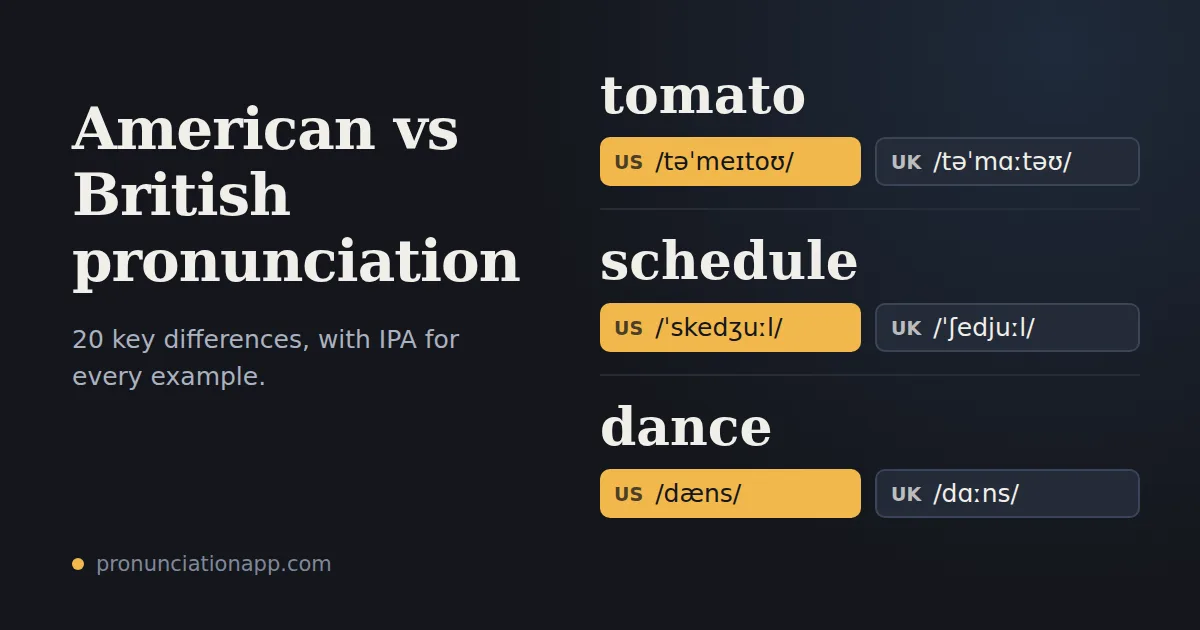
- schedule: US /ˈskedʒuːl/ · UK /ˈʃedjuːl/
Vowel differences
6. The bath vowel
Words like "dance," "class" and "path" use a short /æ/ in American English and a long /ɑː/ in British English.
- dance: US /dæns/ · UK /dɑːns/
- bath: US /bæθ/ · UK /bɑːθ/
- can't: US /kænt/ · UK /kɑːnt/
7. The "hot" vowel
The vowel in words like "hot" and "stop" is different.
- hot: US /hɑːt/ · UK /hɒt/
- stop: US /stɑːp/ · UK /stɒp/
8. The "go" vowel
The diphthong in "go" and "no" starts in a different place.
- go: US /ɡoʊ/ · UK /ɡəʊ/
- home: US /hoʊm/ · UK /həʊm/
9. Tomato
The most famous pair of all.
- tomato: US /təˈmeɪtoʊ/ · UK /təˈmɑːtəʊ/
10. Either and neither
Both pronunciations exist in both countries, but the most common ones differ.
- either: US /ˈiːðər/ · UK /ˈaɪðə/
Word ending differences
11. The -ile ending
In American English, many -ile words end in a weak syllable. In British English, they end with the /aɪl/ sound.
- missile: US /ˈmɪsl/ · UK /ˈmɪsaɪl/
- fertile: US /ˈfɜːrtl/ · UK /ˈfɜːtaɪl/
- mobile: US /ˈmoʊbl/ · UK /ˈməʊbaɪl/
12. The -ary and -ory endings
American speakers keep the full ending. British speakers often shorten it.
- secretary: US /ˈsekrəteri/ · UK /ˈsekrətri/
- dictionary: US /ˈdɪkʃəneri/ · UK /ˈdɪkʃənri/
13. Aluminum
This word even has a different spelling and a different number of syllables.
- aluminum / aluminium: US /əˈluːmɪnəm/ · UK /ˌæljəˈmɪniəm/
Stress differences
14. Garage
- garage: US /ɡəˈrɑːʒ/ · UK /ˈɡærɑːʒ/
15. Advertisement
- advertisement: US /ˌædvərˈtaɪzmənt/ · UK /ədˈvɜːtɪsmənt/
16. Ballet
- ballet: US /bæˈleɪ/ · UK /ˈbæleɪ/
Individual word differences
17. Vitamin
- vitamin: US /ˈvaɪtəmɪn/ · UK /ˈvɪtəmɪn/
18. Privacy
- privacy: US /ˈpraɪvəsi/ · UK /ˈprɪvəsi/
19. Lieutenant
- lieutenant: US /luːˈtenənt/ · UK /lefˈtenənt/
20. The letter Z
Not a pronunciation of a word, but you'll hear it every day.
- Z: US /ziː/ ("zee") · UK /zed/ ("zed")
Quick comparison table
| Feature | American | British |
|---|---|---|
| R after a vowel | Pronounced | Usually silent |
| T between vowels | Flap /ɾ/ | Clear /t/ |
| "dance" vowel | /æ/ | /ɑː/ |
| "hot" vowel | /ɑː/ | /ɒ/ |
| "go" vowel | /oʊ/ | /əʊ/ |
| "new" | /nuː/ | /njuː/ |
| -ile endings | /l/ | /aɪl/ |
Which accent should you learn?
Here's the honest answer: pick the one you'll hear most. If you're moving to the US or watching mostly American media, learn American English. If you're studying in the UK, learn British English.
What matters more than which accent you choose is being consistent. Mixing "tomato" in British style with a rhotic American R won't stop people understanding you, but sticking to one accent makes it easier to practise and sounds more natural. Don't forget that Australian and Indian English have their own patterns too, which our tool also supports.
How to practise American vs British pronunciation
- Choose 5 words per day from this list.
- Listen to both accents. Type each word into the pronunciation tool and switch between US and UK.
- Compare the IPA. Notice which symbols change.
- Say both versions aloud. Exaggerate the differences at first.
- Check tricky words in Cambridge Dictionary, which shows both accents, or Merriam-Webster for American audio.
Common mistakes
- Mixing accents in one word. Saying an American R with a British "dance" vowel sounds unnatural.
- Over-pronouncing the R when aiming for British English.
- Assuming one accent is "wrong." They're both correct.
- Learning from spelling. As we saw with -ed endings, spelling often doesn't show the sound.
Frequently asked questions
What is the biggest difference in American vs British pronunciation?
The R sound. Americans pronounce it after vowels, while most British speakers don't.
Is British English harder to understand?
Not necessarily. It depends on what you've heard most. Both are clear once you're used to them.
Can I mix American and British pronunciation?
Yes, people do it all the time. Just try to stay consistent within a single word or sentence.
Which accent is better for exams like IELTS or TOEFL?
IELTS accepts many accents, and TOEFL tends to use North American speakers, but clear speech matters more than accent.
Final thoughts
American vs British pronunciation seems complicated at first, but most differences follow patterns: the R sound, the flapped T, the "dance" vowel and a few word endings. Learn those and you'll understand a huge part of both accents.
Ready to hear the difference? Choose any word from this article in the free pronunciation tool, switch between US and UK, and compare the IPA.
Paste any sentence from this guide into the free tool, hear it in four accents and get instant feedback on your pronunciation.