Modal Verbs: Rules, Examples and How They Sound
Learn modal verbs with clear rules, examples and exercises, plus how can, can't, should've and other forms sound in real speech. A free grammar lesson.
In this article 10 sections
“She cans swim.” “Do you can help me?” “He musts go.” If you’ve ever written sentences like these, you’ve bumped into the most common surprise about modal verbs: they don’t behave like other verbs.
Modal verbs are small, useful words like can, could, should and must. We use them all the time to talk about ability, permission, advice and possibility. In this lesson you’ll learn the rules, see what each modal does, and hear how they actually sound in speech, which is very different from how they look on the page.
The rule in one sentence
A modal verb is followed by the base form of another verb, and it never changes: no -s, no -ing and no “to.”
The modal verbs
The main ones are:
can, could, may, might, must, shall, should, will, would
A few other phrases work in a similar way: ought to, have to and need to. They’re called “semi-modals,” and they follow some of the rules but not all.
The four rules every modal verb follows
1. Modal + base verb. After a modal, use the plain form of the verb.
- She can swim. (not “She can swims” or “She can swimming”)
2. No -s for he, she, it. Modals don’t change with the subject.
- He can swim. (not “He cans swim”)
3. Questions: swap places. Put the modal before the subject, with no “do.”
- Can you swim? (not “Do you can swim?”)
4. Negatives: add not. Put “not” after the modal, or use the short form.
- She can’t swim. / She cannot swim.
One more small rule: most modals aren’t followed by “to.” We say “I must go,” not “I must to go.” The exception is “ought to,” which keeps its “to.”
What modal verbs do
Each modal has a few jobs. Here are the main ones.
| Job | Modals | Example |
|---|---|---|
| Ability | can, could | I can swim. She could read at four. |
| Permission | can, may, could | May I come in? |
| Possibility | may, might, could | It might rain later. |
| Advice | should, ought to | You should rest. |
| Obligation | must, have to | You must wear a seatbelt. |
| Requests and offers | could, would, will, shall | Could you help me? Shall I open the window? |
A few points are worth knowing:
- Could is the past of “can” for general ability (“She could swim when she was five”), but it’s also a polite way to ask (“Could you help me?”).
- Might and may both show possibility, and “might” suggests it’s a bit less likely.
- Must shows strong obligation (“You must stop”). In the negative, “mustn’t” means “it’s forbidden,” and “don’t have to” means “it isn’t necessary.”
- Should gives advice. It’s softer than “must.”
- Would is used for polite requests (“Would you like some tea?”) and for imagined situations (“I would travel more if I had time”).
Modals about the past
To talk about the past, use a modal plus have and the past participle.
| Form | Meaning | Example |
|---|---|---|
| should have + verb | you didn’t, but it was a good idea | I should have called. |
| could have + verb | it was possible, but it didn’t happen | We could have won. |
| would have + verb | an imagined result | I would have helped. |
| must have + verb | a confident guess | She must have left early. |
| might have + verb | a possible explanation | He might have forgotten. |
Want to hear how this sounds right now? Type any word into the Free Pronunciation Tool and listen to it in 4 accents.
Hear it: how modal verbs sound
This is the part most grammar lessons skip, and it’s where modal verbs get really interesting. In everyday speech, modals are small and quick, and they sound very different from how they’re spelled.
Weak forms in a sentence
When a modal isn’t stressed, its vowel shrinks into a short, relaxed sound, called the schwa. You can read more in our guide to the schwa sound.
| Modal | Weak form | In a sentence |
|---|---|---|
| can | /kən/ | I can go. → /aɪ kən ˈɡoʊ/ |
| could | /kəd/ | I could go. → /aɪ kəd ˈɡoʊ/ |
| should | /ʃəd/ | I should go. → /aɪ ʃəd ˈɡoʊ/ |
| would | /wəd/ | I would go. → /aɪ wəd ˈɡoʊ/ |
| must | /məst/ | I must go. → /aɪ məst ˈɡoʊ/ |
| will | /wəl/ or /əl/ | I’ll go. → /aɪl ˈɡoʊ/ |
Notice that the stress falls on the main verb (“go”), not on the modal. That’s the rhythm of English: the important word is strong, and the little helper word is quick.
Strong forms: negatives and short answers
Modals keep their full, strong sound in two situations: when they’re negative, and when they come at the end of a sentence.
| Modal | Negative | Short answer |
|---|---|---|
| can | can’t /kænt/ | Yes, I can. /jes aɪ ˈkæn/ |
| could | couldn’t /ˈkʊdnt/ | Yes, I could. /jes aɪ ˈkʊd/ |
| should | shouldn’t /ˈʃʊdnt/ | Yes, you should. /jes ju ˈʃʊd/ |
| would | wouldn’t /ˈwʊdnt/ | Yes, I would. /jes aɪ ˈwʊd/ |
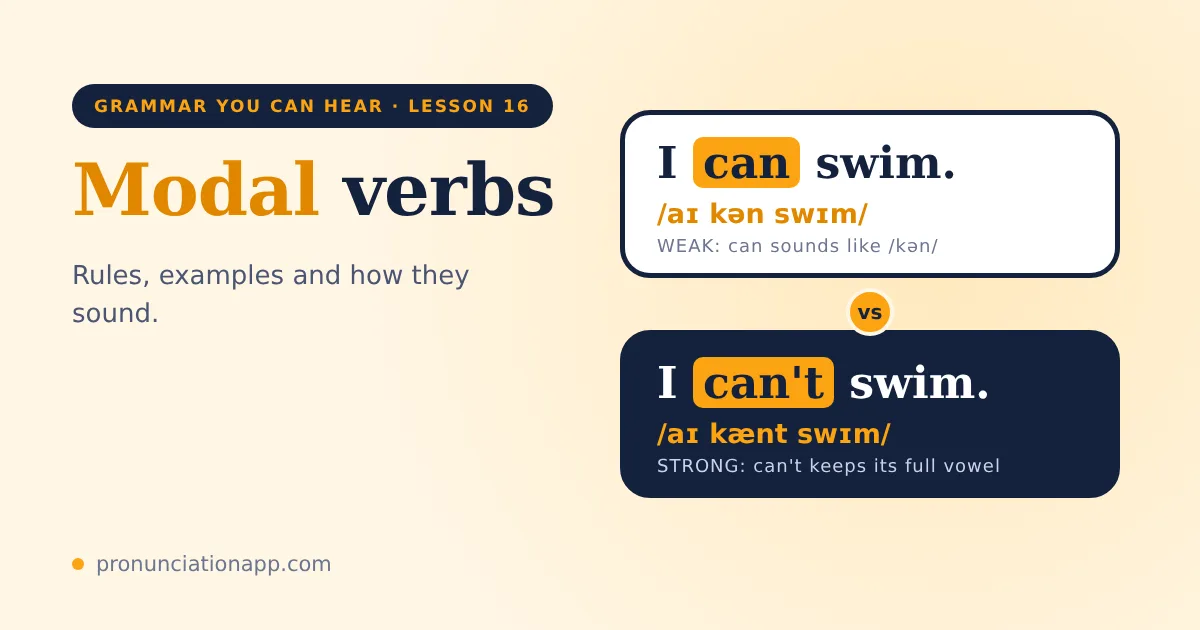
This is how listeners tell the difference between “I can go” and “I can’t go.” In “I can go,” the word “can” is weak: /kən/. In “I can’t go,” the word is strong: /kænt/. In American English, the final T in “can’t” is often very light, so the vowel does most of the work. That’s why it helps to practise both forms side by side.
Silent L in could, would and should
Look at the spelling of “could,” “would” and “should.” They all have an L, but you never say it. They sound like “cud,” “wud” and “shud.” It’s one of the classic examples in our guide to silent letters in English.
“Should’ve,” “could’ve” and “would’ve”
In speech, “have” shrinks after a modal into a tiny /əv/ sound.
| Written | Spoken | IPA |
|---|---|---|
| should have | should’ve | /ˈʃʊdəv/ |
| could have | could’ve | /ˈkʊdəv/ |
| would have | would’ve | /ˈwʊdəv/ |
| must have | must’ve | /ˈmʌstəv/ |
Because “should’ve” sounds like “should of,” many native speakers write “should of” by mistake. It’s wrong in writing. The correct form is always “should have” or “should’ve.”
Casual forms to recognise
In fast, informal speech, you’ll hear a few more squashed forms.
- have to → “hafta” /ˈhæftə/
- ought to → “oughta” /ˈɔːtə/
- going to → “gonna” /ˈɡʌnə/ (not a modal, but often used with them)
You don’t need to copy these, but it helps to recognise them. For more on how small words shrink, see word stress in English.
You can hear any of these sentences in the pronunciation tool. Type one in, choose an accent, and click each word to see its IPA.
Common mistakes
- Adding -s: “He cans swim.” Modals never take -s.
- Using “do” in questions: “Do you can help?” It should be “Can you help?”
- Adding “to”: “I must to go.” It should be “I must go.”
- Using the wrong verb form: “She can swims” or “She can swimming.” After a modal, use the base form.
- Writing “should of”: it should be “should have” or “should’ve.”
- Mixing up must and have to in the negative: “You mustn’t go” means it’s forbidden. “You don’t have to go” means it’s optional.
- Saying the L in “could,” “would” and “should.” It’s silent.
Practice time
A. Choose the best modal.
- You ____ wear a seatbelt. It’s the law. (must / might)
- ____ I borrow your pen? (May / Must)
- She ____ swim when she was five. (can / could)
- It’s cloudy. It ____ rain later. (might / must)
- You look ill. You ____ see a doctor. (should / can)
- His car is outside. He ____ be at home. (must / can’t)
- ____ you help me, please? (Could / Should)
- They left very late. They ____ be here yet. (can’t / must)
B. Correct the mistakes.
- She cans swim.
- Can you to help me?
- He musts go.
- I should of called you.
- Do you can swim?
C. Say it out loud. Read these slowly, then at normal speed. Listen for the weak and strong forms.
- “I can swim.” / “I can’t swim.” / “Yes, I can.”
- “You should rest.” / “You shouldn’t worry.”
- “She should’ve called, and he could’ve helped.”
Then check each one in the tool, and see whether your weak and strong forms match.
Answers
A. 1. must 2. May 3. could 4. might 5. should 6. must 7. Could 8. can’t
B. 1. She can swim. 2. Can you help me? 3. He must go. 4. I should have called you. (or “I should’ve called you.”) 5. Can you swim?
Questions people ask
What are modal verbs?
They’re helping verbs that show ability, permission, possibility, advice or obligation. The main ones are can, could, may, might, must, shall, should, will and would.
Why don’t modal verbs take -s?
They’re a special group of verbs that don’t change with the subject. We say “he can,” “she should” and “it might,” always in the same form.
How do you pronounce “can” and “can’t”?
In a sentence, “can” is weak, /kən/. “Can’t” is strong, /kænt/. At the end of a sentence, “can” is strong too, as in “Yes, I can.”
Is “should of” correct?
No. It comes from the way “should have” sounds when it’s shortened to “should’ve.” The correct written forms are “should have” and “should’ve.”
What’s the difference between must and have to?
“Must” often shows a rule or strong personal feeling, and “have to” often shows an external obligation. In the negative, they’re very different: “mustn’t” means forbidden, and “don’t have to” means not necessary.
Is “could” the past of “can”?
For general ability in the past, yes: “She could swim at five.” But “could” is also a polite form for requests, and it can talk about possibilities in the present.
Start small
Pick three things you can do and three you can’t, and say them out loud: “I can cook. I can’t draw. I could swim when I was young.” Listen to the weak “can” and the strong “can’t.”
That small habit will help you with both the grammar and the sound.
Want to hear how this sounds right now? Type any word into the Free Pronunciation Tool and listen to it in 4 accents.
Paste any sentence from this guide into the free tool, hear it in four accents and get instant feedback on your pronunciation.