Word Stress in English: Rules, Examples and Tips
Learn word stress in English with 7 clear rules, IPA examples and a simple practice routine. Stop guessing which syllable to stress and sound natural.
In this article 15 sections
- 01What is word stress in English?
- 02Why word stress in English matters
- 03Rule 1: Two-syllable nouns and adjectives usually stress the first sy…
- 04Rule 2: Two-syllable verbs usually stress the second syllable
- 05Rule 3: Some words change stress between noun and verb
- 06Rule 4: Stress the syllable before certain endings
- 07Rule 5: Stress the third syllable from the end for -ate, -ize, and -fy
- 08Rule 6: Compound nouns stress the first part
- 09Rule 7: Suffixes like -er, -ing, -ed, -ly and -ness usually don't mov…
- 10Quick reference table
- 11Commonly mis-stressed words
- 12A 5-minute practice routine for word stress in English
- 13Common mistakes to avoid
- 14Frequently asked questions
- 15Final thoughts
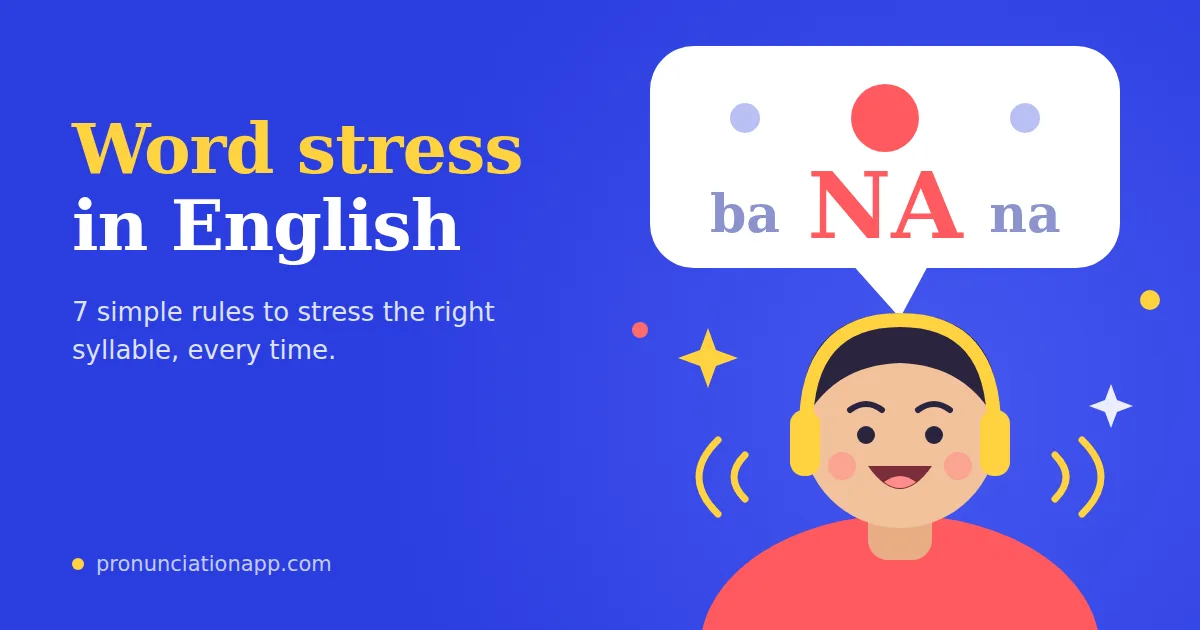
Have you ever said a word correctly, letter by letter, and still watched someone squint at you? The problem might not be your sounds at all. It might be your stress.Word stress in English means saying one syllable in a word louder, longer and clearer than the others. Get it wrong and a word like "banana" can become hard to recognise, even when every individual sound is right. Get it right and your English suddenly sounds smoother and more natural.
This guide explains what word stress is, gives you seven practical rules, and finishes with a short practice routine.
What is word stress in English?
Every English word has one syllable that stands out. That's the stressed syllable. It's usually a little louder, a little longer, and a little higher in pitch than the rest.
- ba-NA-na: the middle syllable is stressed
- TA-ble: the first syllable is stressed
- be-GIN: the second syllable is stressed
Dictionaries mark this with a small vertical line before the stressed syllable in IPA. For example, "banana" is written /bəˈnænə/, and the line sits right before the second syllable. A lower line (ˌ) marks a weaker, secondary stress in longer words.
There's another effect you should know about. Unstressed syllables usually get weaker, and their vowels often shrink into a soft /ə/ sound, called the schwa. In "banana," the first and last syllables both contain schwa-like sounds. That contrast between strong and weak is what gives English its rhythm.
Why word stress in English matters
Stress helps listeners recognise words quickly. Put it in the wrong place and people have to work harder to understand you, even if your vowels and consonants are perfect. It also changes meaning in some cases, as you'll see with the noun and verb pairs below.
The good news is that stress follows patterns. There are exceptions, but seven rules cover a large number of everyday words.
Rule 1: Two-syllable nouns and adjectives usually stress the first syllable
- table /ˈteɪbl/
- doctor /ˈdɑːktər/
- window /ˈwɪndoʊ/
- mother /ˈmʌðər/
- happy /ˈhæpi/
- simple /ˈsɪmpl/
Exceptions: some nouns take the second syllable, especially those borrowed from French, such as hotel /hoʊˈtel/, police /pəˈliːs/, and machine /məˈʃiːn/.
Rule 2: Two-syllable verbs usually stress the second syllable
- begin /bɪˈɡɪn/
- decide /dɪˈsaɪd/
- repeat /rɪˈpiːt/
- arrive /əˈraɪv/
- agree /əˈɡriː/
Exceptions: verbs like visit /ˈvɪzɪt/, answer /ˈænsər/, listen /ˈlɪsn/, and offer /ˈɔːfər/ stress the first syllable.
Rule 3: Some words change stress between noun and verb
This is one of the most useful patterns. The same spelling can be a noun or a verb, and stress tells you which.
| Word | As a noun | As a verb |
|---|---|---|
| record | REcord /ˈrekərd/ | reCORD /rɪˈkɔːrd/ |
| present | PREsent /ˈpreznt/ | preSENT /prɪˈzent/ |
| object | OBject /ˈɑːbdʒekt/ | obJECT /əbˈdʒekt/ |
| contract | CONtract /ˈkɑːntrækt/ | conTRACT /kənˈtrækt/ |
Example: "I want to record a record" doesn't work, but "I want to record a record" does. Stress shows which is which.
Rule 4: Stress the syllable before certain endings
Words ending in -tion, -sion, -cian, -ic, -ical, -ity and similar endings usually put the stress on the syllable just before the ending.
- educaTION → education /ˌedʒuˈkeɪʃn/
- inforMAtion → information /ˌɪnfərˈmeɪʃn/
- eLECtric → electric /ɪˈlektrɪk/
- ecoNOMic → economic /ˌiːkəˈnɑːmɪk/
- aBILity → ability /əˈbɪləti/
- possiBILity → possibility /ˌpɑːsəˈbɪləti/
Notice that the stress often moves when the word changes. "Photograph" is PHO-to-graph, but "photography" is pho-TOG-ra-phy /fəˈtɑːɡrəfi/. Learn the endings and you can predict the stress of hundreds of words.
Rule 5: Stress the third syllable from the end for -ate, -ize, and -fy
In longer words ending in -ate, -ize (or -ise) and -fy, the stress usually falls two syllables before the ending. Counting from the end helps.
- ACtivate → activate /ˈæktɪveɪt/
- comMUnicate → communicate /kəˈmjuːnɪkeɪt/
- ORganize → organize /ˈɔːrɡənaɪz/
- CLAssify → classify /ˈklæsɪfaɪ/
Rule 6: Compound nouns stress the first part
When two words join to make one noun, the first word gets the stress.
- GREENhouse (a place for growing plants) vs. a green HOUSE (any house painted green)
- BLACKboard vs. a black BOARD
- TOOTHbrush
- AIRport
This small change tells the listener whether you mean one thing or two.
Rule 7: Suffixes like -er, -ing, -ed, -ly and -ness usually don't move the stress
- TEACH → TEACHer
- beGIN → beGINning
- HAPpy → HAPpiness
- CARE → CAREful
If you know the stress of the base word, the extended word often keeps it.
Quick reference table
| Rule | Pattern | Examples |
|---|---|---|
| 1 | 2-syllable nouns/adjectives: first syllable | TAble, HAPpy |
| 2 | 2-syllable verbs: second syllable | beGIN, deCIDE |
| 3 | Noun/verb pairs shift stress | REcord / reCORD |
| 4 | Before -tion, -ic, -ity | eduCAtion, eLECtric |
| 5 | Third from end: -ate, -ize, -fy | ACtivate, ORganize |
| 6 | Compound nouns: first part | GREENhouse |
| 7 | Suffixes -er, -ing, -ness: no shift | TEACHer, HAPpiness |
Commonly mis-stressed words
These words trip up learners all the time.
- hotel /hoʊˈtel/ (second syllable)
- banana /bəˈnænə/ (second syllable)
- comfortable /ˈkʌmftərbl/ (first syllable, and often only three syllables)
- vegetable /ˈvedʒtəbl/ (first syllable)
- interesting /ˈɪntrəstɪŋ/ (first syllable)
Stress can also differ between accents. For instance, "garage" and "advertisement" are stressed differently in American and British English, which we cover in our guide to American vs British pronunciation.
A 5-minute practice routine for word stress in English
- Pick five words. Choose words from this list or from your own reading.
- Listen first. Type each word into the pronunciation tool and play it slowly.
- Find the mark. Look at the IPA and find the ˈ symbol. That's your stressed syllable.
- Tap it out. Tap the table lightly on every syllable and harder on the stressed one. For "banana," that's soft, hard, soft.
- Exaggerate. Say the word with the stressed syllable much louder and longer than normal, then bring it back to a natural level.
- Use it in a sentence. For example: "I want to record a song about a hotel."
For more listening practice, check stress patterns in Cambridge Dictionary or the free audio lessons at the British Council LearnEnglish website.
Common mistakes to avoid
- Stressing every syllable equally. English isn't syllable-timed, so make the difference clear.
- Not weakening unstressed syllables. Say "ba-NA-na," not "ba-NA-NA."
- Following the spelling. Like silent letters, stress often can't be predicted from how a word looks. See our guide to silent letters in English for more on this.
- Guessing instead of checking. When in doubt, look it up.
Frequently asked questions
How do I know which syllable to stress?
Use the rules above as a starting point, then check the IPA in a dictionary. The ˈ symbol always comes right before the stressed syllable.
Does word stress in English change the meaning of a word?
Sometimes, yes. Pairs like PREsent (a gift) and preSENT (to show) are different words that share spelling.
Is word stress the same in American and British English?
Mostly, but not always. Words like "garage," "ballet" and "advertisement" differ between the two.
Why do unstressed syllables sound so weak?
English speakers shorten unstressed vowels, often to a schwa /ə/. This helps create the rhythm that makes English sound natural.
Final thoughts
Word stress in English can feel unpredictable, but the seven rules above cover many of the words you'll use every day. Start with the first three, check new words in a dictionary, and practise a few each day. Within a few weeks, you'll start to hear (and say) the rhythm automatically.
Want to hear it for yourself? Type any word from this article into the free pronunciation tool, choose an accent, and follow the stress mark in the IPA.
Paste any sentence from this guide into the free tool, hear it in four accents and get instant feedback on your pronunciation.