Simple Past Tense: Rules, Examples and How It Sounds
Learn the simple past tense with clear rules, regular and irregular verbs, examples and exercises, plus how -ed endings sound so you can say it right.
In this article 9 sections
“Yesterday I go to the market.” You can probably hear what’s wrong with that sentence. The action is finished, so the verb has to change. That change is what the simple past tense is all about.
It’s one of the most useful tenses in English, because we use it every time we tell a story, explain what happened or talk about yesterday. In this lesson you’ll learn the rules, the regular and irregular verbs, and how the -ed ending actually sounds, which is where many learners slip up.
The rule in one sentence
We use the simple past tense for actions that started and finished in the past, and for regular verbs we add -ed.
How to form the simple past tense
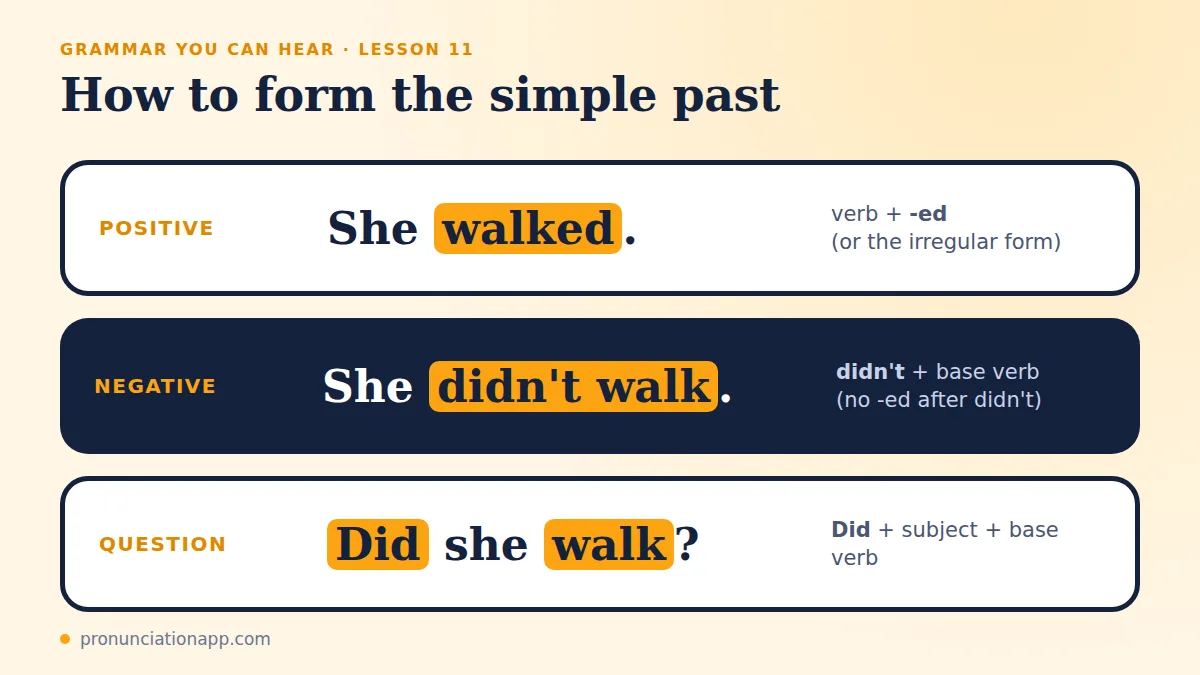
| Structure | Example | |
|---|---|---|
| Positive | subject + past form | She walked home. |
| Negative | subject + didn’t + base verb | She didn’t walk home. |
| Question | Did + subject + base verb? | Did she walk home? |
The most important thing to remember is this: only the positive sentence uses the past form. In negatives and questions, “did” carries the past tense, and the main verb goes back to its base form.
- She didn’t went. ❌ → She didn’t go. ✅
- Did you saw it? ❌ → Did you see it? ✅
The verb “be” is the exception. It doesn’t use “did.” Instead it has two past forms, was and were: “I was tired,” “They were late,” “Was she at home?” and “We weren’t ready.”
Regular and irregular verbs
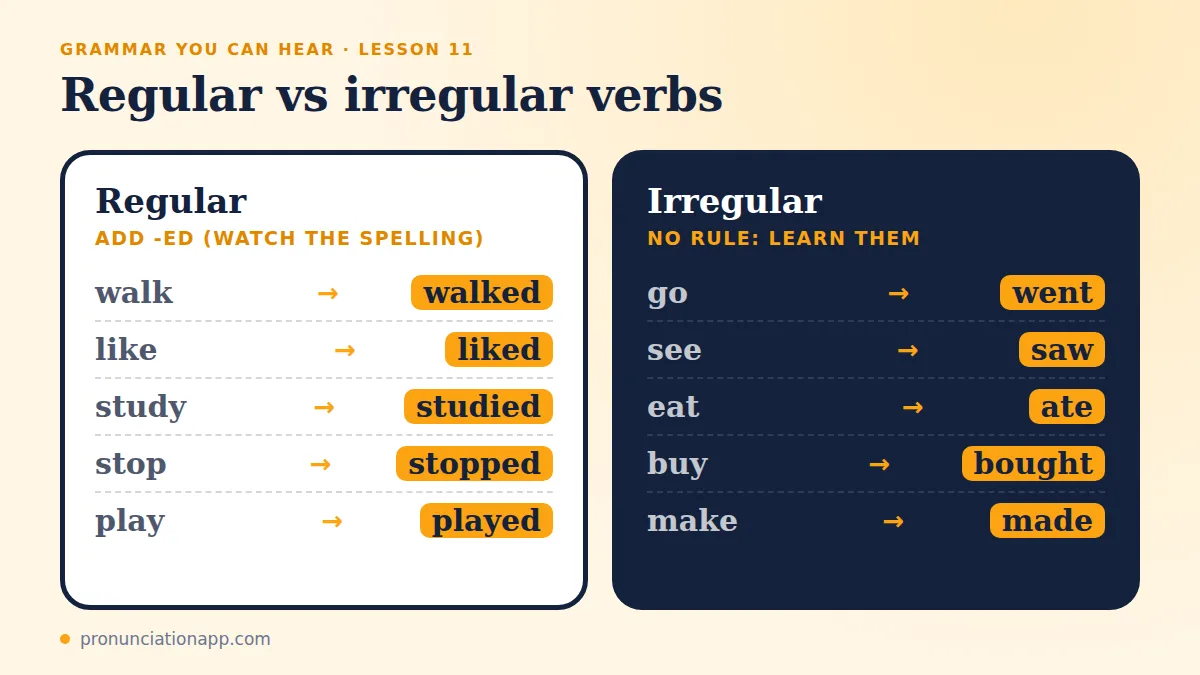
Regular verbs: add -ed
Most verbs just add -ed, but there are a few spelling rules.
| Rule | Example |
|---|---|
| Most verbs: add -ed | walk → walked, help → helped |
| Verbs ending in -e: add -d | like → liked, dance → danced |
| Consonant + y: change y to -ied | study → studied, carry → carried |
| Vowel + y: add -ed | play → played, enjoy → enjoyed |
| Short verbs ending consonant-vowel-consonant: double the last letter | stop → stopped, plan → planned |
Careful with that last one. Longer verbs usually don’t double: “visit” becomes “visited,” and “open” becomes “opened.”
Irregular verbs: learn them
Some of the most common English verbs don’t follow the -ed rule at all. There’s no shortcut, but you’ll meet them so often that they become automatic.
| Base | Past | Base | Past |
|---|---|---|---|
| go | went | think | thought |
| see | saw | write | wrote |
| eat | ate | come | came |
| have | had | take | took |
| make | made | buy | bought |
| do | did | get | got |
Learn five a week, and say each one in a sentence.
When to use the simple past tense
1. Finished actions at a specific time
- I visited my aunt yesterday.
- They moved here in 2019.
2. A series of past actions (telling a story)
- I got up, had breakfast and left the house.
3. Past habits
- When I was a child, I played outside every day.
4. Past situations or states
- She lived in Paris for ten years.
Time words that often go with it: yesterday, last night, last week, two days ago, in 2020, when I was young.
Want to hear how this sounds right now? Type any word into the Free Pronunciation Tool and listen to it in 4 accents.
Hear it: how the simple past sounds
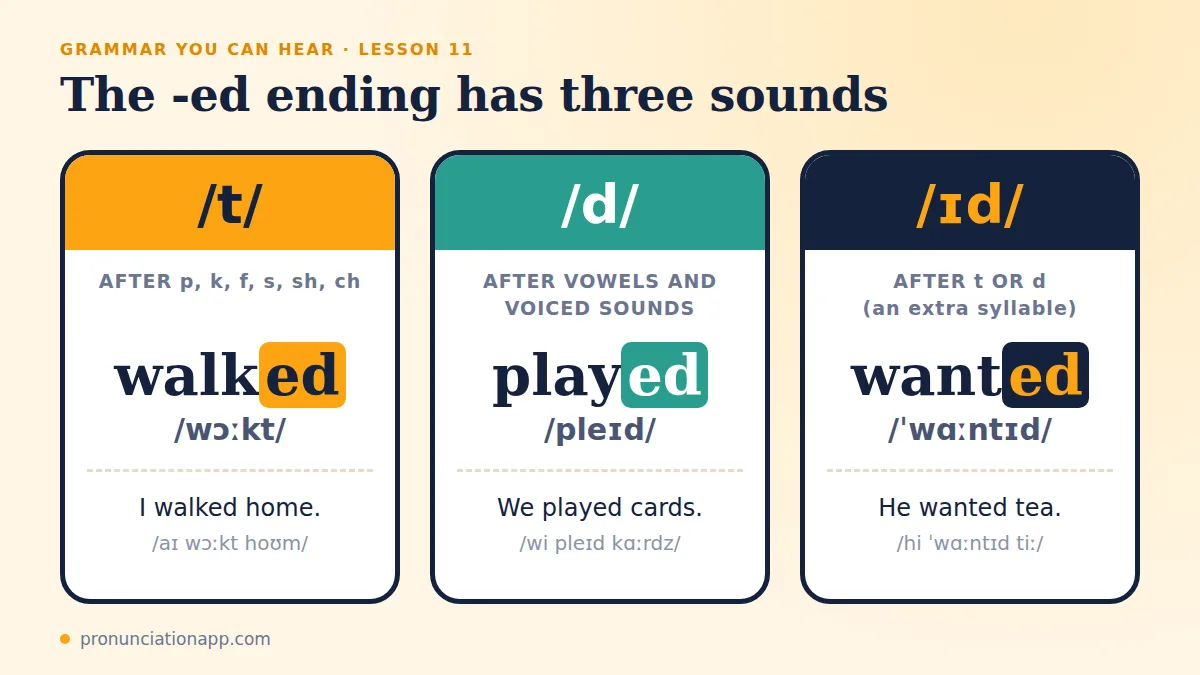
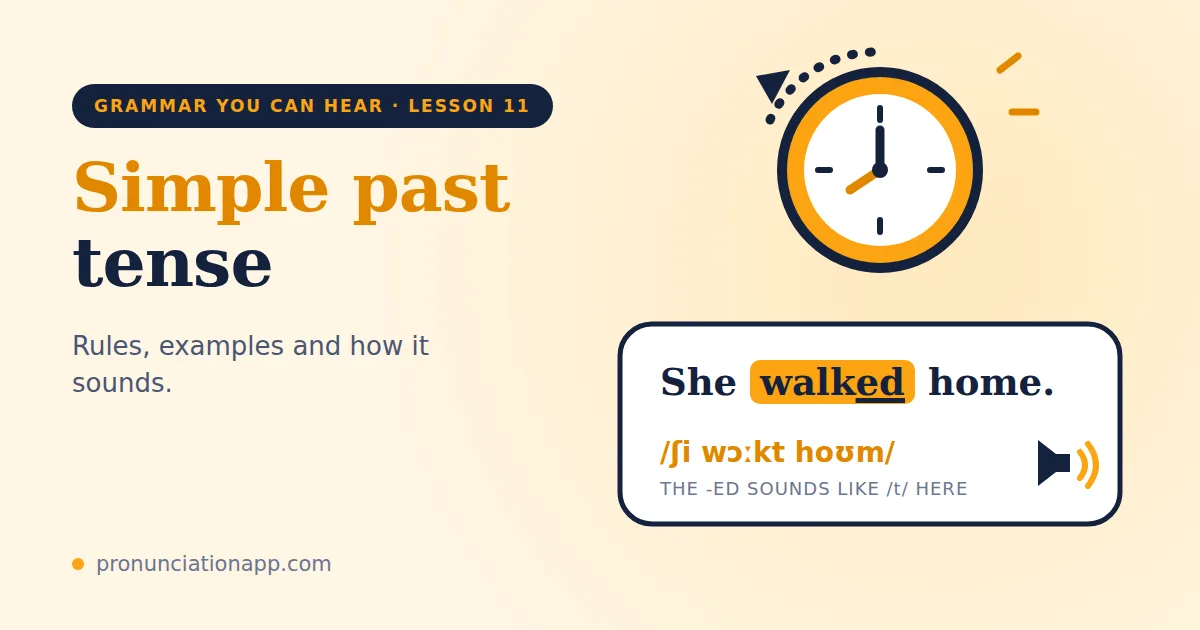
This is the part most grammar lessons skip. You can write “walked” perfectly and still say it wrong.
The -ed ending has three sounds
Just like the S endings in our simple present lesson, the -ed ending depends on the sound before it.
| Sound | Example | IPA |
|---|---|---|
| /t/ | walked | /wɔːkt/ |
| /d/ | played | /pleɪd/ |
| /ɪd/ | wanted | /ˈwɑːntɪd/ |
- After a voiceless sound (p, k, f, s, sh, ch), say /t/: walked, helped, laughed, missed, washed, watched.
- After a voiced sound or a vowel, say /d/: played, cleaned, lived, opened.
- After t or d, say /ɪd/, which adds a syllable: wanted, needed, started, decided.
The big one to remember: “walked” is one syllable, not “walk-ed.” Our full guide to how to pronounce -ed endings has the throat test and more examples.
Irregular verbs that trip people up
Some past forms sound very different from what you’d expect from the spelling. If you’re unsure how one sounds, a word pronouncer lets you check it in seconds.
| Verb | Past form | IPA |
|---|---|---|
| say | said | /sed/ |
| buy | bought | /bɔːt/ |
| think | thought | /θɔːt/ |
| catch | caught | /kɔːt/ |
| read | read | /red/ |
| lead | led | /led/ |
Notice that “read” is spelled the same in the present and past, but it sounds different. The present is /riːd/ (“I read every day”) and the past is /red/ (“I read it yesterday”). The sentence tells you which one to use.
Same sound, different word: passed and past
“Passed” is the past tense of “pass,” and “past” is a noun or preposition, but they sound exactly the same: /pæst/.
- She passed the shop. (verb)
- She walked past the shop. (preposition)
Small words shrink in questions
In normal speech, “did” and “was” are often weak. “Did you see it?” sounds like /dɪd jə ˈsiː ɪt/, and in fast casual speech, it can blend into something like “didja.” “Was” often shrinks to /wəz/. This is the weak vowel we explain in our post on the schwa sound.
You can hear any of these sentences in the pronunciation tool. Type one in, choose an accent, and click each word to see its IPA.
Common mistakes
- Using the past form after “didn’t”: “I didn’t went.” After did/didn’t, use the base verb: “I didn’t go.”
- Using the past form in questions: “Did you saw him?” It should be “Did you see him?”
- Adding -ed to irregular verbs: “I goed home.” It should be “I went home.”
- Saying “walk-ed” with two syllables. Only verbs ending in t or d add the extra syllable.
- Mixing with the present perfect: “I have seen him yesterday.” If you say when it happened, use the simple past: “I saw him yesterday.” (We’ll explain this in a later lesson.)
- Forgetting the ending when speaking fast. “I walk home yesterday” sounds like the present tense.
Practice time
A. Put the verb in brackets into the simple past.
- We ____ (visit) the museum yesterday.
- She ____ (not go) to school last Friday.
- ____ you ____ (see) the film last night?
- He ____ (buy) a new phone two days ago.
- They ____ (play) football after school.
- I ____ (not eat) breakfast this morning.
- The baby ____ (cry) all night.
- ____ she (be) late for class yesterday?
B. Sort these verbs by the sound of their -ed ending: /t/, /d/ or /ɪd/.
walked, played, wanted, helped, cleaned, needed
C. Say it out loud. Read these sentences slowly, then at normal speed:
- I walked home, watched a film and played a game.
- She wanted to stop and rest.
- We cleaned the kitchen and cooked dinner.
Then check each one in the tool and see whether your -ed endings match.
Answers
A. 1. visited 2. didn’t go 3. Did / see 4. bought 5. played 6. didn’t eat 7. cried 8. Was
B. /t/: walked, helped. /d/: played, cleaned. /ɪd/: wanted, needed.
Questions people ask
How do you form the simple past tense?
For regular verbs, add -ed to the base verb: “walk” becomes “walked.” Irregular verbs have their own forms, like “go” becoming “went.” For negatives and questions, use “did” plus the base verb.
What’s the difference between the simple past and the present perfect?
The simple past is for finished actions at a specific time (“I saw him yesterday”). The present perfect connects the past to now (“I have seen him”). We cover this in a later lesson of this series.
How do you pronounce -ed endings?
There are three sounds: /t/ after voiceless sounds, /d/ after voiced sounds, and /ɪd/ after t or d.
Do all past tense verbs end in -ed?
No. Only regular verbs do. Irregular verbs like “go,” “see” and “eat” have their own past forms.
Is “past simple” the same as “simple past”?
Yes. They’re two names for the same tense.
Want to hear how this sounds right now? Type any word into the Free Pronunciation Tool and listen to it in 4 accents.
Try it today
Think about yesterday, and say five sentences about it out loud, such as “I woke up at seven. I made coffee. I walked to the shop.” Then say one thing you didn’t do: “I didn’t watch TV.”
Say them again slowly, and listen to each ending. Repeat tomorrow with a new day.
Paste any sentence from this guide into the free tool, hear it in four accents and get instant feedback on your pronunciation.