The Schwa Sound in English: Rules, Examples and Tips
Learn the schwa sound (/ə/), the most common vowel in English. See where it appears, 6 easy rules, IPA examples and a simple practice routine.
In this article 13 sections
- 01What is the schwa sound?
- 02Why the schwa sound is so important
- 03The schwa sound has many spellings
- 04Rule 1: Most unstressed vowels become a schwa
- 05Rule 2: Unstressed prefixes often use a schwa
- 06Rule 3: Unstressed endings often use a schwa
- 07Rule 4: Small function words use a schwa
- 08Rule 5: Say the schwa short and relaxed
- 09Rule 6: Don't trust the spelling, trust the stress
- 10Common mistakes with the schwa sound
- 11A 5-minute practice routine
- 12Frequently asked questions
- 13Final thoughts
Say the word "banana" slowly. Now say it the way you'd say it in a real conversation. Did you notice that the first and last syllables almost disappeared into a quick, relaxed "uh"? That tiny, lazy vowel is the schwa sound, and it's the most common vowel sound in English.
Once you learn to hear and use the schwa sound, a lot of confusing things start to make sense: why English has such a strong rhythm, why spelling can't be trusted, and why native speakers seem to "swallow" parts of words. This guide explains what the schwa is, where it appears, and how to practise it.
What is the schwa sound?
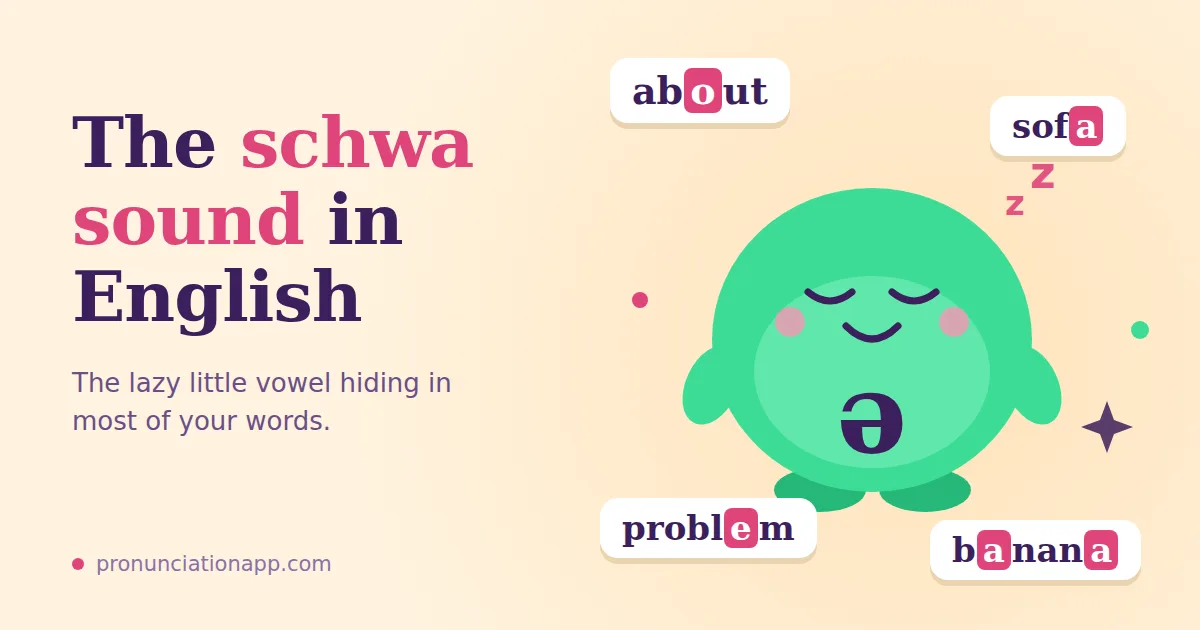
The schwa is a short, weak, relaxed vowel. Its IPA symbol is /ə/, an upside-down, backwards "e." To make it, relax your jaw, tongue and lips as if you're about to say "uh" but with less effort. Nothing is stretched, rounded or pushed forward.
Some quick examples:
- about /əˈbaʊt/
- sofa /ˈsoʊfə/
- banana /bəˈnænə/
- today /təˈdeɪ/
- lemon /ˈlemən/
The name "schwa" comes from a Hebrew term for a similar vowel mark, and it's used in linguistics around the world.
Why the schwa sound is so important
English is a stress-based language. That means stressed syllables are strong and clear, while unstressed syllables shrink. The schwa is what unstressed vowels usually shrink into.
If you pronounce every vowel fully, you'll sound slow and choppy, and listeners may find you harder to follow. If you use the schwa naturally, your English gets a smoother rhythm. It's closely linked to word stress in English: the stressed syllable gets the energy, and the unstressed ones get the schwa.
The schwa sound has many spellings
Here's what makes it tricky: any vowel letter can be a schwa, and so can some letter combinations. You can't tell from the spelling alone.
| Spelling | Word | IPA |
|---|---|---|
| a | about | /əˈbaʊt/ |
| e | taken | /ˈteɪkən/ |
| i | family | /ˈfæməli/ |
| o | lemon | /ˈlemən/ |
| u | supply | /səˈplaɪ/ |
| ou | famous | /ˈfeɪməs/ |
In "banana," there are three letter A's, but only one of them is a full vowel. The first and last are schwas: /bəˈnænə/.
Rule 1: Most unstressed vowels become a schwa
This is the master rule. In a word with more than one syllable, the syllables that aren't stressed often contain a schwa.
- police /pəˈliːs/
- support /səˈpɔːrt/
- problem /ˈprɑːbləm/
- sofa /ˈsoʊfə/
Not every unstressed vowel is a schwa, but a great many are. Check the IPA when unsure.
Rule 2: Unstressed prefixes often use a schwa
Short prefixes such as a-, com-, con- and de- are usually weak.
- about /əˈbaʊt/
- command /kəˈmænd/
- control /kənˈtroʊl/
- today /təˈdeɪ/
Rule 3: Unstressed endings often use a schwa
Many common word endings are weak.
- -tion: nation /ˈneɪʃən/
- -ous: famous /ˈfeɪməs/
- -ance / -ence: distance /ˈdɪstəns/
- -er / -or / -ar: teacher /ˈtiːtʃər/
In American English, the unstressed "-er" ending is often called an r-colored schwa (/ɚ/), while in British English it's a plain /ə/: "teacher" /ˈtiːtʃə/. This is another example of the differences we covered in American vs British pronunciation.
Rule 4: Small function words use a schwa
This is where the schwa sound really shows up in conversation. Words like "a," "the," "to," "of," "and," "for" and "can" are usually weak when they're not emphasised.
| Word | Weak form | Example |
|---|---|---|
| a | /ə/ | a cup |
| to | /tə/ | I want to go |
| of | /əv/ | a piece of cake |
| and | /ən/ | bread and butter |
| for | /fər/ | waiting for you |
| can | /kən/ | I can swim |
Take the sentence "A cup of tea and a piece of cake." In natural speech it sounds like /ə ˈkʌp əv ˈtiː ən ə ˈpiːs əv ˈkeɪk/. The content words (cup, tea, piece, cake) are strong, and the small words in between are schwas.
When you want to emphasise one of these words, you use the strong form. "I can swim!" (said to prove a point) uses the full /kæn/.
Rule 5: Say the schwa short and relaxed
The schwa is never long and never stressed. It's not the same as the /ʌ/ in "cup," which is a stressed vowel. Compare:
- cut /kʌt/ (stressed, clearer)
- about /əˈbaʊt/ (unstressed, weaker)
If you make your schwa too loud or too long, it stops sounding natural.
Rule 6: Don't trust the spelling, trust the stress
If you find yourself unsure, go back to word stress. Find the stressed syllable first, then check whether the other syllables are weakened. For instance:
- comfortable /ˈkʌmftərbl/ (only three syllables, with a weak middle)
- interesting /ˈɪntrəstɪŋ/
- vegetable /ˈvedʒtəbl/
This is also why silent letters in English and schwas often appear together: both come from spelling that no longer matches speech.
Common mistakes with the schwa sound
- Saying every vowel fully. "Ba-NAH-nah" with three strong vowels sounds robotic. Say /bəˈnænə/.
- Stressing small words. "I want TO go" sounds odd. Say "I want tə go."
- Making the schwa too long. It's very short.
- Using the wrong mouth shape. Don't smile or round your lips. Relax.
- Avoiding it completely. Some learners think the schwa sounds "lazy" and try to avoid it. Using it makes you sound more natural, not less careful.
A 5-minute practice routine
- Choose five words with a schwa, such as "about," "sofa," "banana," "family" and "problem."
- Listen first. Type each word into the pronunciation tool and play it slowly.
- Find the schwa. Look for the /ə/ symbol in the IPA and underline it.
- Say it relaxed. Say the stressed syllable clearly, then let the other syllables be short and soft.
- Practise a full sentence. Try: "A cup of tea and a piece of cake." Focus on making "a," "of" and "and" weak.
- Record yourself. Compare it with the audio and see whether your weak syllables are short enough.
You can also check any word's IPA in Cambridge Dictionary, or explore the full symbol chart from the International Phonetic Association.
Frequently asked questions
What is the schwa sound?
It's a short, weak, relaxed vowel written /ə/ in IPA. It usually appears in unstressed syllables, like the first syllable in "about."
Why is the schwa the most common vowel in English?
Because English has strong stress patterns, most words have at least one unstressed syllable, and most unstressed vowels weaken to a schwa. Small function words add to this.
Is the schwa the same as "uh"?
It's similar, but weaker and shorter. The stressed "uh" in "cup" is a different sound, /ʌ/.
Do all accents use the schwa?
Nearly all accents of English use it, although details vary. The r-colored schwa, for example, is more common in American English.
Can a stressed syllable have a schwa?
Usually not. Stressed vowels are full vowels. The schwa belongs to unstressed syllables.
Final thoughts
The schwa sound may be small, but it shapes the rhythm of English more than any other vowel. Learn to spot it, keep it short and relaxed, and let the stressed syllables carry the weight. Once it clicks, your English will sound smoother almost immediately.
Ready to hear it? Try any word from this article in the free pronunciation tool, check the IPA for /ə/, and practise saying it out loud.
Paste any sentence from this guide into the free tool, hear it in four accents and get instant feedback on your pronunciation.