Simple Present Tense: Rules, Examples and How It Sounds
Learn the simple present tense with clear rules, examples and exercises, plus how the third-person s sounds, so you can write it and say it correctly.
In this article 10 sections
Grammar You Can Hear, Lesson 7
"She work in a bank." If you've ever written that, and then felt something was missing, you already know the main thing about the simple present tense. It's the S on the verb.
This is one of the first tenses everyone learns, and it's also one of the easiest to get slightly wrong, even years later. In this lesson you'll learn the rules, see when to use it, and, because this series is about grammar you can hear, learn how that tricky final S actually sounds.
The rule in one sentence
We use the simple present tense to talk about habits, facts and things that are generally true, and for he, she and it we add an -s or -es to the verb.
How to form the simple present tense
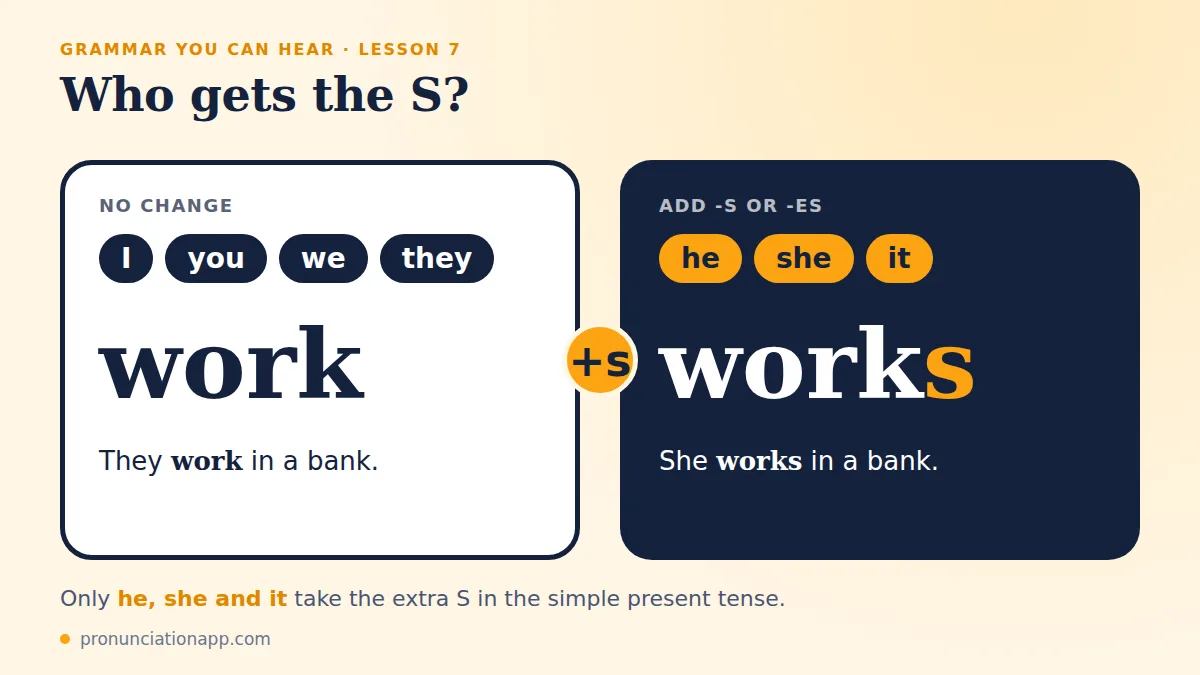
For most subjects, the verb stays in its base form. Only he, she and it change.
| Subject | Positive | Negative | Question |
|---|---|---|---|
| I | I work | I don't work | Do I work? |
| you / we / they | They work | They don't work | Do they work? |
| he / she / it | She works | She doesn't work | Does she work? |
Two things to notice. First, after "does" or "doesn't," the main verb goes back to its base form, so it's "She doesn't work," not "She doesn't works." The S is already used by "does." Second, "do" and "does" show up in questions and negatives, but not in normal positive sentences.
Spelling the -s ending
Most verbs just add -s. A few follow different patterns:
| Verb ends in... | What you do | Example |
|---|---|---|
| most letters | add -s | work → works, play → plays |
| s, sh, ch, x, z, o | add -es | watch → watches, fix → fixes, go → goes |
| consonant + y | change y to -ies | study → studies, carry → carries |
| vowel + y | just add -s | play → plays, enjoy → enjoys |
And one irregular verb: have becomes has, as in "He has a car."
When to use the simple present tense
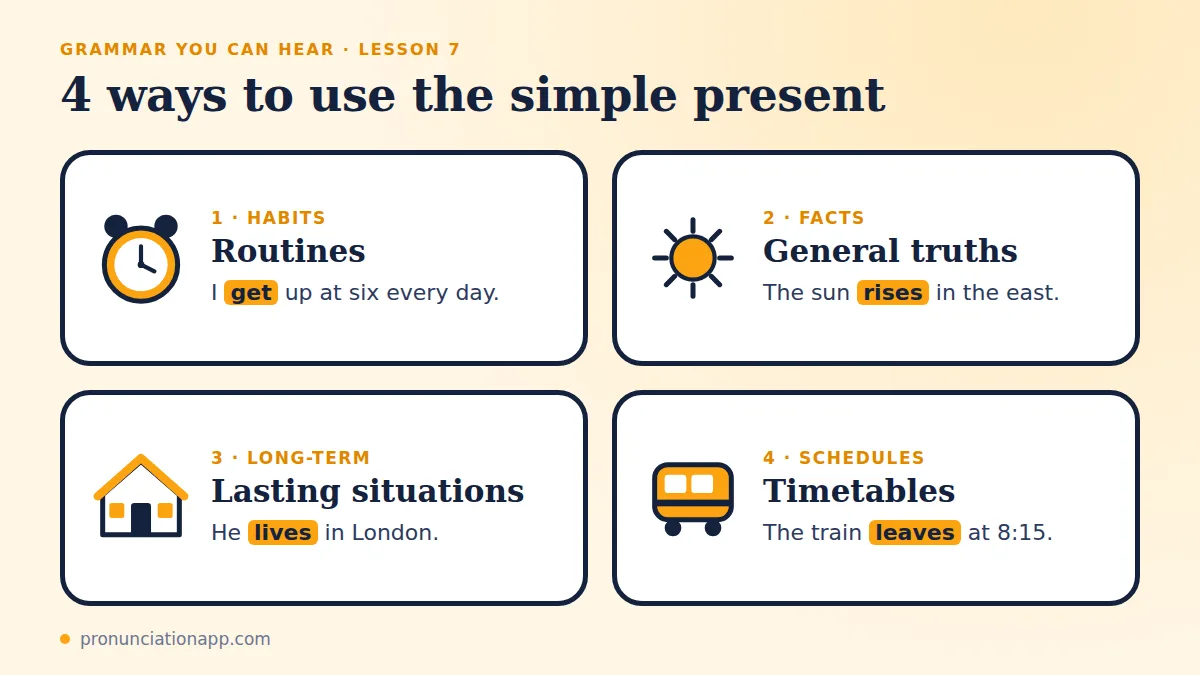
1. Habits and routines
- I get up at six every day.
- She drinks tea in the morning.
2. Facts and general truths
- Water boils at 100 degrees Celsius.
- The sun rises in the east.
3. Permanent or long-term situations
- He lives in London.
- They work at a hospital.
4. Timetables and schedules
- The train leaves at 8:15.
- The shop opens at nine.
Time words that often go with it: always, usually, often, sometimes, never, every day, on Mondays, once a week.
Frequency words like "always" and "never" usually go before the main verb but after "be": "She always arrives early" and "He is never late."
Hear it: how the simple present sounds
This is the part most grammar lessons skip. Writing the S is one thing, but saying it correctly is another. And the S ending changes sound depending on the verb.
The third-person S has three sounds
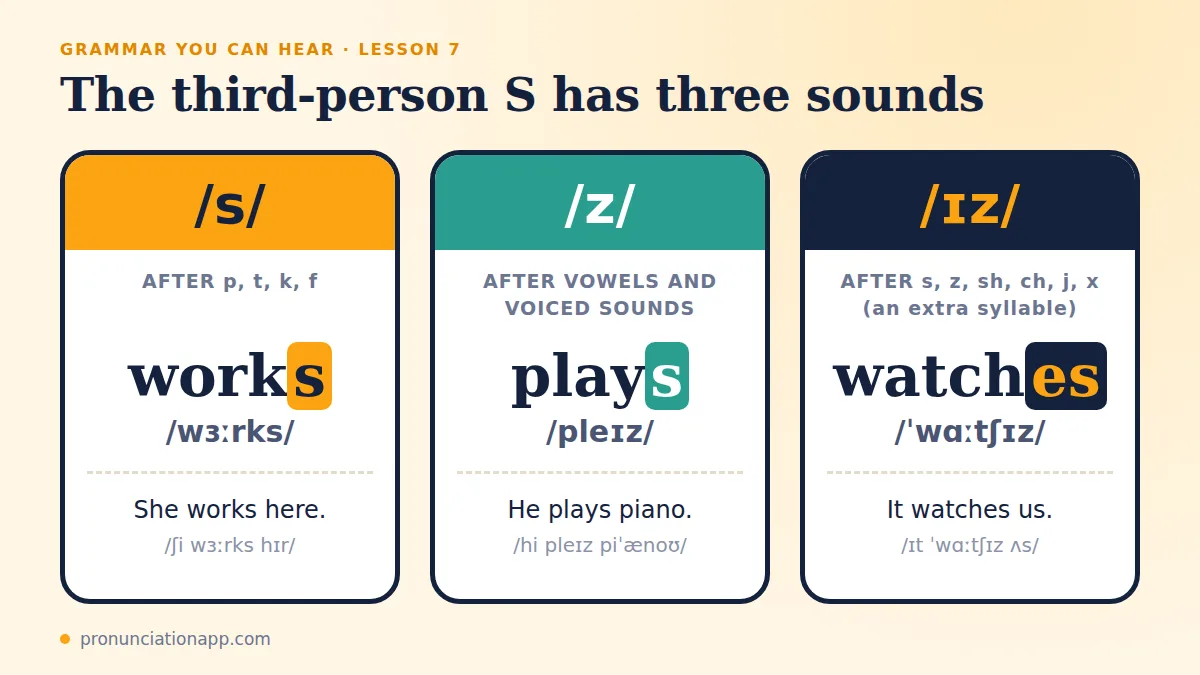
It's the same rule as plural nouns, and it depends on the last sound of the verb.
| Sound | Example | IPA |
|---|---|---|
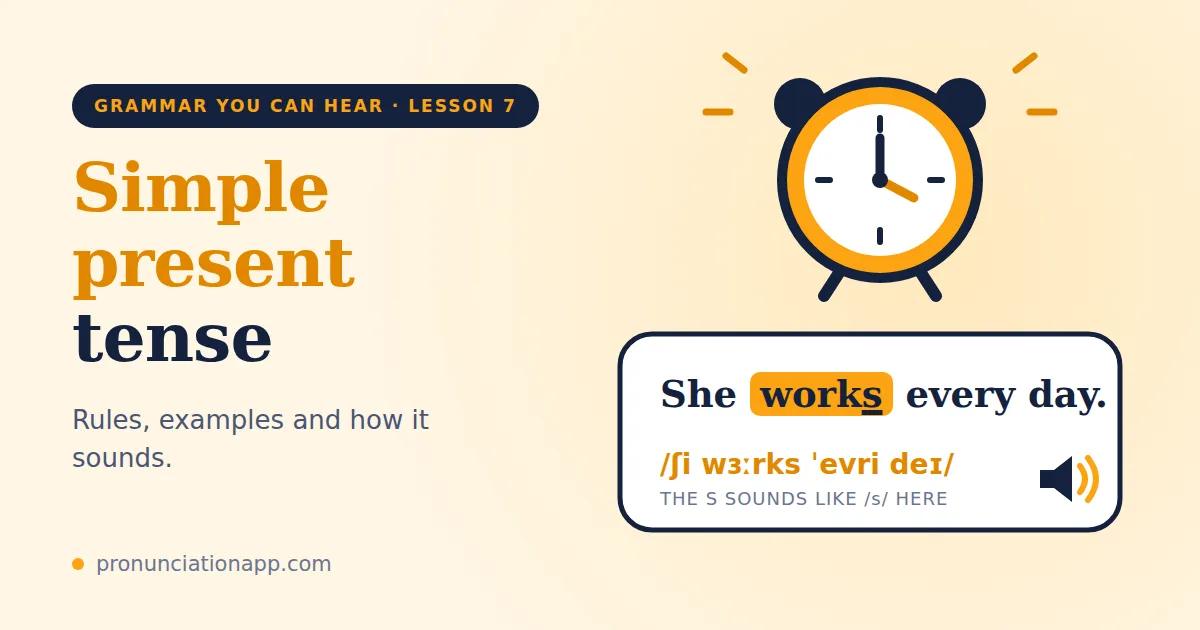
| /s/ | she works | /ʃi wɜːrks/ |
| /z/ | he plays | /hi pleɪz/ |
| /ɪz/ | it watches | /ɪt ˈwɑːtʃɪz/ |
- After a voiceless sound (p, t, k, f), you say /s/: works, hopes, sits, laughs.
- After a voiced sound or a vowel, you say /z/: plays, runs, loves, goes.
- After a hissing sound (s, sh, ch, z, j, x), you say /ɪz/ and add a syllable: watches, washes, fixes, changes.
If you want the full explanation, with the throat test and more examples, see our guide to how to pronounce s endings.
Four verbs that don't follow the pattern
A few very common verbs have sounds you just need to learn:
- does /dʌz/ (not "dohz")
- says /sez/ (not "sayz")
- has /hæz/
- goes /ɡoʊz/ (one syllable, not "go-es")
"Do" and "does" are weak in questions
In real speech, "do" and "does" at the start of a question are quick and unstressed. "Does she work here?" sounds like /dəz ʃi ˈwɜːrk hɪr/. The word "does" shrinks to /dəz/, using the weak vowel we explain in our post on the schwa sound.
"Do you" often blends into something like "d'you" /dʒə/ in fast, casual speech. You don't need to copy this, but it helps to recognise it when you hear it.
Negatives get stress
Here's a small contrast. In negatives, "don't" and "doesn't" are stressed, not weak: "I don't know" /aɪ ˈdoʊnt ˈnoʊ/. That's how listeners know the sentence is negative.
Sentence stress
In a normal sentence, the important words get the stress, and the small grammar words shrink. Try this one:
"She works in a hospital."
/ʃi ˈwɜːrks ɪn ə ˈhɑːspɪtl/
"Works" and "hospital" are strong, while "in" and "a" get quick and weak. That's the rhythm of English. For more on this, see word stress in English.
You can hear any of these sentences in the pronunciation tool. Type one in, pick an accent, slow it down to 0.5×, and click each word to see its IPA.
Common mistakes
- Forgetting the S: "He work every day." It should be "He works."
- Adding S after does: "She doesn't works." After does/doesn't, use the base verb: "She doesn't work."
- Using "don't" with he/she/it: "He don't like it." It should be "He doesn't like it."
- Saying a new syllable too often: "work-es" for "works." Only verbs ending in hissing sounds, like "watches," get an extra syllable.
- Using the continuous for habits: "I am going to school every day." For habits, use "I go to school every day."
Simple present or present continuous?
A quick way to tell them apart: simple present is for what happens in general, and present continuous is for what's happening right now.
- She works in a bank. (her job, in general)
- She is working on a report. (at this moment)
We'll cover the continuous in the next lesson in this series. For a bigger picture, see our overview of English tenses.
Practice time
A. Fill in the blanks with the correct form of the verb.
- She ____ (study) every evening.
- They ____ (not like) coffee.
- ____ he ____ (play) football on Sundays?
- The sun ____ (rise) in the east.
- My brother ____ (watch) TV after dinner.
- We ____ (go) to school by bus.
- The shop ____ (open) at nine.
- Maria ____ (not eat) meat.
B. Sort these verbs by the sound of their S ending: /s/, /z/ or /ɪz/.
works, plays, washes, hopes, runs, fixes
C. Say it out loud. Read these three sentences slowly, then at normal speed:
- He watches the news every night.
- She plays the piano and he sings.
- The bus stops here at ten.
Then check each one in the tool, and see if your S endings match.
Answers
A. 1. studies 2. don't like 3. Does / play 4. rises 5. watches 6. go 7. opens 8. doesn't eat
B. /s/: works, hopes. /z/: plays, runs. /ɪz/: washes, fixes.
Questions people ask
Why do we add S to the verb in the simple present?
Only with he, she and it, the third person singular. It's a leftover from older forms of English, and it's one of the very few verb endings the language still uses today.
Do I use do or does?
Use does with he, she and it, and do with I, you, we and they. In "does" sentences, the main verb has no S.
How do you pronounce "does"?
As /dʌz/ when it's the main verb, like "He does his homework." In questions it often shrinks to /dəz/: "Does she work here?"
Is the simple present tense about the present?
Not exactly. It's really about habits, facts and schedules. For something that's happening right now, we use the present continuous.
What's the difference between simple present and present simple?
None. They're two names for the same tense.
Start small
Pick three things you do every day, and write one sentence about each, in the third person: "She wakes up at six. She drinks coffee. She takes the bus." Then say them out loud, and listen to each S ending.
That small habit will help you with both the grammar and the sound.
Paste any sentence from this guide into the free tool, hear it in four accents and get instant feedback on your pronunciation.