How to Pronounce Food Names: 30+ Menu Words With IPA
Learn how to pronounce food names with IPA and simple spelling clues: Italian, French, Spanish and Asian menu words like gnocchi, croissant and pho.
In this article 13 sections
- 01How to pronounce food names: 3 quick tips
- 02Spelling clues that decode the menu
- 03Italian food names
- 04French food names
- 05Spanish and Latin American food names
- 06Asian food names
- 07Other tricky food words
- 08Anglicised or authentic: which should you use?
- 09Practise ordering
- 10A 10-minute practice plan
- 11Mistakes to avoid
- 12Questions people ask
- 13Try three words now
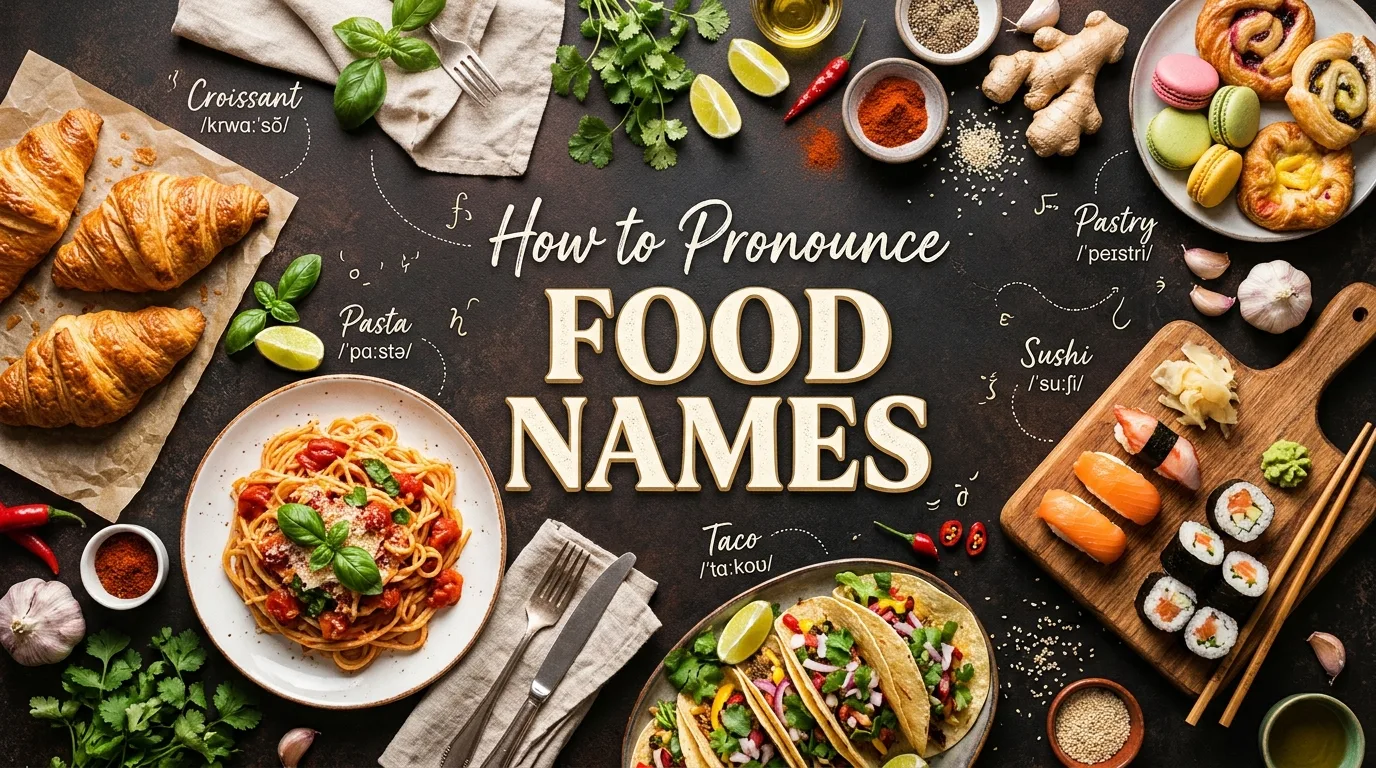
You’re at a restaurant, the waiter asks what you’d like, and you’re staring at the word “gnocchi.” Do you say it, point at the menu, or order something safe like pasta? Knowing how to pronounce food names takes the stress out of that moment. Most menu words come from Italian, French, Spanish or Asian languages, and they follow patterns you can learn once and use everywhere. This guide gives you the patterns, plus more than 30 popular words with IPA and a simple respelling.
How to pronounce food names: 3 quick tips
- Listen first. If you’re unsure, hear the word before you say it. Type it into a word pronouncer and listen a few times.
- Learn the spelling clues. Languages follow rules. Once you know that Italian “gn” sounds like “ny,” you can say “gnocchi,” “lasagna” and “bologna” without guessing.
- Say it the way your listener will understand. Many food words have both an authentic version and an English version. More on that below.
Spelling clues that decode the menu
Here’s a quick cheat sheet. Each one shows a spelling pattern, how it sounds and an example.
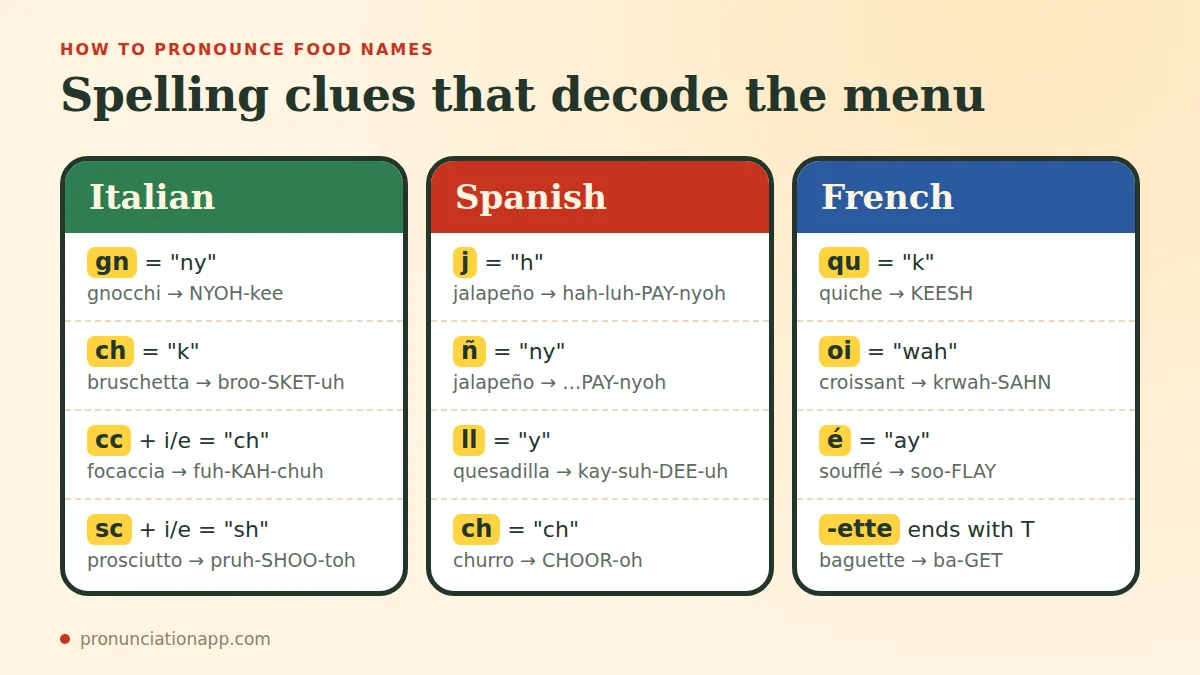
| Language | Spelling | Sounds like | Example |
|---|---|---|---|
| Italian | gn | “ny” | gnocchi → NYOH-kee |
| Italian | ch | “k” | bruschetta → broo-SKET-uh |
| Italian | cc before i or e | “ch” | focaccia → fuh-KAH-chuh |
| Italian | sc before i or e | “sh” | prosciutto → pruh-SHOO-toh |
| Spanish | j | “h” | jalapeño → hah-luh-PAY-nyoh |
| Spanish | ñ | “ny” | jalapeño |
| Spanish | ll | “y” | quesadilla → kay-suh-DEE-uh |
| Spanish | ch | “ch” | churro → CHOOR-oh |
| French | qu | “k” | quiche → KEESH |
| French | oi | “wah” | croissant → krwah-SAHN |
| French | é | “ay” | soufflé → soo-FLAY |
These aren’t perfect for every word, but they cover a lot of the menu.
Italian food names
| Word | IPA (US) | Say it like |
|---|---|---|
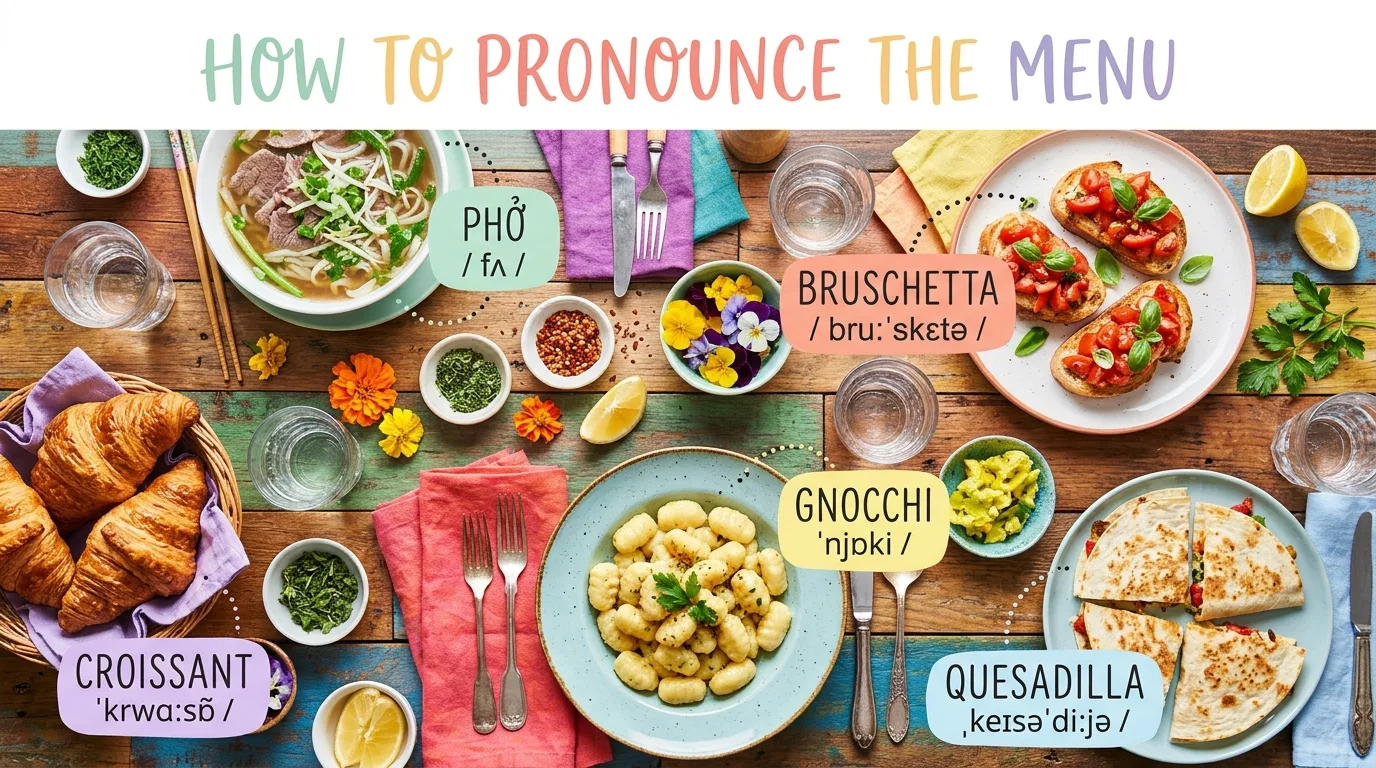
| gnocchi | /ˈnjoʊki/ | NYOH-kee |
| bruschetta | /bruːˈsketə/ | broo-SKET-uh |
| prosciutto | /prəˈʃuːtoʊ/ | pruh-SHOO-toh |
| focaccia | /fəˈkɑːtʃə/ | fuh-KAH-chuh |
| mozzarella | /ˌmɑːtsəˈrelə/ | mot-suh-REL-uh |
| cappuccino | /ˌkæpəˈtʃiːnoʊ/ | kap-uh-CHEE-noh |
| espresso | /eˈspresoʊ/ | eh-SPRES-oh |
| ciabatta | /tʃəˈbɑːtə/ | chuh-BAH-tuh |
Quick notes: “bruschetta” has a K sound in the middle (“sk”), not “sh.” And it’s “espresso,” never “expresso.” That’s one of the most common mistakes, and it’s on our list of commonly mispronounced words.
French food names
| Word | IPA (US) | Say it like |
|---|---|---|
| croissant | /krwɑːˈsɑːnt/ | krwah-SAHN |
| baguette | /bæˈɡet/ | ba-GET |
| quiche | /kiːʃ/ | KEESH |
| crème brûlée | /ˌkrem bruːˈleɪ/ | krem broo-LAY |
| soufflé | /suːˈfleɪ/ | soo-FLAY |
For “croissant,” many American speakers also say /krəˈsɑːnt/ (“kruh-SAHNT”), and that’s accepted too. The final “t” is optional in the more French version.
Spanish and Latin American food names
| Word | IPA (US) | Say it like |
|---|---|---|
| jalapeño | /ˌhɑːləˈpeɪnjoʊ/ | hah-luh-PAY-nyoh |
| chipotle | /tʃɪˈpoʊtleɪ/ | chih-POHT-lay |
| quesadilla | /ˌkeɪsəˈdiːjə/ | kay-suh-DEE-yuh |
| guacamole | /ˌɡwɑːkəˈmoʊli/ | gwah-kuh-MOH-lee |
| chorizo | /tʃəˈriːzoʊ/ | chuh-REE-zoh |
| churro | /ˈtʃʊroʊ/ | CHOOR-oh |
| paella | /paɪˈeɪjə/ | pie-AY-yuh |
| açaí | /ˌɑːsɑːˈiː/ | ah-sah-EE |
Two to watch: “chipotle” ends with a clear “lay,” and “paella” sounds like “pie-AY-yuh,” with the double L pronounced as a “y.”
Asian food names
| Word | IPA (US) | Say it like |
|---|---|---|
| pho | /fʌ/ | FUH (rhymes with “duh”) |
| sriracha | /sɪˈrɑːtʃə/ | sih-RAH-chuh |
| edamame | /ˌedəˈmɑːmeɪ/ | ed-uh-MAH-may |
| ramen | /ˈrɑːmən/ | RAH-mun |
| sushi | /ˈsuːʃi/ | SOO-shee |
| kimchi | /ˈkɪmtʃi/ | KIM-chee |
| bao | /baʊ/ | BOW (rhymes with “now”) |
“Pho” is the one that surprises people most, because it rhymes with “duh,” not “foe.”
Other tricky food words
| Word | IPA (US) | Say it like |
|---|---|---|
| quinoa | /ˈkiːnwɑː/ | KEEN-wah |
| hummus | /ˈhʌməs/ | HUM-us |
| tzatziki | /tsɑːtˈsiːki/ | tsaht-SEE-kee |
| schnitzel | /ˈʃnɪtsl/ | SHNIT-sul |
| gyro | /ˈdʒaɪroʊ/ or /ˈjɪroʊ/ | JY-roh or YEE-roh |
| Worcestershire | /ˈwʊstərʃər/ | WUSS-ter-sher |
“Gyro” has two accepted pronunciations. The first is common in American English, and the second is closer to the Greek. “Worcestershire” is a famous trap. The “Worce” part sounds like “wuss,” and the middle syllables almost disappear.
Want to hear how this sounds right now? Type any word into the Free Pronunciation Tool and listen to it in 4 accents.
Anglicised or authentic: which should you use?
Here’s a question that comes up a lot. Should you say “croissant” the French way or the English way? Should you roll your R in “paella”?
There’s no single right answer. Many food words have settled into English with a pronunciation of their own, and that version is perfectly correct in English. Trying to sound fully authentic can sometimes make you harder to understand, especially if the person you’re talking to uses the English version.
A simple rule: use the pronunciation your listener will recognise. If you’re at an Italian restaurant, a closer-to-Italian “gnocchi” will be welcomed. If you’re ordering coffee with colleagues, the usual English “latte” is fine. And if you’re unsure, it’s always okay to point at the menu.
Accents matter too. Some words differ between American and British English, like “herb,” “schedule” and “tomato.” See our guide to American vs British pronunciation for more.
Practise ordering
Say these three sentences slowly, then at normal speed:
- “Could I have the gnocchi, please?”
- “I’ll have a cappuccino and a croissant.”
- “The quinoa salad and a bowl of pho, please.”
Break any tricky word into chunks first. For example, “cap-uh-CHEE-noh.” The stress is on the third syllable. If you want help finding stress, see word stress in English.
A 10-minute practice plan
- Pick five words from the tables above.
- Listen to each in the tool, three times, then once more slowly.
- Check the IPA. If the symbols are new, start with how to read IPA.
- Say each word five times, then in a sentence.
- Record yourself and compare it with the audio.
- Add five new words tomorrow.
For more hard words in other categories, see our guide on how to pronounce English words online, and for hearing any word in several accents, try pronunciation audio online.
Mistakes to avoid
- Saying “expresso.” It’s “espresso.”
- Reading “gn” as a hard G. In Italian, “gnocchi” starts with “ny,” not “guh-nock-ee.”
- Saying “sh” in “bruschetta.” It’s “sk.”
- Rhyming “pho” with “foe.” It rhymes with “duh.”
- Over-correcting. If the English version is common, you don’t need to sound fully authentic.
- Guessing instead of checking. A few seconds with the audio saves an awkward moment.
Questions people ask
How do you pronounce gnocchi?
NYOH-kee, in IPA /ˈnjoʊki/. The “gn” sounds like the “ny” in “canyon.”
How do you pronounce croissant?
Most commonly krwah-SAHN, in IPA /krwɑːˈsɑːnt/. Many American speakers also say “kruh-SAHNT,” and both are accepted.
How do you pronounce pho?
FUH, in IPA /fʌ/. It rhymes with “duh.”
Is it “espresso” or “expresso”?
It’s “espresso,” /eˈspresoʊ/. “Expresso” is a very common mistake, but it isn’t the standard form.
Should I use the authentic pronunciation?
Use the one your listener will understand. For many words, the English version is perfectly correct.
What’s the easiest way to learn food pronunciations?
Learn the spelling clues for each language, listen to the audio, and practise the words in sentences.
Try three words now
Pick three words from this page that you weren’t sure about. Type each into the tool, listen three times and say them out loud. Next time you see them on a menu, you’ll be ready.
Want to hear how this sounds right now? Type any word into the Free Pronunciation Tool and listen to it in 4 accents.
Paste any sentence from this guide into the free tool, hear it in four accents and get instant feedback on your pronunciation.