Word Pronouncer: A Free Tool to Hear How Any Word Sounds
Use our free word pronouncer to hear any English word in 4 accents, see the IPA and practise out loud. Learn how to use it step by step.
In this article 10 sections
You’re about to say a word in a meeting, and you realise you’ve only ever read it. Do you take the risk, or check? A word pronouncer lets you check in a few seconds: type the word, press play and hear it.
This page explains what a word pronouncer is, what to look for in a good one, and how to use it so the word actually stays in your head. (You’ll sometimes see it spelled “word pronuncer.” It means the same thing.)
What is a word pronouncer?
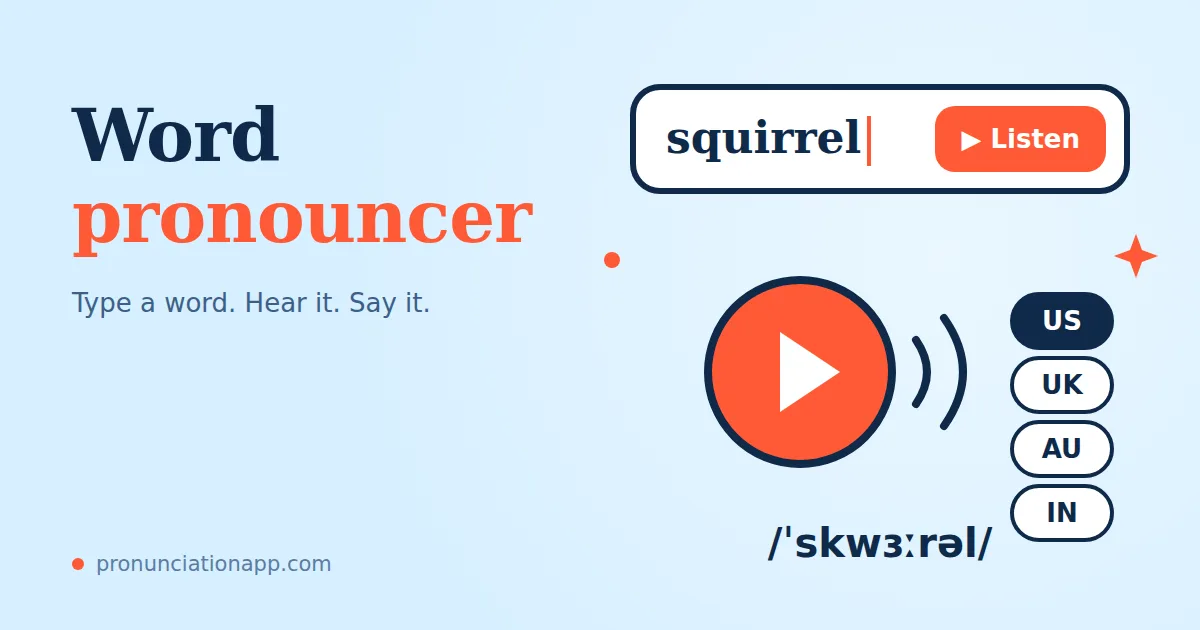
A word pronouncer is a tool that says a word aloud for you. You type or paste the word, and it plays the audio. The best ones also let you choose an accent, slow the audio down and see the word’s IPA.
People use it for new vocabulary, difficult words, work terms, exam preparation and anything they’ve only seen written down.
What a good word pronouncer should do
| Feature | Why it matters |
|---|---|
| Works for any word | You’re not limited to a fixed list |
| Several accents | Words can differ between US, UK, Australian and Indian English |
| Slow playback | Makes each sound easier to hear |
| Shows the IPA | Explains why the word sounds the way it does |
| Handles sentences | Lets you practise natural rhythm, not just single words |
| Free and quick | You’ll actually use it |
| Works on a phone | Handy when you’re out and about |
Our tool covers these, so you can check them against any other word pronouncer you try. (Please remove any feature from this table that your tool doesn’t have.)
How to use a word pronouncer
Anyone can press play. Here’s how to make it count:
- Type one word at a time. Single words give you something specific to focus on.
- Listen at least three times. The first listen only gives you the general shape.
- Slow it down. Slowing the audio down reveals each sound.
- Switch accents. If you’re not sure which one to follow, listen to two. Read more in American vs British pronunciation.
- Read the IPA. Click a word to see it, and use our guide on how to read IPA if the symbols are new.
- Say it out loud and save it. Repeat the word five times, then add it to a personal list. Review the list once a week.
When a word pronouncer helps most
- Before a presentation or interview, to check key words in your script.
- For exams, to practise vocabulary you’ll need to say.
- When reading aloud, from a story to a speech.
- When teaching, to play examples in class.
- When learning new words, so you learn the sound together with the spelling.
Word pronouncer vs dictionary vs translation app
All three can help, but they do different jobs.
| Word pronouncer | Dictionary | Translation app | |
|---|---|---|---|
| Any word, phrase or sentence | Yes | Listed words only | Yes |
| Choose an accent | Often | Usually UK and US | Rarely |
| Shows IPA | Often | Often | Rarely |
| Definitions and examples | Not the focus | Yes | Basic |
A good habit is to use a word pronouncer for speed, and a dictionary like Cambridge Dictionary for a second opinion on important words.
What about names?
Names are the hardest thing for any tool, because they don’t follow the usual rules. A generated voice may get an unusual name wrong. If it matters, such as for a client or a speech, ask the person how they say it, or find a recorded source.
Ten words to try
Type each of these into the tool, listen three times and say them out loud (American IPA).
| Word | IPA |
|---|---|
| entrepreneur | /ˌɑːntrəprəˈnɜːr/ |
| epitome | /ɪˈpɪtəmi/ |
| hyperbole | /haɪˈpɜːrbəli/ |
| quinoa | /ˈkiːnwɑː/ |
| chaos | /ˈkeɪɑːs/ |
| Wednesday | /ˈwenzdeɪ/ |
| comfortable | /ˈkʌmftərbl/ |
| squirrel | /ˈskwɜːrəl/ |
| anxiety | /æŋˈzaɪəti/ |
| library | /ˈlaɪbreri/ |
You’ll find longer lists in our guide to pronounce English words online, and you can hear more tools and tips in our post on pronunciation audio online.
Want to hear how this sounds right now? Type any word into the Free Pronunciation Tool and listen to it in 4 accents.
Mistakes to avoid
- Listening once and moving on. Repeat it.
- Never saying the word. Listening isn’t the same as speaking.
- Ignoring stress. Check which syllable is strongest. See word stress in English.
- Trusting one source for rare names.
- Switching accents mid-sentence. Pick one and stay consistent.
Questions people ask
What is a word pronouncer?
It’s a tool that plays the spoken version of a word you type, so you can hear how to say it.
Is a word pronouncer accurate?
For common words, it’s very helpful. For rare names or specialised terms, double-check with a dictionary or a native speaker.
Can I use it for sentences?
Yes. Sentences are good practice because you hear the rhythm of natural speech.
Is it free?
Yes, you can use our word pronouncer for free.
Can a word pronouncer improve my accent?
It helps, especially when you listen carefully and repeat out loud. For bigger changes, combine it with shadowing and recording yourself. Our guide to how to reduce your accent has a simple routine.
Is “word pronuncer” a different tool?
No. It’s a common misspelling of “word pronouncer,” and refers to the same type of tool.
Try one word now
Pick a word you’ve been avoiding, type it in, and listen three times. Slow it down once, check the IPA, and say it out loud five times. One word, one minute, and it’s yours.
Want to hear how this sounds right now? Type any word into the Free Pronunciation Tool and listen to it in 4 accents.
Paste any sentence from this guide into the free tool, hear it in four accents and get instant feedback on your pronunciation.