Commonly Mispronounced Words in English (With IPA)
See 28 commonly mispronounced words in English with IPA, quick fixes and simple tips. From Wednesday to library, learn how to say them with confidence.
In this article 9 sections
Everyone has a word that trips them up. Maybe you've said "liberry" for years, or avoided "choir" in a meeting because you weren't sure how it went. Honestly, you're in good company. English spelling gives you almost no help, and even native speakers get plenty of words wrong. This is a list of 28 commonly mispronounced words, sorted by why they're tricky. Each one comes with the IPA (American English) and the mistake people usually make. Skim it, find the ones you weren't sure about, and fix them one by one.
A quick note before we start. A few of these are debated, and I've flagged them. Not every "mistake" is wrong in every accent, so when I say something is common, I mean common, not forbidden.
Words with silent letters and spelling traps
Some words are written one way and said another. These are the classic ones, and they're close cousins of the patterns in our guide to silent letters in English.
| Word | Say it like this | Common mistake |
|---|---|---|
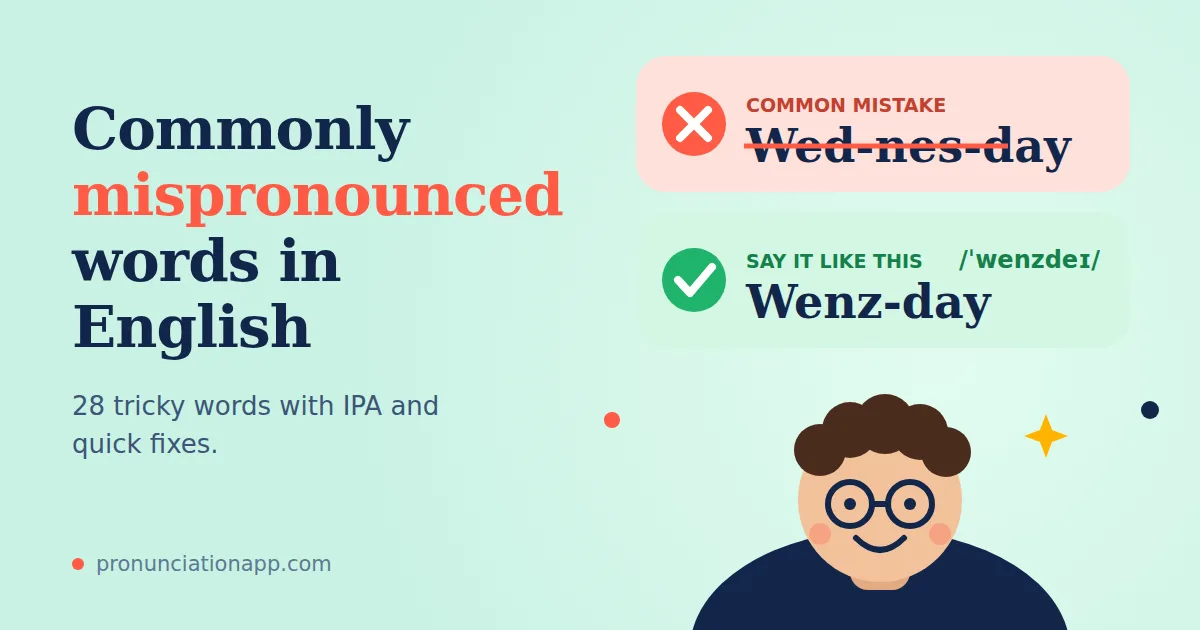
| Wednesday | /ˈwenzdeɪ/ ("WENZ-day") | Wed-nes-day |
| island | /ˈaɪlənd/ ("EYE-lund") | is-land |
| receipt | /rɪˈsiːt/ ("ri-SEET") | re-ceipt, with the P |
| debt | /det/ | deb-t, with the B |
| salmon | /ˈsæmən/ ("SAM-un") | sal-mon, with the L |
| mortgage | /ˈmɔːrɡɪdʒ/ ("MOR-gij") | mort-gage, with the T |
| choir | /ˈkwaɪər/ ("KWY-er") | choy-er |
| colonel | /ˈkɜːrnl/ (sounds like "kernel") | co-lo-nel |
"Colonel" is a strange one. It sounds exactly like "kernel," and that's a leftover from an old spelling. Nobody expects you to work that out. Just memorise it.
Words where people add or drop a syllable
These aren't hard sounds. People just put in too many syllables, or too few.
| Word | Say it like this | Common mistake |
|---|---|---|
| library | /ˈlaɪbreri/ ("LY-brer-ee") | liberry (dropping the first R) |
| comfortable | /ˈkʌmftərbl/ ("KUMF-ter-bul") | com-for-ta-ble (four syllables) |
| vegetable | /ˈvedʒtəbl/ ("VEJ-tuh-bul") | veg-e-ta-ble |
| interesting | /ˈɪntrəstɪŋ/ ("IN-truh-sting") | in-ter-est-ing |
| chocolate | /ˈtʃɑːklət/ ("CHOK-lit") | choc-o-late |
| February | /ˈfebjueri/ ("FEB-yoo-air-ee") | see note below |
| mischievous | /ˈmɪstʃɪvəs/ ("MIS-chuh-vus") | mis-CHEE-vee-us |
| recipe | /ˈresəpi/ ("RESS-uh-pee") | re-SIPE |
A note on "comfortable" and "interesting": the shorter versions are the standard, but the longer ones aren't a disaster, and some dictionaries list them too. They just sound slightly less natural.
"February" is a debated one. Some people say "FEB-roo-air-ee," with both R's, which follows the spelling. Many others say "FEB-yoo-air-ee," and that's very common too. Either way, people will understand you.
If you want to know why these words shrink so much in speech, that's the schwa sound at work. The weak syllables get squashed.
Words with the wrong stress or vowel
These are the ones that sound "off" because the stress or a vowel is in the wrong place. If you haven't read it yet, our guide to word stress in English helps with the pattern.
| Word | Say it like this | Common mistake |
|---|---|---|
| pronunciation | /prəˌnʌnsiˈeɪʃn/ ("pruh-nun-see-AY-shun") | pro-NOUN-ciation |
| espresso | /eˈspresoʊ/ ("eh-SPRESS-oh") | ex-presso |
| especially | /ɪˈspeʃəli/ ("ih-SPESH-uh-lee") | ex-pecially |
| hyperbole | /haɪˈpɜːrbəli/ ("hy-PER-buh-lee") | hyper-bowl |
| epitome | /ɪˈpɪtəmi/ ("ih-PIT-uh-mee") | epi-tome |
| genre | /ˈʒɑːnrə/ ("ZHAHN-ruh") | gen-ree |
| quinoa | /ˈkiːnwɑː/ ("KEEN-wah") | kwin-OH-uh |
| asterisk | /ˈæstərɪsk/ ("AS-ter-isk") | asterix |
The first one on that list is a bit funny. "Pronunciation" is one of the most mispronounced words in English, probably because it looks like "pronounce." So if you've ever said "pro-NOUN-ciation," you're not alone, and now you know.
A few more pairs and one-offs
| Word | Say it like this | Common mistake |
|---|---|---|
| suite | /swiːt/ ("sweet") | mixing it up with "suit" /suːt/ |
| clothes | /kloʊðz/ or /kloʊz/ | cloth-es, with two syllables |
| height | /haɪt/ ("hite") | heighth |
| nuclear | /ˈnuːkliər/ ("NOO-klee-er") | nuke-yoo-lar |
| segue | /ˈseɡweɪ/ ("SEG-way") | seeg |
"Nuclear" with the extra "yoo-lar" sound is a very widespread variant, even among well-known public speakers. Most dictionaries still list /ˈnuːkliər/ as the standard.
"Clothes" has a funny history. Plenty of people say it as "close," and that's completely fine. Saying the TH sound in it can feel awkward, so most native speakers skip it.
Why we get these words wrong
Almost every item on this list falls into one of four reasons:
- Spelling doesn't match sound. English borrowed words from French, Latin and Greek, and kept their spellings.
- We pronounce what we see. Words like "Wednesday" and "debt" have letters we no longer say.
- Unstressed syllables shrink. We say "comfortable" in three syllables because that's how the rhythm works.
- We only ever read the word. If you've seen "quinoa" fifty times but never heard it, you'll guess.
That last one is the big one. Many mispronunciations come from reading a word long before hearing it said aloud. If that sounds like you, you aren't doing anything wrong. You've just been reading more than listening.
How to fix a mispronounced word
You don't need a special method. Do this:
- Look it up. Type the word into the pronunciation tool or check Cambridge Dictionary or Merriam-Webster. Listen two or three times.
- Say it out loud, slowly. Break it into syllables, then speed it up.
- Put it in a real sentence. "Wednesday works for me" sticks better than "Wednesday" alone.
- Use it three times today. Actually use it. Say it to yourself in the car if you have to.
- Keep a list. Whenever you catch yourself unsure about a word, write it down, and look up your list once a week.
If a word is hard because it sounds like another one, such as "suite" and "suit," our post on minimal pairs in English has more practice like that.
A small warning about "wrong"
I want to be fair here. English is spoken in lots of countries, and the "correct" pronunciation changes with the accent. "Library" is /ˈlaɪbrəri/ in British English, with the weak middle syllable. "Schedule" and "tomato" are different on each side of the Atlantic. Our guide to American vs British pronunciation covers more of these.
So before you correct someone, check the accent. And if someone corrects you, check it too.
Quick questions
What are the most commonly mispronounced words in English?
Words like "Wednesday," "library," "February," "comfortable," "vegetable," "espresso" and "pronunciation" show up on almost every list. They're common words with tricky spelling.
Why do I keep mispronouncing words I read a lot?
Because you learned them from the page instead of from speech. Listening to the word a few times fixes it quickly.
Is it a big problem if I mispronounce a word?
Not usually. People understand you from context. But getting the common ones right makes you sound more confident, and it's an easy win.
Do native speakers mispronounce words too?
All the time. Plenty of the words on this list trip up native speakers, which is why they appear on so many "mispronounced words" lists.
How many words should I learn at once?
Three to five a week is plenty. Short and regular beats a long list you forget.
Pick three today
You don't have to memorise all 28. Scroll back up, choose the three that surprised you most, and say them out loud right now. Look them up in the tool if you're not sure. By next week, they'll feel normal.
Paste any sentence from this guide into the free tool, hear it in four accents and get instant feedback on your pronunciation.