How to Pronounce S Endings: 3 Simple Rules and Examples
Learn how to pronounce s endings in English: /s/, /z/ and /ɪz/. Simple rules for plurals, verbs and possessives, with examples and a quick practice plan.
In this article 14 sections
- 01The three sounds of the S ending
- 02The throat test (again)
- 03Rule 1: Say /s/ after voiceless sounds
- 04Rule 2: Say /z/ after voiced sounds
- 05Rule 3: Say /ɪz/ after "hissing" sounds
- 06Where do S endings show up?
- 07Tricky ones to watch
- 08Quick summary
- 09Why it's worth getting right
- 10Common mistakes
- 11A sentence that uses all three
- 12A 5-minute practice routine
- 13Questions people ask
- 14Try it today
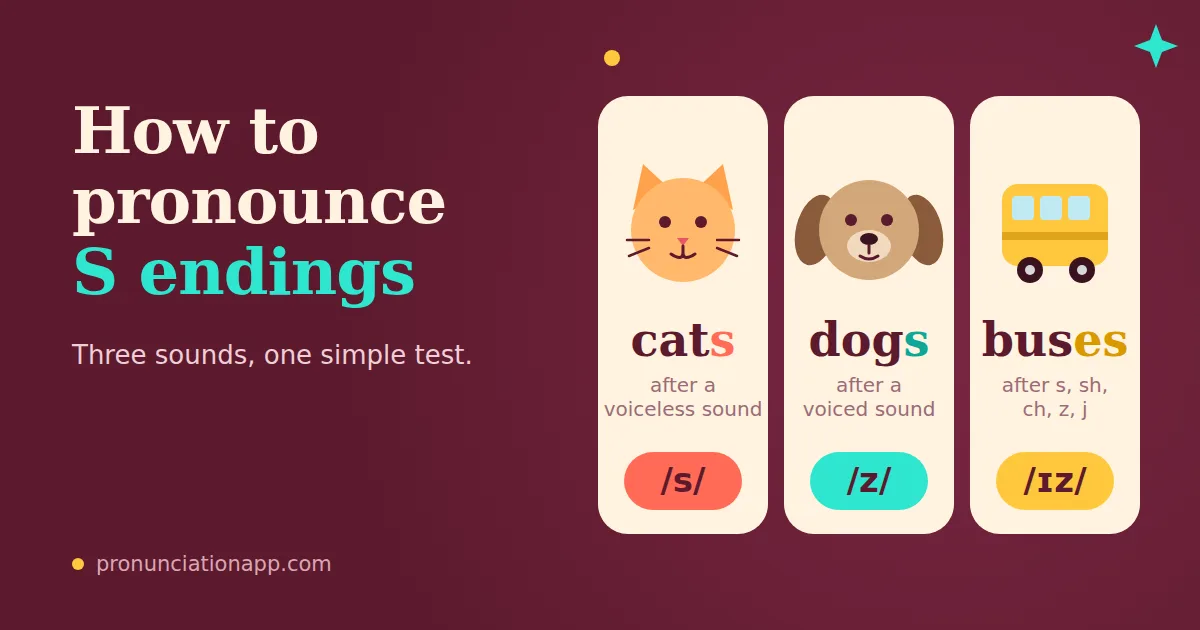
Say these three words out loud: cats, dogs, buses. Did you notice that the "s" at the end sounds different each time? In "cats" it's a hiss, in "dogs" it's more like a buzz, and "buses" even gets a whole extra syllable.
If that sounds confusing, take a breath. Once you know how to pronounce s endings, the whole thing comes down to one question: what sound comes right before the S?
This matters more than you'd think. The same ending shows up on plurals (cats), on verbs (she works) and on possessives (Mike's car), so it's everywhere in English.
The three sounds of the S ending
The ending is always spelled -s or -es, but it can sound three ways:
| Sound | Example | IPA |
|---|---|---|
| /s/ | cats | /kæts/ |
| /z/ | dogs | /dɔːɡz/ |
| /ɪz/ | buses | /ˈbʌsɪz/ |
Only the third one adds a syllable. "Cats" and "dogs" stay at one syllable, while "buses" has two.
If this feels familiar, it should. It's the same idea as the -ed ending, which you can read about in our guide to how to pronounce -ed endings. The rule depends on the last sound of the word, not the last letter.
The throat test (again)
Voiceless or voiced? Put two fingers on your throat and say "sssss." No vibration. Now say "zzzzz." You'll feel a buzz.
Before you add the S, say the last sound of your word and check your throat. That tells you which ending to use. It's the same trick we use for the "th" sounds, too.
Rule 1: Say /s/ after voiceless sounds
If the word ends in a voiceless sound (/p/, /t/, /k/, /f/, /θ/), the S is a plain /s/.
- cats /kæts/
- books /bʊks/
- cups /kʌps/
- hats /hæts/
- laughs /læfs/
- months /mʌnθs/
Remember to listen to the sound, not look at the spelling. "Laughs" ends in a /f/ sound even though the letters are "gh," so it takes /s/.
Rule 2: Say /z/ after voiced sounds
If the word ends in a voiced sound, including every vowel sound, the S is /z/.
- dogs /dɔːɡz/
- bags /bæɡz/
- days /deɪz/
- hands /hændz/
- cars /kɑːrz/
- runs /rʌnz/
This is the most common group, because most English sounds are voiced. It's also the one learners most often get wrong, because it's tempting to say a hissy /s/ instead. Try holding the buzz a little longer on "dogs" and "days."
Rule 3: Say /ɪz/ after "hissing" sounds
If the word ends in a sound like /s/, /z/, /ʃ/ ("sh"), /tʃ/ ("ch") or /dʒ/ ("j"), you can't just add another hiss, because it would be too hard to say. English adds a small vowel instead, and you get an extra syllable.
- buses /ˈbʌsɪz/
- kisses /ˈkɪsɪz/
- roses /ˈroʊzɪz/
- wishes /ˈwɪʃɪz/
- watches /ˈwɑːtʃɪz/
- judges /ˈdʒʌdʒɪz/
- boxes /ˈbɑːksɪz/
Here's a sneaky one. "Box" ends in the letter X, but the sound is /ks/, so it counts as an /s/ ending. That's why we say "boxes" with an extra syllable. The same goes for "fixes" and "mixes."
Where do S endings show up?
Everywhere. The same three rules cover:
- Plural nouns: cats /kæts/, dogs /dɔːɡz/, buses /ˈbʌsɪz/
- Third person singular verbs: he works /wɜːrks/, she plays /pleɪz/, it watches /ˈwɑːtʃɪz/
- Possessives: Mike's /maɪks/, Anna's /ˈænəz/, Alex's /ˈæleksɪz/
- Short forms: it's /ɪts/, he's /hiːz/
So if you learn the rule once, you've learned four jobs' worth of endings.
Tricky ones to watch
A few words don't follow the obvious pattern, so they're worth knowing.
Words that change the sound before the S. "Knife" becomes "knives" /naɪvz/, "leaf" becomes "leaves" /liːvz/, and "wife" becomes "wives" /waɪvz/. The F turns into a V.
Noun and verb pairs. "House" as a noun is /haʊs/, but "houses" is /ˈhaʊzɪz/. The S in the middle turns voiced.
Words with TH. For many speakers, "paths" is /pæðz/ and "baths" is /bæðz/, with a voiced TH. But "months" stays /mʌnθs/. Accents vary here, so check an audio source if you're unsure.
Irregular verbs. "Says" is /sez/, not /seɪz/. "Does" is /dʌz/. "Has" is /hæz/. "Goes" is /ɡoʊz/, with no extra syllable even though it ends in "-es." You just have to learn these.
-es doesn't always mean an extra syllable. "Makes," "likes" and "goes" all stay at one syllable. Only the hissing sounds above add one.
Quick summary
| The word ends with... | Say the S as | Example |
|---|---|---|
| p, t, k, f, θ (voiceless) | /s/ | cats, books |
| Vowels, b, d, g, v, m, n, l, r (voiced) | /z/ | dogs, days |
| s, z, sh, ch, j | /ɪz/ | buses, wishes |
Why it's worth getting right
The S ending carries real meaning. "I have two dog" sounds incomplete, and "She work every day" misses a grammar signal. People will usually still understand you, but dropping the S can confuse the meaning, especially on the phone.
It's also a good habit to build. Many learners forget the S when they speak fast, even though they know the rule perfectly well when writing. That's normal. It just takes practice to make it automatic.
Common mistakes
- Saying /s/ after voiced sounds. "Dogs" ending in a hiss instead of a /z/.
- Adding a syllable to "cats." "Cat-iz" is wrong. It's one syllable.
- Skipping the extra syllable in "buses." "Buses" needs /ɪz/.
- Dropping the S completely when speaking fast.
- Saying "mak-es" for "makes." It's /meɪks/.
If you often mix up pairs like "rice" /raɪs/ and "rise" /raɪz/ or "peace" /piːs/ and "peas" /piːz/, our post on minimal pairs in English has more practice with these.
A sentence that uses all three
Try saying this one slowly, then at normal speed:
"The cats and dogs watched the buses and boxes."
In IPA: /ðə kæts ənd dɔːɡz wɑːtʃt ðə ˈbʌsɪz ənd ˈbɑːksɪz/
Cats has /s/, dogs has /z/, and buses and boxes both have /ɪz/. If you can say that sentence smoothly, you've got the whole rule.
A 5-minute practice routine
- Make three columns on a piece of paper: /s/, /z/ and /ɪz/.
- Sort ten words into the columns. Try: cups, bags, wishes, books, plays, judges, hats, rooms, kisses, runs.
- Check your answers. Type each word into the pronunciation tool and listen. Look at the IPA, too. If you need help reading it, see our guide to how to read IPA.
- Read a paragraph aloud. Underline every S ending first, then read it, thinking about each one.
- Record yourself and listen back for missing or wrong endings.
For more listening practice, BBC Learning English and Cambridge Dictionary both have free audio.
Questions people ask
How many ways are there to pronounce the S ending?
Three: /s/, /z/ and /ɪz/. Which one you use depends on the sound before it.
Does -es always add a syllable?
No. It only adds a syllable after hissing sounds, like in "buses" and "watches." In "makes" or "goes," the -es is not a separate syllable.
How do I pronounce the possessive 's?
The same way as plural S. It's /s/ in "Mike's," /z/ in "Anna's," and /ɪz/ in "Alex's."
Why do I keep forgetting the S when I speak?
It's a very common habit, and some languages don't mark plurals or verb endings in the same way. Slowing down a little and practising the ending on its own usually helps.
Is this rule the same in American and British English?
Yes, the three-way rule is the same. A few individual words differ slightly between accents.
Try it today
Pick five words from your day, like "keys," "friends," "bags," "lunches" and "books." Say each one out loud and decide which sound the S makes. Then check them in the tool.
Do that for a week, and you'll stop thinking about it. The S will just come out right.
Paste any sentence from this guide into the free tool, hear it in four accents and get instant feedback on your pronunciation.