Pronunciation Helper English: A Free Tool and Daily Habits
Need a pronunciation helper English learners can trust? Hear any word, check the IPA and build a daily habit with this simple guide and free tool.
In this article 9 sections
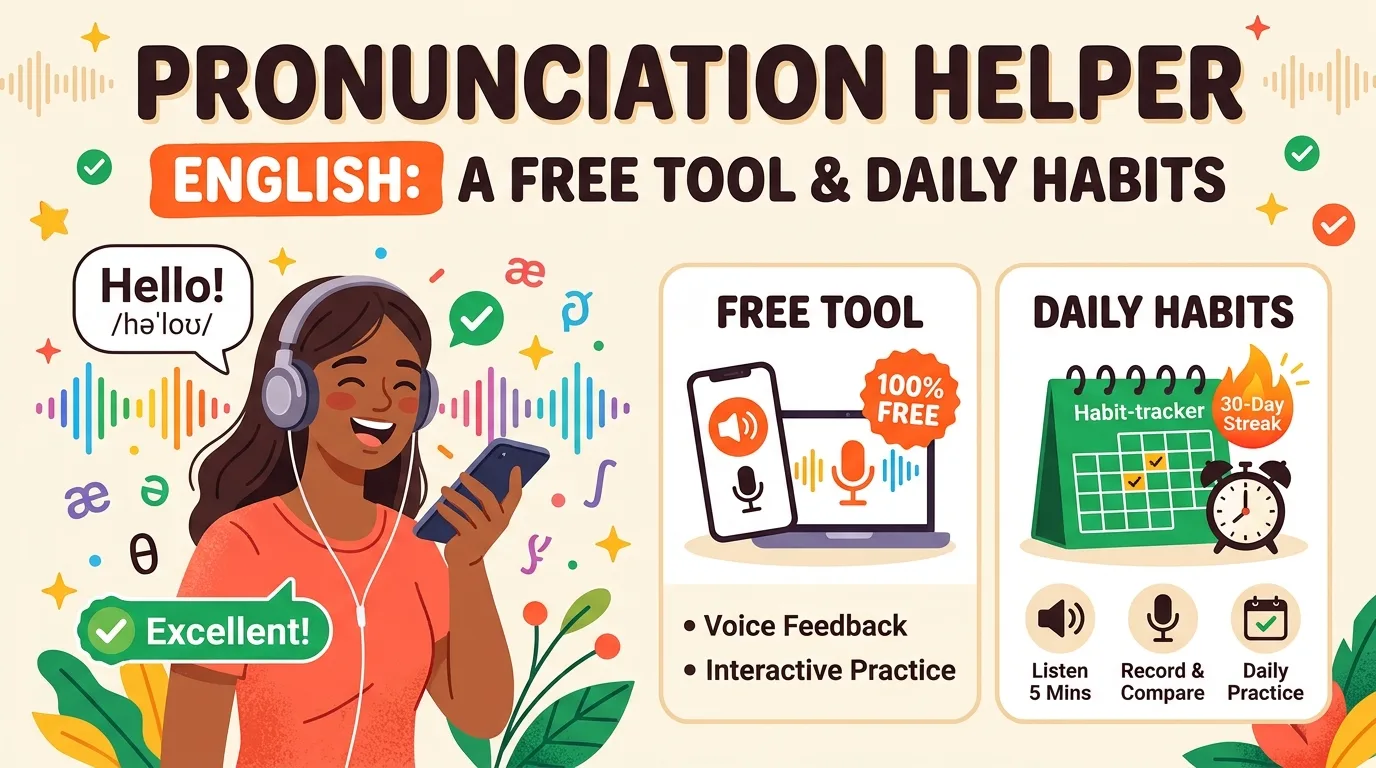
You know the feeling. You’re about to say a word in a meeting, a class or a phone call, and you freeze. Is it “ben-uh-fit” or “ben-uh-fish”? Where does the stress go? You could guess, or you could ask a pronunciation helper. A good pronunciation helper English learners can rely on does three things. It lets you hear the word, shows you why it sounds that way, and gets you to say it. This guide explains what each part looks like, how to build a simple daily habit around it, and how to fix the most common problems.
What is a pronunciation helper?
A pronunciation helper is anything that helps you say English words clearly and confidently. That can be a website, an app, a dictionary, a teacher, a friend or a recording of yourself. The best helpers combine all three of the steps below, because hearing a word alone isn’t enough to change how you speak.
Think of it as a small system, rather than one tool:
- A tool that plays the word.
- A method that tells you what to listen for.
- Feedback that shows you whether you’re getting closer.
Pronunciation helper English: the three parts
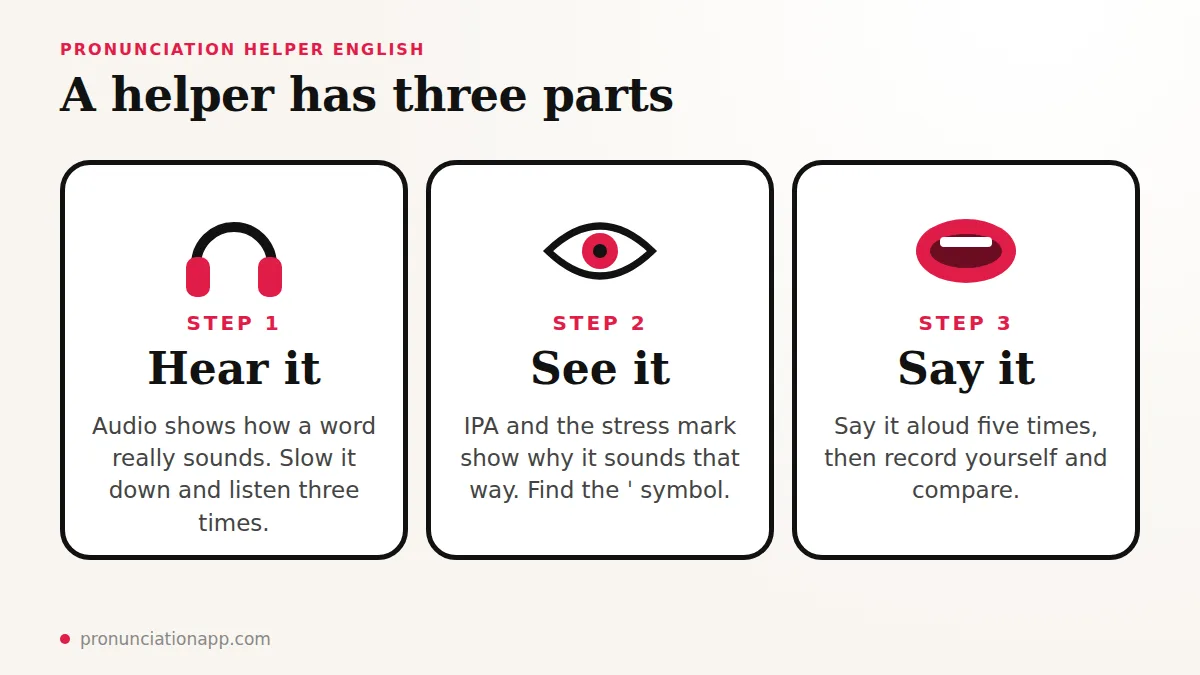
Step 1: Hear it
Audio is where everything starts. Type a word, press play, and listen three times without speaking. Then slow it down and listen again, so you can catch every sound.
For the full routine, see our guide to pronunciation audio online. It explains what to listen for, how to compare accents and which words to try first.
Step 2: See it
Hearing tells you how a word sounds. Seeing the IPA tells you why. The IPA shows each sound as a symbol, and it includes the stress mark (ˈ) that goes before the strongest syllable.
For example, “pronunciation” is /prəˌnʌnsiˈeɪʃn/. The mark sits right before “eɪʃn,” so the stress is on “AY”: pro-nun-si-AY-shun. If the symbols are new to you, our guide to how to read IPA takes about ten minutes.
Step 3: Say it
This is the step people skip, and it’s the one that changes your speech. Say the word out loud five times. Then say it in a sentence. Then record yourself and compare it with the audio.
Without this step, you’ve only learned to recognise a word. With it, you’ve practised producing it.
Want to hear how this sounds right now? Type any word into the Free Pronunciation Tool and listen to it in 4 accents.
Common problems and the helper fix
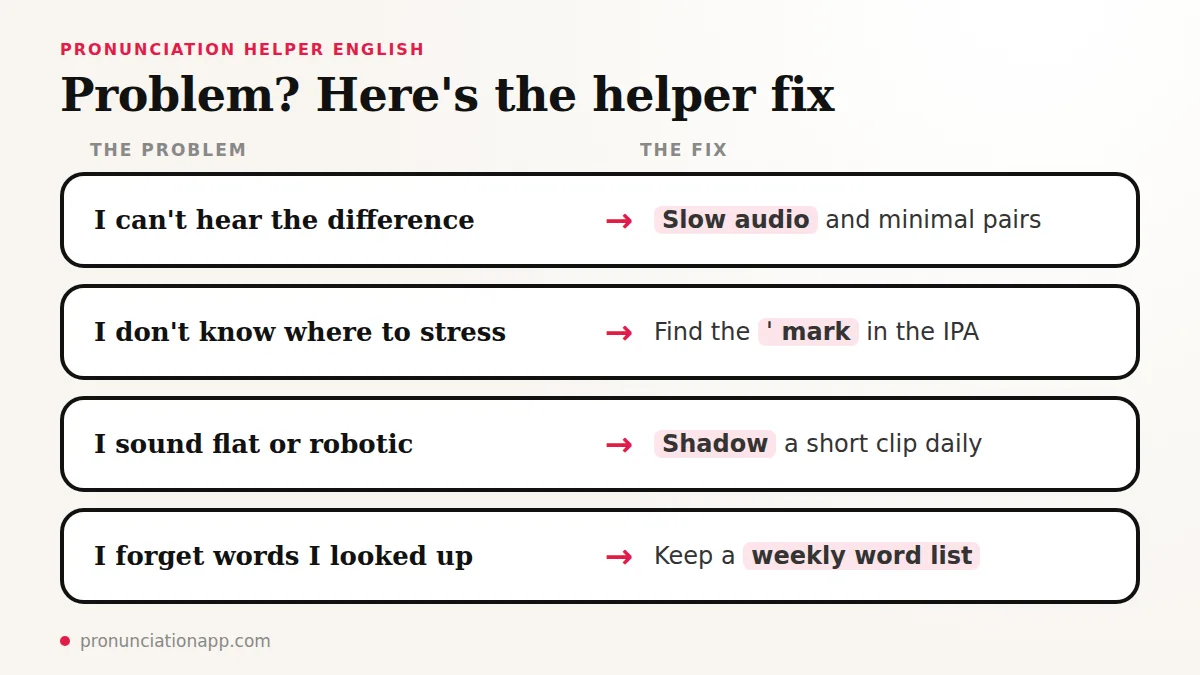
| Problem | The helper fix |
|---|---|
| “I can’t hear the difference between two sounds” | Use slow audio and practise minimal pairs, like ship and sheep |
| “I don’t know where to put the stress” | Find the ˈ mark in the IPA, and learn the basic rules |
| “I sound flat or robotic” | Shadow a short clip every day, copying the rhythm |
| “I forget the words I looked up” | Keep a weekly word list and say each word again |
Here are a few ways to go deeper on each one:
- Similar sounds: see minimal pairs in English.
- Stress: see word stress in English.
- Flat or robotic speech: learn about the weak vowel in the schwa sound.
- Shadowing and recording: see how to practice English speaking alone.
A 10-minute daily helper routine
You don’t need much time. Here’s a simple routine you can do each day.
| Time | What to do | Part |
|---|---|---|
| 2 minutes | Type three new words and listen to each three times | Hear it |
| 3 minutes | Check the IPA and find the stress in each word | See it |
| 3 minutes | Say each word five times, then in a sentence | Say it |
| 2 minutes | Record yourself and listen back | Feedback |
Do this for two weeks. By the end, you’ll notice that you hesitate less, and that you catch your own mistakes before anyone else does.
Who uses a pronunciation helper?
- English learners who want to say new vocabulary correctly
- Professionals preparing for presentations, calls and interviews
- Students getting ready for speaking exams
- Teachers playing examples in class
- Parents helping children, which we cover in English pronunciation for kids
Choosing the right helper for you
You might use more than one helper, and that’s fine. Here’s a quick guide.
| If you need to... | Use... |
|---|---|
| Check any word quickly | A speech tool, like our word pronouncer |
| Check an important word carefully | A recorded dictionary, like Cambridge Dictionary |
| Practise a whole list of words | Our guide to how to pronounce English words online |
| Get structured lessons | A free learning site, like British Council LearnEnglish |
| Get personal feedback | A teacher, tutor or language partner |
If you’re comparing options, our guide to choosing a free pronunciation website explains what to look for.
Mistakes to avoid
- Listening without speaking. Say the word out loud every time.
- Skipping the IPA. Even a few symbols make a big difference.
- Practising a word wrongly. Check the audio before you repeat it.
- Learning too many words at once. Five a day is plenty.
- Relying on one helper only. For important words, check a second source.
- Expecting instant results. Pronunciation improves in small steps.
Questions people ask
What is a pronunciation helper?
It’s any tool, resource or method that helps you say words clearly. The best ones combine audio, IPA and speaking practice.
Is there a free pronunciation helper for English?
Yes. Many websites and dictionaries offer free audio. Our free tool lets you type any word, hear it in four accents and check the IPA.
How can a helper improve my pronunciation?
By showing you what correct sounds and stress look like and sound like, and by giving you a routine for practising them. The improvement comes from repeating that routine, not from hearing a word once.
How long does it take to see results?
Many learners notice small changes within two to four weeks of daily practice. Bigger changes take longer, and it varies from person to person.
Can a helper correct my pronunciation automatically?
Some tools use speech recognition to give rough feedback. It can be useful, but it can mishear clear speech and accept unclear speech, so treat it as a guide, not a judge. A person’s feedback is still the most reliable.
Is a pronunciation helper the same as a word pronouncer?
A word pronouncer is one kind of helper. It plays a word aloud. A full helper also includes IPA, a routine and feedback. You may also see “word pronuncer” or “pronounciation tool,” and they mean the same type of tool.
Start with one word today
Pick a word you’ve been unsure about. Type it in, listen three times, check the IPA, say it five times and record yourself once. That’s a complete helper session, and it takes about a minute.
Tomorrow, do it with another word. In two weeks, you’ll have a habit.
Want to hear how this sounds right now? Type any word into the Free Pronunciation Tool and listen to it in 4 accents.
Paste any sentence from this guide into the free tool, hear it in four accents and get instant feedback on your pronunciation.