Minimal Pairs in English: Ship vs Sheep and More
Practise minimal pairs in English with clear lists, IPA and sentences. Learn ship vs sheep, light vs right, vine vs wine and more to fix tricky sounds.
In this article 10 sections
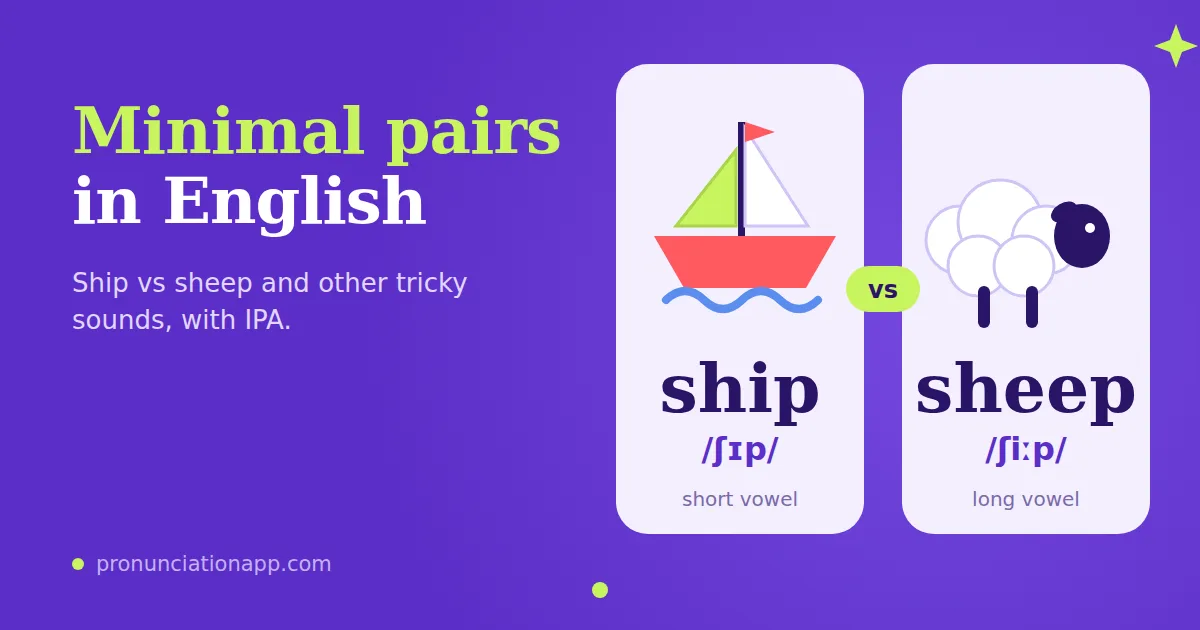
Imagine you're on a boat trip and you say, "Look at that beautiful sheep!" Your friends laugh, because you meant "ship." The two words differ by only one tiny sound, but it's enough to change the meaning completely. Word pairs like this are called minimal pairs in English. They're one of the best tools for training your ears and your mouth, because they show you exactly which sounds matter. This guide explains what minimal pairs are, gives you organised lists with IPA, and shows you how to practise them effectively.
What are minimal pairs?
A minimal pair is two words that differ by only one sound, in the same position, and that have different meanings.
- ship /ʃɪp/ and sheep /ʃiːp/ (the vowel changes)
- light /laɪt/ and right /raɪt/ (the first consonant changes)
- bad /bæd/ and bat /bæt/ (the last consonant changes)
The sounds that make a difference in meaning are called phonemes. If swapping one sound creates a new word, English treats those two sounds as separate. That's how we know they matter.
Why practise minimal pairs in English?
Minimal pairs are useful for three reasons:
- They train your listening. You learn to hear differences your first language may not make.
- They give you clear feedback. If someone mishears "sheep" for "ship," you know exactly which sound to fix.
- They focus your practice. Instead of studying everything, you target the sounds that cause the most confusion.
You don't need to practise every pair. Choose the ones that match your own challenges.
Vowel minimal pairs
Short /ɪ/ vs long /iː/
This is the most famous pair of sounds. The long /iː/ is tenser and longer, while /ɪ/ is short and relaxed.
| Short /ɪ/ | Long /iː/ |
|---|---|
| ship /ʃɪp/ | sheep /ʃiːp/ |
| bit /bɪt/ | beat /biːt/ |
| live /lɪv/ | leave /liːv/ |
| sit /sɪt/ | seat /siːt/ |
| fill /fɪl/ | feel /fiːl/ |
Short /ʊ/ vs long /uː/
| Short /ʊ/ | Long /uː/ |
|---|---|
| full /fʊl/ | fool /fuːl/ |
| pull /pʊl/ | pool /puːl/ |
| look /lʊk/ | Luke /luːk/ |
/æ/ vs /e/ vs /ʌ/
| /æ/ | /e/ | /ʌ/ |
|---|---|---|
| bad /bæd/ | bed /bed/ | bud /bʌd/ |
| pan /pæn/ | pen /pen/ | pun /pʌn/ |
| cap /kæp/ | kept /kept/ | cup /kʌp/ |
A note on "cot" /kɑːt/ and "caught" /kɔːt/. Many American speakers pronounce these the same, so this pair only works in some accents. That's one of the differences we cover in American vs British pronunciation.
Consonant minimal pairs
/r/ vs /l/
| /r/ | /l/ |
|---|---|
| right /raɪt/ | light /laɪt/ |
| rock /rɑːk/ | lock /lɑːk/ |
| read /riːd/ | lead /liːd/ |
| grass /ɡræs/ | glass /ɡlæs/ |
/b/ vs /v/
| /b/ | /v/ |
|---|---|
| berry /ˈberi/ | very /ˈveri/ |
| boat /boʊt/ | vote /voʊt/ |
| bet /bet/ | vet /vet/ |
| ban /bæn/ | van /væn/ |
/v/ vs /w/
| /v/ | /w/ |
|---|---|
| vine /vaɪn/ | wine /waɪn/ |
| very /ˈveri/ | wary /ˈweri/ |
| veil /veɪl/ | wail /weɪl/ |
If you speak Indian English, this pair may be a useful one to practise, as we describe in our guide to Indian English pronunciation.
/s/ vs /ʃ/ vs /tʃ/
| /s/ | /ʃ/ | /tʃ/ |
|---|---|---|
| sip /sɪp/ | ship /ʃɪp/ | chip /tʃɪp/ |
| sea /siː/ | she /ʃiː/ | cheese /tʃiːz/ |
| sore /sɔːr/ | shore /ʃɔːr/ | chore /tʃɔːr/ |
/θ/ vs /s/ vs /t/
| /θ/ | /s/ | /t/ |
|---|---|---|
| think /θɪŋk/ | sink /sɪŋk/ | tink (not a word) |
| three /θriː/ | tree /triː/ | |
| thank /θæŋk/ | tank /tæŋk/ |
For the full tongue position, see our guide on how to pronounce th.
/p/ vs /b/
| /p/ | /b/ |
|---|---|
| pin /pɪn/ | bin /bɪn/ |
| pack /pæk/ | back /bæk/ |
| pear /per/ | bear /ber/ |
/n/ vs /ŋ/
| /n/ | /ŋ/ |
|---|---|
| sin /sɪn/ | sing /sɪŋ/ |
| thin /θɪn/ | thing /θɪŋ/ |
| ran /ræn/ | rang /ræŋ/ |
/dʒ/ vs /j/
| /dʒ/ | /j/ |
|---|---|
| jam /dʒæm/ | yam /jæm/ |
| jet /dʒet/ | yet /jet/ |
With and without H
| No /h/ | With /h/ |
|---|---|
| air /er/ | hair /her/ |
| eat /iːt/ | heat /hiːt/ |
| art /ɑːrt/ | heart /hɑːrt/ |
Final consonant minimal pairs
The last sound of a word changes the meaning just as much as the first. Many learners drop or soften final consonants, so these pairs are very useful.
| Voiceless | Voiced |
|---|---|
| bat /bæt/ | bad /bæd/ |
| back /bæk/ | bag /bæɡ/ |
| rice /raɪs/ | rise /raɪz/ |
| peace /piːs/ | peas /piːz/ |
| cap /kæp/ | cab /kæb/ |
Notice that the vowel is also longer before a voiced consonant. Say "bad" with a long, stretched vowel and "bat" with a short, quick one. This is closely related to the voiced and voiceless test in our guide to how to pronounce -ed endings.
Minimal pairs in sentences
Words are easier to say in isolation than in a sentence, so try these:
- "Put the ship next to the sheep."
- "Turn right at the light."
- "I want to wash my watch." (wash /wɑːʃ/, watch /wɑːtʃ/)
- "The vet said the bet was bad."
- "Please don't pull the fool into the pool."
- "I think the sink is full."
Read each one slowly. Then repeat it faster while keeping the difference clear.
How to practise minimal pairs in English
- Pick one pair. Don't try to learn everything. Choose one that gives you trouble, such as /ɪ/ vs /iː/.
- Listen first. Type both words into the pronunciation tool and play them one after the other.
- Play the ABX game. Ask a friend to say either "ship" or "sheep" without showing you. Say which one you heard. Repeat until you get ten in a row.
- Say them aloud. Exaggerate the difference at first, then bring it back to natural speed.
- Record and compare. Listen to your recording and compare it with the audio.
- Use them in sentences. Try the examples above, then make your own.
You can also look up any word in Cambridge Dictionary to hear the audio, or use the listening activities on British Council LearnEnglish.
Common mistakes
- Practising too many pairs at once. Focus on one or two.
- Only reading, not listening. If you can't hear the difference, you'll struggle to say it. Listen first.
- Over-exaggerating forever. Exaggerate to learn, then return to a natural pace.
- Ignoring context. In real speech, context often helps. Minimal pairs train accuracy, but you don't need to stress about every word.
Frequently asked questions
What are minimal pairs in English?
They're two words that differ by only one sound and have different meanings, such as "ship" and "sheep."
How do minimal pairs help pronunciation?
They show you which sound differences matter, train your ears to hear them, and give you clear targets for practice.
Which minimal pairs should I practise first?
Start with the ones your first language doesn't distinguish. For many learners, that's /ɪ/ vs /iː/, /r/ vs /l/, /b/ vs /v/ or /θ/ vs /s/.
Are minimal pairs the same in every accent?
No. Some pairs, like "cot" and "caught," merge in certain accents. Others, like /v/ and /w/, are more difficult for speakers of certain first languages.
How long should I practise each day?
Five to ten minutes is enough. Short, regular sessions work better than one long session per week.
Final thoughts
Minimal pairs in English take a little effort, but they're one of the fastest ways to fix the sounds that cause the most confusion. Choose one pair, train your ears first, practise it in sentences, and then move on to the next.
Ready to test your ears? Type "ship" and "sheep" into the free pronunciation tool, listen to both, and see if you can hear the difference.
Paste any sentence from this guide into the free tool, hear it in four accents and get instant feedback on your pronunciation.