How to Pronounce Place Names: 35+ Tricky Places With IPA
Learn how to pronounce place names like Leicester, Edinburgh, Arkansas and Beijing, with IPA, simple rules and tips for tricky cities, states and countries.
In this article 10 sections
You’re planning a trip, or reading the news, and you hit a place name that doesn’t look like it sounds. “Leicester.” “Worcester.” “Arkansas.” The spelling gives you almost no clue. Place names are some of the hardest words in English, because they’re often very old. Sounds changed over centuries, but the spelling stayed the same. This guide shows you how to pronounce place names with IPA and simple respellings, covering the UK, the US and the world, plus the endings that explain a lot of them.
One note before we start. For place names, the locals decide. Pronunciations can vary by region and even between residents, so I’ve given the most widely accepted version and flagged where there’s a debate.
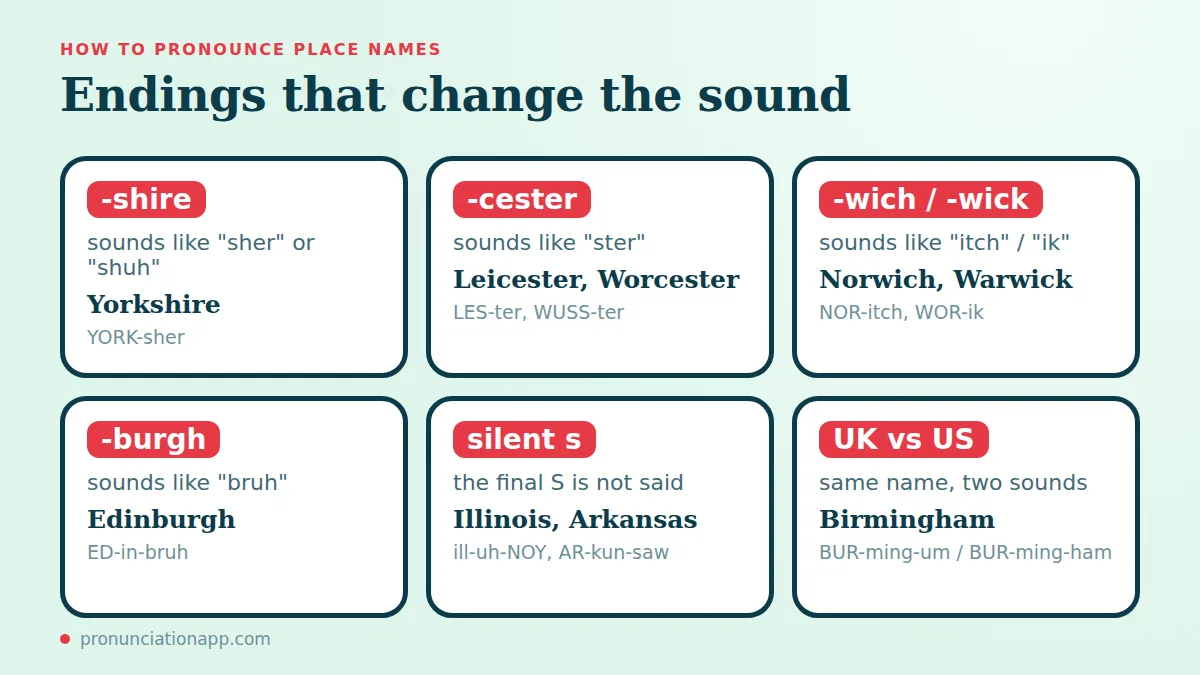
How to pronounce place names: six endings to know
A handful of endings appear again and again. Learn these, and you can say a lot of names you’ve never seen before.
| Ending | Sounds like | Examples |
|---|---|---|
| -shire | “sher” or “shuh” | Yorkshire /ˈjɔːrkʃər/ |
| -cester / -chester | “ster” | Leicester /ˈlestər/, Worcester /ˈwʊstər/, Gloucester /ˈɡlɑːstər/ |
| -wich / -wick | “itch” / “ik” | Norwich /ˈnɒrɪtʃ/, Greenwich /ˈɡrenɪtʃ/, Warwick /ˈwɔːrɪk/ |
| -burgh / -borough | “bruh” | Edinburgh /ˈedɪnbrə/, Loughborough /ˈlʌfbərə/ |
| Silent final s | the S isn’t said | Illinois /ˌɪləˈnɔɪ/, Arkansas /ˈɑːrkənsɔː/ |
| Same name, two sounds | UK vs US | Birmingham. Worcester and Gloucester |
If silent letters are new to you, our guide to silent letters in English explains why English has so many.
UK place names
| Place | IPA | Say it like |
|---|---|---|
| Leicester | /ˈlestər/ | LES-ter |
| Worcester | /ˈwʊstər/ | WUSS-ter |
| Gloucester | /ˈɡlɑːstər/ (UK /ˈɡlɒstə/) | GLOS-ter |
| Edinburgh | /ˈedɪnbrə/ | ED-in-bruh |
| Greenwich | /ˈɡrenɪtʃ/ | GREN-itch |
| Norwich | /ˈnɒrɪtʃ/ | NOR-itch |
| Warwick | /ˈwɔːrɪk/ | WOR-ik |
| Reading | /ˈredɪŋ/ | RED-ing |
| Derby | /ˈdɑːrbi/ | DAR-bee |
| Southwark | /ˈsʌðək/ | SUDH-uck |
| Loughborough | /ˈlʌfbərə/ | LUFF-buh-ruh |
A few extra notes:
- “Reading” is the town, and it rhymes with “wedding,” not “heading.”
- Americans often say “Edinburgh” as “ED-in-burr-oh.” That’s a common version in the US, but in Scotland it’s “ED-in-bruh.”
- “Southwark” in London sounds like “SUDH-uck” in everyday speech.
US place names
| Place | IPA (US) | Say it like |
|---|---|---|
| Arkansas | /ˈɑːrkənsɔː/ | AR-kun-saw |
| Illinois | /ˌɪləˈnɔɪ/ | ill-uh-NOY |
| Kansas | /ˈkænzəs/ | KAN-zus |
| Nevada | /nəˈvædə/ | nuh-VAD-uh |
| Michigan | /ˈmɪʃɪɡən/ | MISH-ih-gun |
| Wisconsin | /wɪsˈkɑːnsn/ | wis-KON-sin |
| Connecticut | /kəˈnetɪkət/ | kuh-NET-ih-kut |
| Massachusetts | /ˌmæsəˈtʃuːsɪts/ | mass-uh-CHOO-sits |
| Pennsylvania | /ˌpensəlˈveɪniə/ | pen-sul-VAY-nee-uh |
| Louisville | /ˈluːivɪl/ | LOO-ee-vil |
| Detroit | /dɪˈtrɔɪt/ | dih-TROYT |
| Chicago | /ʃɪˈkɑːɡoʊ/ | shih-KAH-goh |
Quick notes: “Illinois” and “Arkansas” both end with a silent S, and “Connecticut” has a silent C, so it sounds like “kuh-NET-ih-kut.” “Nevada” is a famous debate. Most Americans say “nuh-VAD-uh,” but some locals prefer “nuh-VAH-duh.” “Louisville” in Kentucky can sound like “LOO-uh-vul” in local speech.
Same name, different sound
Some names are spelled identically in the UK and the US, but pronounced differently.
| Name | In the UK | In the US |
|---|---|---|
| Birmingham | /ˈbɜːmɪŋəm/ (“BUR-ming-um”) | /ˈbɜːrmɪŋhæm/ (“BUR-ming-ham”), as in Alabama |
The Houston example is a fun one. The Texas city is “HYOO-stun,” but the street in New York City is “HOW-stun.” For more differences like these, see our guide to American vs British pronunciation.
Want to hear how this sounds right now? Type any word into the Free Pronunciation Tool and listen to it in 4 accents.
Cities and countries around the world
| Place | IPA (US) | Say it like |
|---|---|---|
| Beijing | /ˌbeɪˈdʒɪŋ/ | bay-JING |
| Peru | /pəˈruː/ | puh-ROO |
| Moscow | /ˈmɑːskaʊ/ (UK /ˈmɒskoʊ/) | MOS-cow (UK: MOS-koh) |
| Bangkok | /ˈbæŋkɑːk/ | BANG-kok |
| Venezuela | /ˌvenəˈzweɪlə/ | ven-uh-ZWAY-luh |
| Haiti | /ˈheɪti/ | HAY-tee |
| Uruguay | /ˈjʊrəɡwaɪ/ | YOOR-uh-gwy |
| Ecuador | /ˈekwədɔːr/ | EK-wuh-dor |
| Colombia | /kəˈlʌmbiə/ | kuh-LUM-bee-uh |
| Reykjavik | /ˈreɪkjəvɪk/ | RAY-kyuh-vik |
| Marseille | /mɑːrˈseɪ/ | mar-SAY |
| Budapest | /ˈbuːdəpest/ | BOO-duh-pest |
| Dubai | /duːˈbaɪ/ | doo-BY |
| Vienna | /viˈenə/ | vee-EN-uh |
Two to watch. “Colombia (the country) is spelled with an O, and Columbia (as in Columbia University) with a U. Both are pronounced kuh-LUM-bee-uh, so the spelling is the only clue.”
Why place names are so unpredictable
Three main reasons:
- They’re old. Many UK names have been worn down over centuries. “Leicester” was once pronounced roughly as it’s spelled.
- They come from many languages. “Illinois” and “Arkansas” come from French versions of Native American names, which is why the final S is silent.
- Local pride. Residents often keep their own pronunciation, even when outsiders use a different one.
That last point is the most important. If you’re ever unsure, listen to how local people say it, and follow them.
Practise in a sentence
Say these three sentences slowly, then at normal speed:
- “I flew from Chicago to Edinburgh, then took a train to Leicester.”
- “She grew up in Arkansas and now lives in Massachusetts.”
- “We’re visiting Peru, Colombia and Ecuador next year.”
Break any word you stumble on into chunks first. For example, “ar-kun-SAW,” “mass-uh-CHOO-sits.” If you want to find the stress, see our guide to word stress in English.
A 10-minute practice plan
- Pick five places you’ll actually say or hear.
- Listen to each in the tool, three times, then once slowly. For help with the tool, see pronunciation audio online.
- Check the IPA. If the symbols are new, see how to read IPA.
- Say each name five times, then in a sentence.
- Record yourself and compare it with the audio.
- Repeat tomorrow with five more.
For more hard words in other categories, see how to pronounce English words online, or use a word pronouncer whenever you’re unsure.
Mistakes to avoid
- Saying every letter. “Leicester” isn’t “lay-sess-ter.”
- Saying the final S in “Illinois” and “Arkansas.”
- Mixing up Colombia and Columbia.
- Assuming UK and US versions match. Birmingham and Worcester are different.
- Treating one version as the only correct one. For many places, more than one pronunciation is in use.
- Guessing instead of checking. A few seconds with the audio saves an awkward moment.
Questions people ask
How do you pronounce Leicester?
LES-ter, in IPA /ˈlestər/. The “ice” in the middle is silent.
How do you pronounce Worcester?
WUSS-ter, in IPA /ˈwʊstər/. It’s the same in the UK and in Massachusetts.
How do you pronounce Edinburgh?
In Scotland, ED-in-bruh, in IPA /ˈedɪnbrə/. Americans often say “ED-in-burr-oh.”
How do you pronounce Arkansas?
AR-kun-saw, in IPA /ˈɑːrkənsɔː/. The final S is silent.
Why are some place names so different from their spelling?
Because spelling was fixed long ago while pronunciation kept changing, and because many names were borrowed from other languages.
Which pronunciation is “correct”?
For place names, the local pronunciation is usually the one to follow. If more than one version is common, both are acceptable.
Try three places now
Pick three places from this page that you’ve been unsure about. Type each into the tool, listen three times and say them out loud. Then say one of the practice sentences as if you were telling a friend about a trip.
Want to hear how this sounds right now? Type any word into the Free Pronunciation Tool and listen to it in 4 accents.
Paste any sentence from this guide into the free tool, hear it in four accents and get instant feedback on your pronunciation.