Indian English Pronunciation vs American: 10 Key Differences
Explore Indian English pronunciation vs American English: 10 key differences in TH, T and D, V and W, R, vowels and rhythm, with tips to practise.
In this article 16 sections
- 01Indian English pronunciation at a glance
- 021. The TH sounds
- 032. T and D: dental and retroflex sounds
- 043. V and W
- 054. The R sound
- 065. Aspiration of P, T and K
- 076. The "day" and "go" vowels
- 087. Rhythm and reduced vowels
- 098. Word stress
- 109. Spelling pronunciations
- 1110. Intonation and melody
- 12Which accent should you use?
- 13A 5-minute practice routine
- 14Common mistakes to avoid
- 15Frequently asked questions
- 16Final thoughts
If you've ever listened to an Indian colleague and an American colleague say the same sentence, you've probably noticed that some sounds are different. Neither one is wrong. They're two well-established varieties of English, each with its own sound patterns. This guide explains Indian English pronunciation and how it differs from American English. It's written for two groups: learners in India who want to understand or adopt a General American accent, and anyone who wants to understand Indian English better.
One important note first. India has many languages, such as Hindi, Tamil, Telugu, Bengali, Marathi and Malayalam, and a speaker's first language shapes their English. That means these are common tendencies, not rules that apply to everyone.
Indian English pronunciation at a glance
Indian English pronunciation is widely understood around the world and is the accent of one of the largest English-speaking populations. Its main features involve consonants (especially T, D, TH, V, and W), vowels, and rhythm.
| Feature | American English | Common in Indian English |
|---|---|---|
| TH sounds | /θ/ and /ð/ (tongue between teeth) | Often a t-like or d-like sound, tongue on the teeth |
| T and D | Alveolar, with flapped T | Often dental or retroflex |
| V and W | Two separate sounds | Sometimes one sound for both |
| R | Smooth, approximant R | Often a tapped R |
| Aspiration | Strong on p, t, k | Often lighter |
| "day" vowel | /eɪ/ (glides) | /eː/ (steady) |
| "go" vowel | /oʊ/ (glides) | /oː/ (steady) |
| Rhythm | Stress-timed, many schwas | More even syllables, fewer reductions |
1. The TH sounds
American English uses /θ/ (think) and /ð/ (this), with the tongue between the teeth. Many Indian English speakers replace these with a stop sound, made with the tongue against the back of the upper teeth.
- think: American /θɪŋk/ · Indian English often like "t-ink" with the tongue on the teeth
- this: American /ðɪs/ · Indian English often like "d-is"
This is the single most recognisable feature. If you want to practise the American sounds, our guide on how to pronounce th walks you through the tongue position step by step.
2. T and D: dental and retroflex sounds
In American English, T and D are made with the tongue tip on the ridge behind the upper teeth (the alveolar ridge). Many Indian languages distinguish dental sounds (tongue on the teeth) from retroflex sounds (tongue curled back), and English T and D are often mapped onto the retroflex ones.
American English also uses a flapped T between vowels, so "water" sounds a little like "wadder" and "city" sounds like "siddy." Indian English speakers usually keep a clear T instead.
- water: American /ˈwɔːɾər/ · Indian English usually a clear T
- better: American /ˈbeɾər/ · Indian English usually a clear T
3. V and W
American English has two distinct sounds: /v/ (teeth touching the lip, as in "very") and /w/ (rounded lips, as in "west"). Some Indian English speakers use one in-between sound for both, so "vine" and "wine" may sound similar.
- vine /vaɪn/ vs. wine /waɪn/
- very /ˈveri/ vs. wary /ˈweri/
If you want the American distinction, try this: for /v/, gently bite your lower lip and hum. For /w/, round your lips and don't touch your teeth at all.
4. The R sound
Most varieties of Indian English are rhotic, which means the R is pronounced after vowels ("car," "hard"), like in American English. The difference is in how the R is made. Indian English often uses a quick tap of the tongue, while American English uses a smooth, gliding R with no tongue contact.
- car: American /kɑːr/ · Indian English usually a light tap on the R
- red: American /red/ · Indian English R often more tapped
5. Aspiration of P, T and K
In American English, the sounds /p/, /t/ and /k/ come with a small puff of air at the start of stressed syllables. Try holding your hand in front of your mouth and saying "pin." You'll feel it.
Indian English speakers often use less of that puff, especially since many Indian languages treat aspirated and unaspirated sounds as different sounds. To an American ear, "pin" with little air can sound closer to "bin."
6. The "day" and "go" vowels
This is one of the clearest vowel differences. American English glides on these vowels, moving from one sound to another:
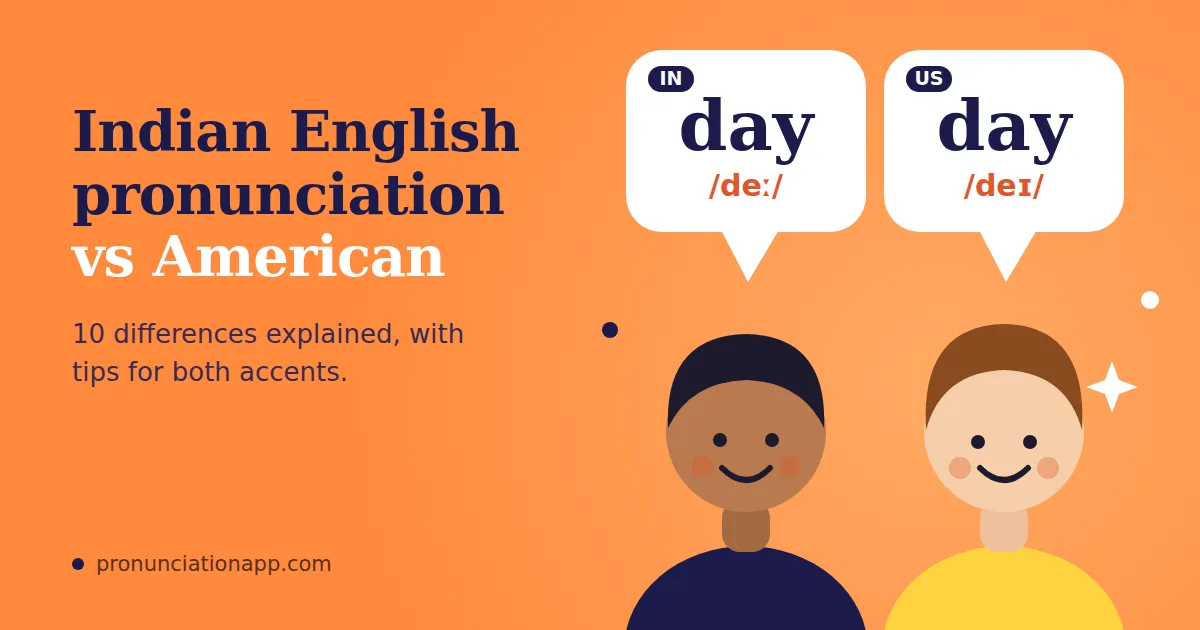
- day: American /deɪ/ · Indian English typically /deː/
- go: American /ɡoʊ/ · Indian English typically /ɡoː/
- name: American /neɪm/ · Indian English typically /neːm/
In Indian English, these vowels usually stay steady rather than gliding. That's why the featured image shows the same word, "day," with two different IPA transcriptions.
7. Rhythm and reduced vowels
American English is stress-timed. Stressed syllables are strong, and unstressed ones shrink into a schwa. Indian English tends to give syllables more equal weight, which is called syllable-timed rhythm. This gives Indian English its clear, even quality, but it can make American listeners feel that everything is equally stressed.
To sound more American, practise weakening the small syllables and function words. Our guide to the schwa sound explains how, and how it changes a sentence like "a cup of tea and a piece of cake."
8. Word stress
Stress placement sometimes differs, and stressed syllables are often less strong compared with unstressed ones. When you're unsure, check the stress mark (ˈ) in the IPA of a dictionary. Our word stress in English guide has seven rules that cover many common words.
9. Spelling pronunciations
Some words are pronounced closer to how they're spelled. A common example is "Wednesday," which American English says as /ˈwenzdeɪ/, but which is sometimes pronounced with every letter, as "Wed-nes-day." The same can happen with the -ed ending in verbs like "walked," where some speakers say "walk-ed." You can review the rules in our guide to how to pronounce -ed endings.
10. Intonation and melody
The pitch pattern, or "music," of Indian English is shaped by the speaker's first language. Pitch may rise and fall in different places than in American English, which can affect how a statement or question sounds to listeners from other backgrounds. Listening to a lot of native audio and copying the melody of whole sentences is the best way to adjust.
Which accent should you use?
There's no right answer. The best accent is the one that's clear for the people you talk to.
- If you work with US clients or plan to study in America, learning a General American accent can help. Focus on TH, V/W, the flapped T, the schwa and the "day" and "go" glides.
- If you mainly speak with Indian colleagues and friends, your natural accent is perfectly fine. Aim for clarity, good stress and steady pace.
- If you're an American or British speaker listening to Indian English, give it a few conversations. It becomes easy to follow very quickly.
A 5-minute practice routine
- Choose one difference per day. Start with TH, then V/W, then the vowel glides.
- Listen to both accents. Type a word into the pronunciation tool and switch between the Indian (IN) and American (US) accents.
- Compare the IPA. See which sounds differ.
- Shadow the audio. Say the word at the same time as the recording, then without it.
- Practise in a sentence. For example: "I think they will very much enjoy the weather today."
- Record yourself and compare it with the audio.
For more listening practice, look up words in Cambridge Dictionary or explore the audio lessons at British Council LearnEnglish.
Common mistakes to avoid
- Treating one accent as "bad." Both are valid. Aim for clarity, not perfection.
- Changing everything at once. Work on one sound at a time.
- Ignoring rhythm. Fixing individual sounds helps, but stress and rhythm matter just as much.
- Copying stereotypes. Learn from real speakers and audio, not from jokes or imitations.
Frequently asked questions
What is the main difference between Indian English and American English pronunciation?
The most noticeable differences are in the TH sounds, the T and D sounds, the V and W sounds, and the rhythm. Vowels like those in "day" and "go" also differ.
Is Indian English pronunciation hard to understand?
No. Millions of people understand it every day. Any difficulty usually comes from unfamiliarity and goes away quickly with exposure.
Is there one Indian accent?
No. Accents vary by region and first language, so a speaker from Kerala may sound different from a speaker from Punjab.
Can I change my accent to American?
Yes, with regular practice. Focus on a few key sounds and rhythm patterns instead of trying to change everything.
Is Indian English the same as British English?
Not exactly. It has historical links to British English, but it also has its own features from Indian languages.
Final thoughts
Indian English pronunciation and American English differ in a handful of predictable ways: TH, T and D, V and W, R, aspiration, vowels and rhythm. Understanding those patterns makes it easier to hear both accents clearly and to adjust your own speech if you choose to.
Curious to hear them side by side? Type any word into the free pronunciation tool, switch between the IN and US accents, and compare.
Paste any sentence from this guide into the free tool, hear it in four accents and get instant feedback on your pronunciation.