How to Pronounce TH: An Easy Guide to /θ/ and /ð/
Learn how to pronounce th in English. Master the voiceless /θ/ and voiced /ð/ sounds with tongue tips, examples, common mistakes and a daily practice plan.
In this article 12 sections
- 01The two TH sounds in English
- 02How to pronounce TH: the tongue position
- 03The throat test
- 04Voiceless /θ/: words to practise
- 05Voiced /ð/: words to practise
- 06Simple rules to help you choose
- 07Exceptions to know
- 08Why it matters: minimal pairs
- 09Common mistakes
- 10A 5-minute practice routine
- 11Frequently asked questions
- 12Final thoughts
Ask an English learner which sound is the hardest, and there's a good chance they'll say "th." Many languages simply don't have it, so your mouth has never had to make it before. That's completely normal. The good news: how to pronounce th comes down to one small movement of your tongue and one simple test. In this guide you'll learn the two "th" sounds, exactly where to put your tongue, which words use which sound, and how to practise until it feels natural.
The two TH sounds in English
The spelling "th" stands for two different sounds, and they're easy to mix up.
| Sound | Type | Symbol | Examples |
|---|---|---|---|
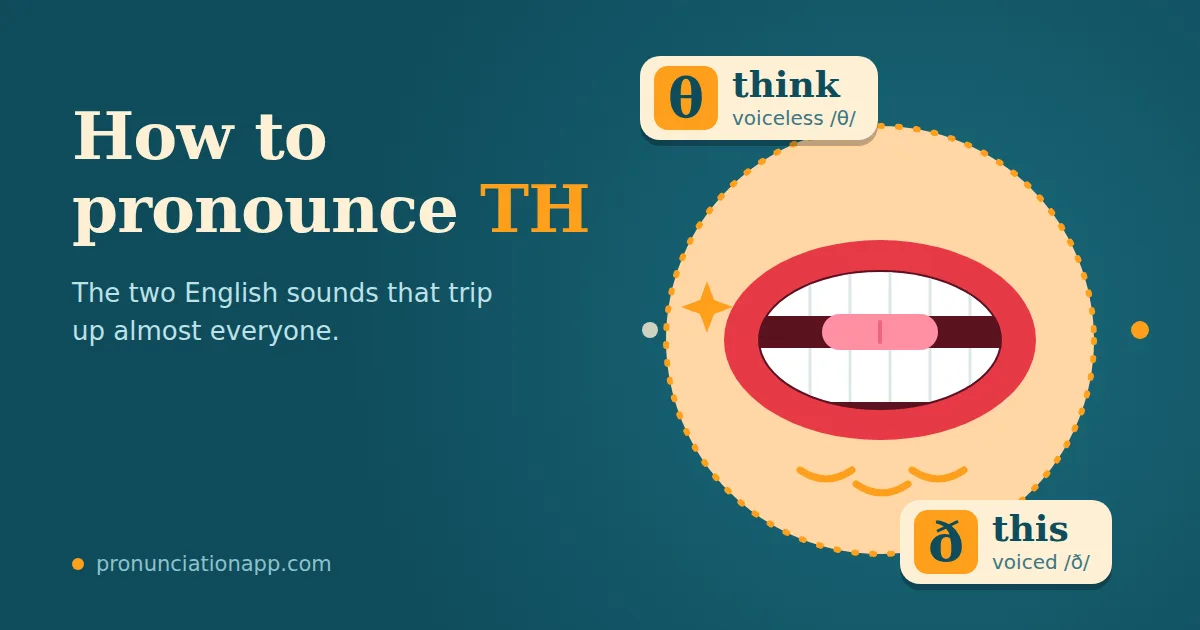
| Voiceless | No voice, just air | /θ/ | think /θɪŋk/, three /θriː/, bath /bæθ/ |
| Voiced | Voice vibrates | /ð/ | this /ðɪs/, that /ðæt/, mother /ˈmʌðər/ |
Both sounds are made in exactly the same place, with the same tongue position. The only difference is whether your vocal cords vibrate.
How to pronounce TH: the tongue position
Here's the step-by-step method:
- Relax your mouth and open it slightly.
- Place the tip of your tongue lightly between your top and bottom teeth. In some accents, the tongue touches just behind the upper teeth. Either is fine.
- Push air out gently so it flows over your tongue. Don't bite down.
- For /θ/, use air only. Say "th" like a soft, breathy whisper.
- For /ð/, add your voice. Same tongue position, but now hum.
The most common mistake is keeping the tongue behind the teeth so no air can escape, which produces a /t/ or /d/ instead.
The throat test
Use the same trick we covered in our guide to how to pronounce -ed endings. Put two fingers on your throat, then say:
- "thhhh" (as in "think"): no buzz. That's /θ/.
- "thhhh" (as in "this"): buzz. That's /ð/.
If you feel a vibration on your fingers and on the tip of your tongue for /ð/, you're doing it right.
Voiceless /θ/: words to practise
- think /θɪŋk/
- three /θriː/
- thank /θæŋk/
- thing /θɪŋ/
- thumb /θʌm/
- thousand /ˈθaʊznd/
- bath /bæθ/
- tooth /tuːθ/
- month /mʌnθ/
- health /helθ/
You'll also hear /θ/ in the middle of words like nothing /ˈnʌθɪŋ/, something /ˈsʌmθɪŋ/, method /ˈmeθəd/ and author /ˈɔːθər/.
Voiced /ð/: words to practise
- this /ðɪs/
- that /ðæt/
- they /ðeɪ/
- those /ðoʊz/
- mother /ˈmʌðər/
- brother /ˈbrʌðər/
- weather /ˈweðər/
- together /təˈɡeðər/
- smooth /smuːð/
- breathe /briːð/
Simple rules to help you choose
English spelling doesn't tell you which "th" to use, but a few patterns cover most words.
Rule 1: Small, common words start with /ð/.
The, this, that, these, those, they, them, then, than, there, though. These are all function words, and they use the voiced sound.
Rule 2: Most other words that start with "th" use /θ/.
Think, three, thank, thick, thin, thing, throw, thought, thumb. These are content words, and they use the voiceless sound.
Rule 3: The word "the" changes slightly.
Before a consonant, it's /ðə/ (the book). Before a vowel, it's /ði/ (the apple). The weak /ə/ here connects to our guide to the schwa sound.
Rule 4: A silent final E often signals /ð/.
Look at these noun and verb pairs:
| Noun (voiceless) | Verb (voiced) |
|---|---|
| breath /breθ/ | breathe /briːð/ |
| bath /bæθ/ | bathe /beɪð/ |
| cloth /klɔːθ/ | clothe /kloʊð/ |
| teeth /tiːθ/ | teethe /tiːð/ |
Also note "clothes," which is usually /kloʊðz/ or /kloʊz/.
Exceptions to know
A few words spelled with "th" don't use either sound.
- Thomas /ˈtɑːməs/
- Thames /temz/
- Thai /taɪ/
- thyme /taɪm/
In these words, "th" is pronounced as a plain /t/. Some words vary by speaker, too. "With" can be /wɪð/ or /wɪθ/, and both are common.
Why it matters: minimal pairs
Saying /s/, /t/ or /f/ instead of /θ/ can change the word entirely. Compare:
| /θ/ | Confusable word |
|---|---|
| think /θɪŋk/ | sink /sɪŋk/ |
| three /θriː/ | tree /triː/ |
| thank /θæŋk/ | tank /tæŋk/ |
| thumb /θʌm/ | some /sʌm/ |
| both /boʊθ/ | boat /boʊt/ |
And for /ð/:
| /ð/ | Confusable word |
|---|---|
| then /ðen/ | den /den/ |
| they /ðeɪ/ | day /deɪ/ |
| breathe /briːð/ | breeze /briːz/ |
Context usually makes your meaning clear, but practising the correct sound removes any risk of confusion.
Common mistakes
- Saying /s/ or /f/ for /θ/: "sink" or "fink" instead of "think."
- Saying /d/ or /z/ for /ð/: "dis" or "zis" instead of "this."
- Biting the tongue. Keep it gentle and relaxed.
- Pushing the tongue too far out. Just the tip should touch the teeth.
- Forgetting to add voice for /ð/, so "this" comes out sounding like "thiss."
Many English accents, including Irish, Indian, and Caribbean varieties, use different sounds here, and that's a normal feature of those accents. If you're aiming for General American or Received Pronunciation, though, use the two sounds above.
A 5-minute practice routine
- Warm up. Stick your tongue out slightly and say "thhhh" for five seconds. Feel the air.
- Use a mirror. Check that you can see the tip of your tongue for both sounds.
- Listen first. Type "think" and "this" into the pronunciation tool and play them slowly.
- Practise minimal pairs. Say "think, sink, think, sink" until the difference is obvious.
- Add words in sentences. For example: "I think that the three brothers were thankful for that other thing."
- Record yourself and compare it with the audio.
For more listening practice, look up any word in Cambridge Dictionary or explore the free audio activities on British Council LearnEnglish.
Frequently asked questions
How do you pronounce TH in English?
Place the tip of your tongue lightly between your teeth and push air out. Add voice for /ð/ (this), or keep it voiceless for /θ/ (think).
Is TH voiced or voiceless?
Both. It's voiceless in words like "think" and voiced in words like "this."
Why is TH so hard for learners?
Many languages don't have these sounds, so the tongue position feels unfamiliar. It gets much easier with short, regular practice.
Can I replace TH with /t/ or /s/?
People will often still understand you, but it can change words, such as "think" and "sink." It's best to learn the real sound.
Do American and British speakers pronounce TH the same way?
Yes, both use /θ/ and /ð/, though some regional accents differ. See our guide to American vs British pronunciation for other differences.
Final thoughts
Learning how to pronounce th takes a little patience, but the method is simple. Tongue tip between the teeth, air flowing gently, and voice on or off. Practise for five minutes a day, focus on the small common words first, and you'll notice the difference within a couple of weeks.
Want to test yourself? Type any word from this article into the free pronunciation tool, listen to the audio, and match the sound.
Paste any sentence from this guide into the free tool, hear it in four accents and get instant feedback on your pronunciation.