English Pronunciation Online (Free): A Complete Guide
Learn English pronunciation online for free. Follow a simple path: sounds, stress, rhythm and speaking practice, plus free tools and a 4-week plan.
In this article 10 sections
Most people who want to improve their English pronunciation have the same problem. They don’t know where to start. There are thousands of videos, apps and word lists, and no clear order for any of it. This guide fixes that. You can learn English pronunciation online for free, without a teacher, a course or any special equipment, as long as you follow a sensible order and practise a little every day. Below you’ll find a five-stage path, a list of free tools and a four-week plan.
Want to hear how this sounds right now? Type any word into the Free Pronunciation Tool and listen to it in 4 accents.
What you can (and can’t) learn online
Let’s be honest about this first. Learning English pronunciation online for free can take you a long way. You can hear any word, learn the sound symbols, practise stress and rhythm, and track your progress by recording yourself.
What you can’t get for free is a person who listens and corrects you in real time. That’s why the plan below includes recording yourself and comparing with native audio. It isn’t the same as a teacher, but it gives you real feedback, and for most learners that’s enough to make steady progress.
English pronunciation online: a 5-stage learning path
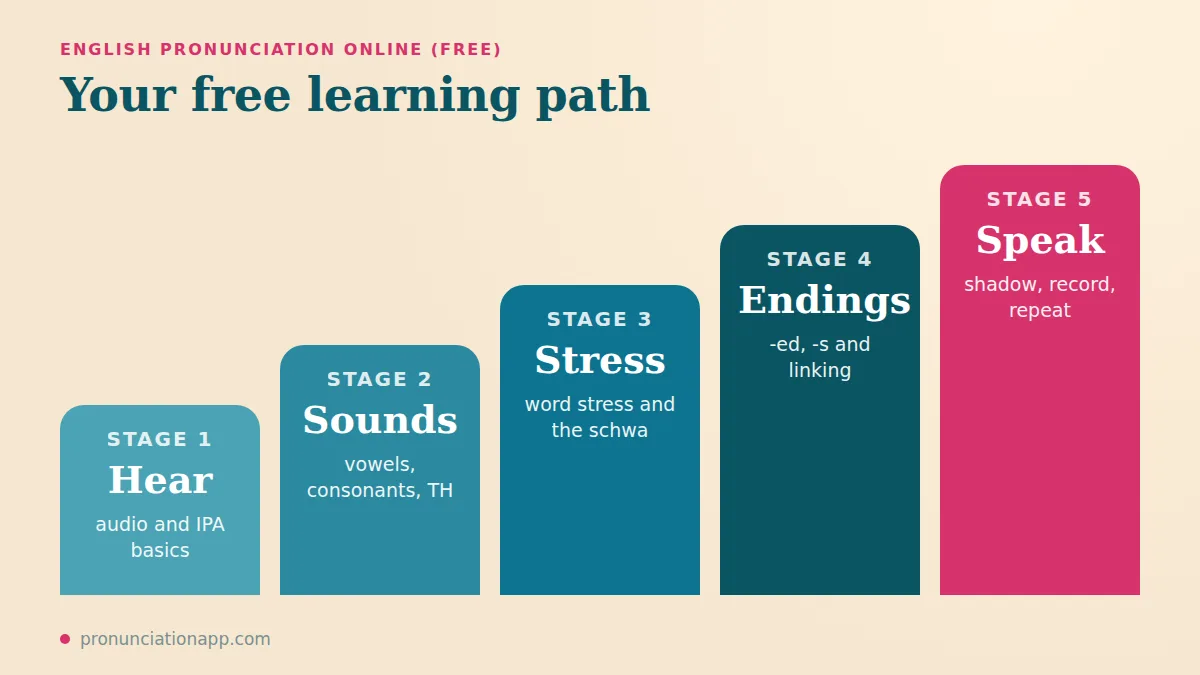
The order matters. Many learners start with the hardest sounds and ignore stress and rhythm, which are often more important. This path goes from the basics to speaking.
Stage 1: Hear it
Before you can say a sound, you need to hear it clearly. Start by getting used to listening to words and checking them, instead of guessing.
- Use pronunciation audio online to hear any word, slow it down and compare accents.
- Learn the basics of IPA, the symbols that show how words sound. Our guide to how to read IPA takes about ten minutes.
Stage 2: Learn the sounds
Now work on individual sounds, starting with the ones that cause you the most trouble.
- TH sounds, as in “think” and “this”: see how to pronounce th.
- Similar sounds, like “ship” and “sheep,” or “right” and “light”: see minimal pairs in English.
- Silent letters, like the K in “knife”: see silent letters in English.
Don’t try to fix everything at once. Choose three sounds, and work on one a week.
Stage 3: Stress and the schwa
This is the stage most people skip, and it makes the biggest difference to how natural you sound. English has a beat. Some syllables are strong, and the rest shrink.
- Learn which syllable to stress in word stress in English.
- Learn the sound those weak syllables turn into: the schwa sound.
Stage 4: Endings and linking
The ends of words carry a lot of meaning, but learners often drop or change them.
- Past tense endings, like “walked” and “wanted”: how to pronounce -ed endings.
- Plural and verb endings, like “cats,” “dogs” and “buses”: how to pronounce s endings.
- Check tricky words in our list of commonly mispronounced words.
Stage 5: Speak
Finally, put it all together. Practise full sentences, not just single words.
- Learn how to practice English speaking alone, with shadowing and recording.
- Work on clarity with our guide to how to reduce your accent.
Want to hear how this sounds right now? Type any word into the Free Pronunciation Tool and listen to it in 4 accents.
Free tools and resources
You don’t need to pay for anything to get started. Here are the main types of free resource, and what each is good for.
| Resource | Good for | Watch out for |
|---|---|---|
| A free pronunciation tool (like ours) | Hearing any word or sentence, in several accents, with IPA | Double-check rare names |
| Online dictionaries (Cambridge, Oxford Learner’s) | Recorded audio and IPA for real words, in UK and US | Only covers listed words |
| British Council LearnEnglish and BBC Learning English | Free listening and pronunciation lessons | Not searchable by word |
| Podcasts and videos | Natural speech and rhythm | Slow for checking one word |
| Your phone’s voice recorder | Feedback: record yourself and compare | Needs honest listening |
For quick word checks, use a tool. For deeper learning, mix in the lessons and listening.
If you want ready-made lists to practise, our page on how to pronounce English words online has word lists by type, and you can also use a word pronouncer any time you’re unsure.
Which accent should you learn?
Pick one accent as your target, and stay with it. Mixing accents isn’t a disaster, but it makes practice harder.
- American (US): common for business, media and many exams.
- British (UK): often used in UK study and some English courses.
- Australian (AU) or Indian (IN): useful if you live, work or study there.
If you’re not sure, read American vs British pronunciation and Indian English pronunciation before deciding.
A free 4-week plan
You don’t need hours. Fifteen minutes a day is enough.
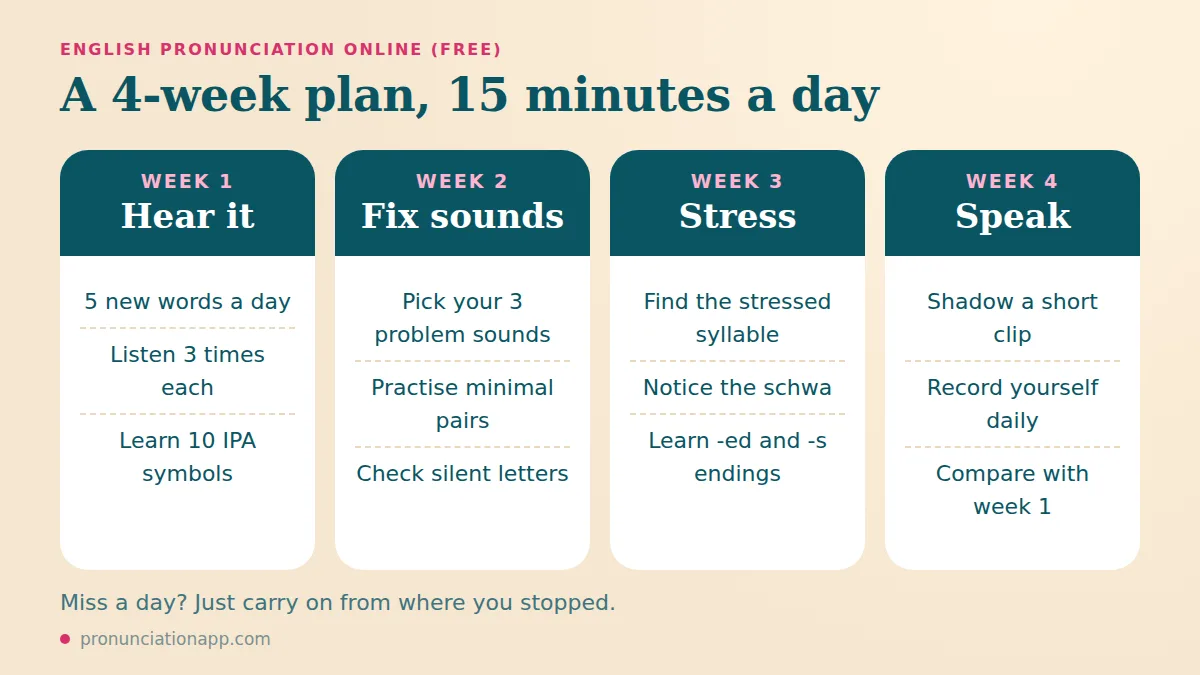
| Week | Focus | Daily 15 minutes |
|---|---|---|
| 1 | Hear it | Listen to five new words, three times each. Learn about ten IPA symbols. |
| 2 | Fix your sounds | Pick three problem sounds. Practise minimal pairs and silent letters. |
| 3 | Stress and endings | Find the stressed syllable in ten words. Practise -ed and -s endings. |
| 4 | Speak | Shadow a short clip. Record yourself daily and compare with week 1. |
If you miss a day, don’t stop. Carry on from where you left off.
Common problems, and where to fix them
| Problem | What to do | Guide |
|---|---|---|
| “Think” sounds like “sink” or “tink” | Put the tongue tip between your teeth | How to pronounce th |
| “Ship” and “sheep” sound the same | Practise short vs long vowels | Minimal pairs |
| Words sound flat or robotic | Work on stress and the schwa | Word stress |
| People mishear “walked” or “dogs” | Practise the endings | -ed endings |
| Not sure how a word sounds | Hear it and check the IPA | Pronunciation audio online |
| No one to practise with | Practise alone | Speaking alone |
How to check your progress
Progress in pronunciation is slow to notice from the inside. Make it visible:
- Record the same paragraph in week 1 and again in week 4, and compare.
- Keep a word list of words you’ve fixed.
- Ask a friend or teacher to listen once a month, if you can.
- Notice real-life wins, like someone understanding you the first time.
Mistakes to avoid
- Starting with the hardest sounds. Begin with hearing and stress.
- Trying to fix everything at once. Choose three things.
- Only listening. Say it out loud.
- Practising a word wrongly. Check the audio first.
- Giving up after a week. Pronunciation improves in small steps.
- Comparing yourself to native speakers. The goal is clarity, not perfection.
Questions people ask
Can I improve my English pronunciation online for free?
Yes. With free audio, IPA guides and regular practice, most learners can make clear progress. Add recording yourself for feedback.
How long does it take to improve?
With about 15 minutes of focused practice a day, many learners notice changes within a few weeks. Bigger changes take months. It varies from person to person.
What are the best free resources?
A pronunciation tool for checking words, an online dictionary for recorded audio, and free lessons from sites like British Council and BBC Learning English.
Do I need a teacher?
Not to start. A teacher or language partner is very helpful later, because they can correct things you can’t hear yourself.
Which accent should I learn?
The one you’ll hear and use most. Consistency matters more than which accent you pick.
Can an app correct my pronunciation?
Some apps use speech recognition to give rough feedback. It can be useful, but it can mishear clear speech and accept unclear speech, so treat it as a guide, not a judge.
How much should I practise each day?
Fifteen minutes is a good target. Short, regular sessions work better than one long session a week.
Start today
You don’t have to follow every step. Pick one word you’ve been unsure about, type it into the tool, listen three times and say it out loud. That’s stage 1, and it takes a minute.
Tomorrow, do it with another word. In four weeks, you’ll be surprised.
Want to hear how this sounds right now? Type any word into the Free Pronunciation Tool and listen to it in 4 accents.
Paste any sentence from this guide into the free tool, hear it in four accents and get instant feedback on your pronunciation.