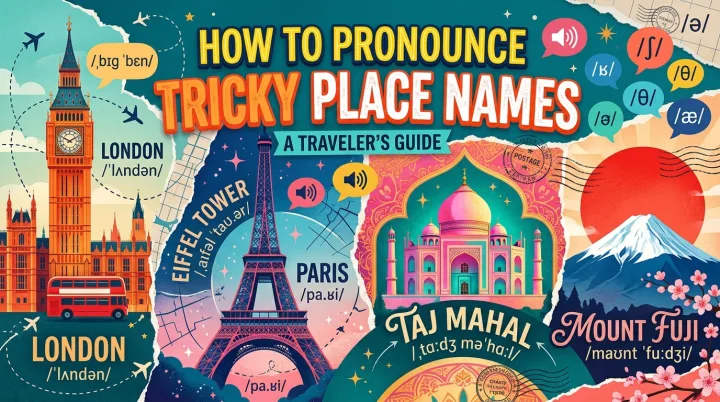
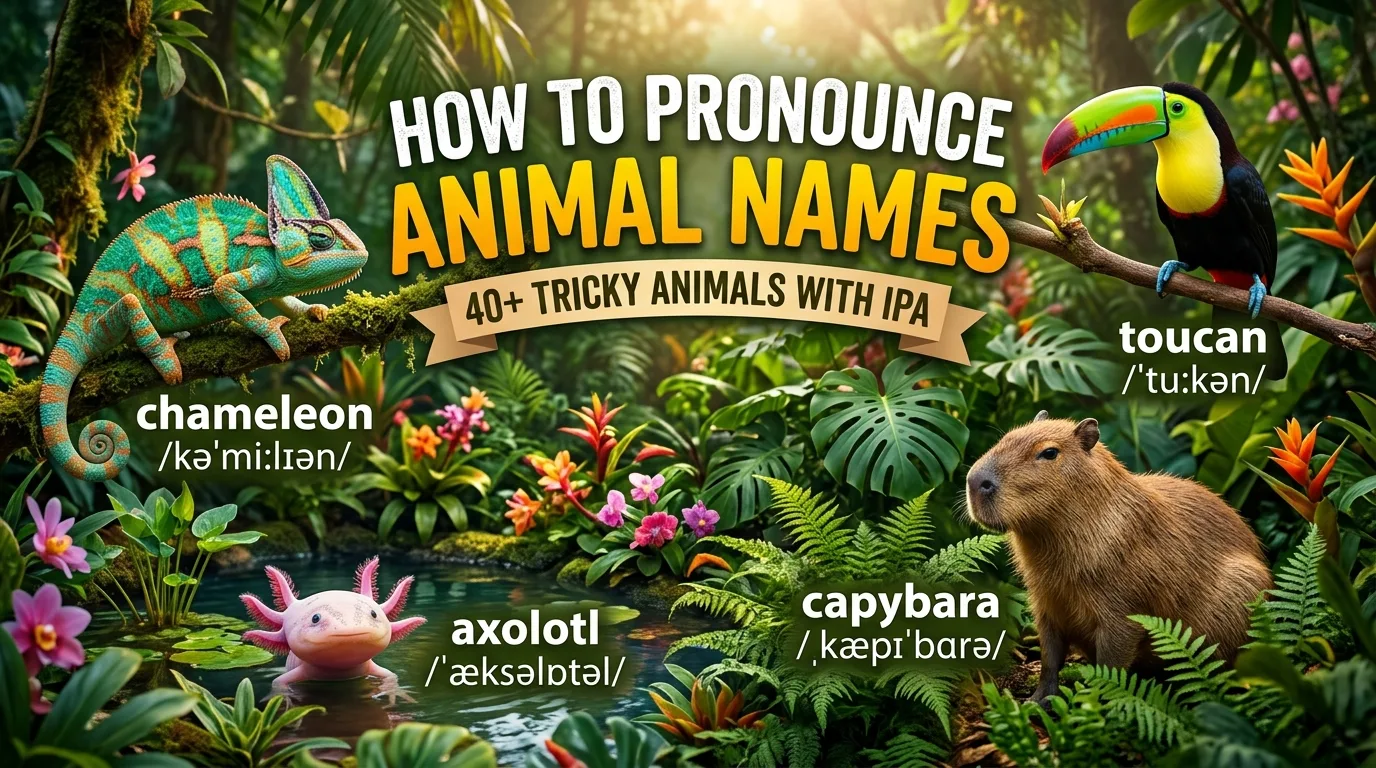
How to Pronounce Animal Names: 40+ Tricky Animals With IPA
Learn how to pronounce animal names like koala, lynx, chameleon and hippopotamus, with IPA, simple respellings and tips for tricky and silent-letter words.
In this article 14 sections
- 01Big mammals
- 02Small and unusual mammals
- 03Reptiles and amphibians
- 04Sea creatures
- 05Birds
- 06Bugs and creepy-crawlies
- 07Animal names with silent letters
- 08Why animal names are tricky
- 09Practise in a sentence
- 10For parents and teachers
- 11A 10-minute practice plan
- 12Mistakes to avoid
- 13Questions people ask
- 14Try three animals now
Animals are one of the first topics anyone learns in English, and yet some of the names are surprisingly hard. Is it “KOH-ah-luh” or “koh-AH-luh”? Does “lynx” have a silent letter? How many syllables does “hippopotamus” really have? This guide shows you how to pronounce animal names, with IPA and simple respellings. It’s grouped by type of animal, and it includes the silent-letter words that trip people up. It’s useful for learners, parents reading to children and teachers planning a zoo lesson.
Big mammals
| Animal | IPA (US) | Say it like |
|---|---|---|
| giraffe | /dʒəˈræf/ | juh-RAF |
| gorilla | /ɡəˈrɪlə/ | guh-RIL-uh |
| jaguar | /ˈdʒæɡwɑːr/ | JAG-wahr |
| leopard | /ˈlepərd/ | LEP-erd |
| cheetah | /ˈtʃiːtə/ | CHEE-tuh |
| hyena | /haɪˈiːnə/ | hy-EE-nuh |
| hippopotamus | /ˌhɪpəˈpɑːtəməs/ | hip-uh-POT-uh-mus |
| rhinoceros | /raɪˈnɑːsərəs/ | ry-NOS-er-us |
| chimpanzee | /ˌtʃɪmpænˈziː/ | chim-pan-ZEE |
| orangutan | /əˈræŋətæn/ | uh-RANG-uh-tan |
A few notes. In British English, “giraffe” is often /dʒɪˈrɑːf/, “juh-RAHF,” and “jaguar” is /ˈdʒæɡjuə/, “JAG-yoo-ar.” The middle of “hippopotamus” is the hardest part, so practise “pot-uh” slowly. And in “rhinoceros,” the “rh” is just an R sound, so it starts with “ry.”
Small and unusual mammals
| Animal | IPA (US) | Say it like |
|---|---|---|
| koala | /koʊˈɑːlə/ | koh-AH-luh |
| lynx | /lɪŋks/ | LINKS |
| armadillo | /ˌɑːrməˈdɪloʊ/ | ar-muh-DIL-oh |
| chipmunk | /ˈtʃɪpmʌŋk/ | CHIP-munk |
| lemur | /ˈliːmər/ | LEE-mer |
| capybara | /ˌkæpɪˈbɑːrə/ | kap-ih-BAR-uh |
| mongoose | /ˈmɑːŋɡuːs/ | MON-goose |
| wolverine | /ˌwʊlvəˈriːn/ | wool-vuh-REEN |
| squirrel | /ˈskwɜːrəl/ | SKWUR-ul |
“Koala” has the stress on the second syllable. “Lynx” has no silent letter, and the “x” is pronounced as “ks.” And “mongoose” has a hard G, as in “go,” and its plural is “mongooses,” not “mongeese.”
Reptiles and amphibians
| Animal | IPA (US) | Say it like |
|---|---|---|
| chameleon | /kəˈmiːliən/ | kuh-MEE-lee-un |
| crocodile | /ˈkrɑːkədaɪl/ | KROK-uh-dyl |
| alligator | /ˈælɪɡeɪtər/ | AL-ih-gay-ter |
| iguana | /ɪˈɡwɑːnə/ | ih-GWAH-nuh |
| axolotl | /ˈæksəlɑːtl/ | AK-suh-lot-ul |
| Komodo dragon | /kəˈmoʊdoʊ/ | kuh-MOH-doh |
“Chameleon” starts with a K sound, not “ch.” That’s the same pattern we saw in medical words like “cholesterol,” in our guide to how to pronounce medical words.
Want to hear how this sounds right now? Type any word into the Free Pronunciation Tool and listen to it in 4 accents.
Sea creatures
| Animal | IPA (US) | Say it like |
|---|---|---|
| octopus | /ˈɑːktəpʊs/ | OK-tuh-pus |
| porpoise | /ˈpɔːrpəs/ | POR-pus |
| narwhal | /ˈnɑːrwɑːl/ | NAR-wahl |
| manatee | /ˈmænətiː/ | MAN-uh-tee |
“Porpoise” has an “oi” in the spelling, but it sounds like “POR-pus,” not “POR-poyz.” And the plural of “octopus” is usually “octopuses,” /ˈɑːktəpʊsɪz/.
Birds
| Animal | IPA (US) | Say it like |
|---|---|---|
| flamingo | /fləˈmɪŋɡoʊ/ | fluh-MING-goh |
| pelican | /ˈpelɪkən/ | PEL-ih-kun |
| penguin | /ˈpeŋɡwɪn/ | PENG-gwin |
| ostrich | /ˈɑːstrɪtʃ/ | OS-trich |
| cassowary | /ˈkæsəweri/ | KAS-uh-wair-ee |
“Penguin” has a hard “gw” sound in the middle, so it’s “PENG-gwin,” not “PEN-jin.”
Bugs and creepy-crawlies
| Animal | IPA (US) | Say it like |
|---|---|---|
| tarantula | /təˈræntʃələ/ | tuh-RAN-chuh-luh |
| scorpion | /ˈskɔːrpiən/ | SKOR-pee-un |
| mosquito | /məˈskiːtoʊ/ | muh-SKEE-toh |
| caterpillar | /ˈkætərpɪlər/ | KAT-er-pil-er |
Animal names with silent letters
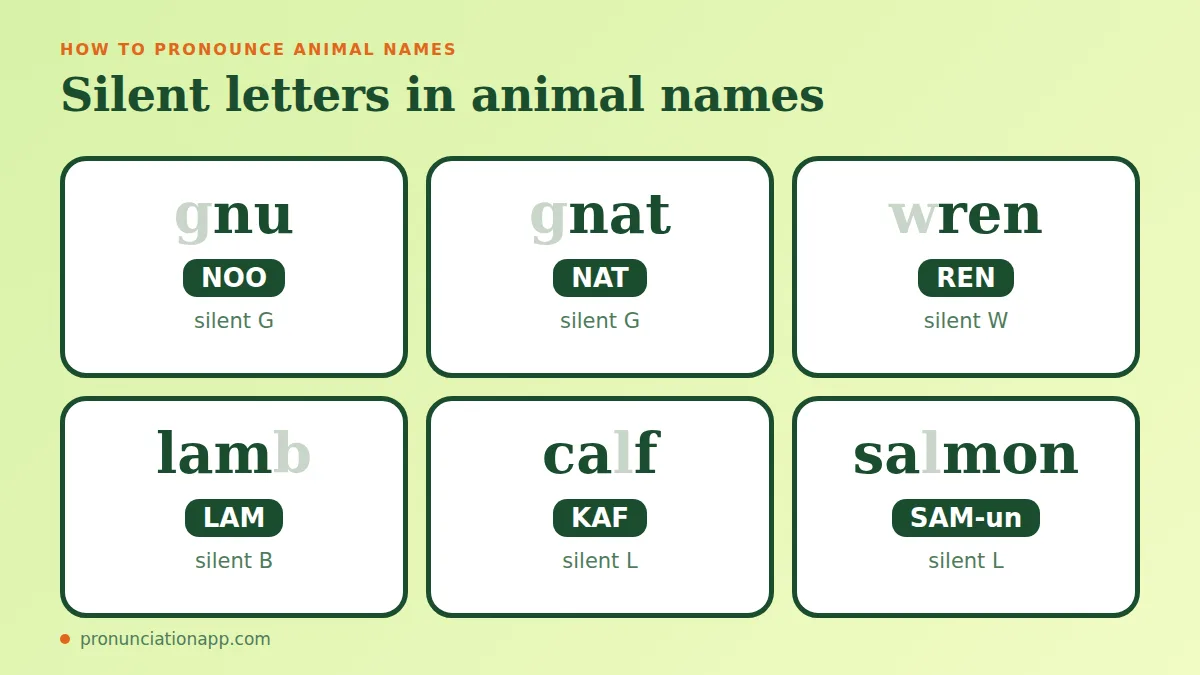
Some animal names have letters that appear in the spelling but not in the sound.
| Animal | IPA (US) | Say it like | Silent letter |
|---|---|---|---|
| gnu | /nuː/ | NOO | g |
| gnat | /næt/ | NAT | g |
| wren | /ren/ | REN | w |
| lamb | /læm/ | LAM | b |
| calf | /kæf/ | KAF | l |
| salmon | /ˈsæmən/ | SAM-un | l |
There are patterns here. “Gn-” at the start of a word is “n,” “wr-” is “r,” and “-mb” at the end loses the B. For more, see our guide to silent letters in English.
Why animal names are tricky
Three main reasons:
- They come from many languages. “Koala” is from an Australian Aboriginal language, “chameleon” is from Greek, “jaguar” is from a South American language and “mongoose” is from Marathi.
- They’re long. Words like “hippopotamus” and “rhinoceros” have four or five syllables, so it’s easy to lose your place.
- The spelling doesn’t match the sound. “Porpoise,” “wolverine” and “squirrel” all have sounds you wouldn’t guess.
That last one is why “squirrel” is famous. It starts with “skw” and then needs the R sound right away, which is hard for many speakers. If that’s your problem, see our guide to how to pronounce difficult English words.
Practise in a sentence
Say these three sentences slowly, then at normal speed:
- “The chameleon watched the koala while a squirrel ate an acorn.”
- “A hippopotamus and a rhinoceros were standing near the penguins.”
- “The lamb and the calf stayed away from the gnat.”
For long words, break them into chunks first, like “hip-uh-POT-uh-mus.” If you need help finding the stress, see word stress in English.
For parents and teachers
If you’re reading to children or teaching a class, here are a few ideas.
- Say the name slowly, in chunks, and let the child copy it.
- Clap the syllables. “Hip-po-pot-a-mus” has five claps.
- Play a silent-letter game. Show “gnu” and ask what the first letter sounds like.
- Use the audio. Type the animal’s name into the tool and let the children hear it before they say it.
A 10-minute practice plan
- Pick five animals you want to learn.
- Listen to each in the tool, three times, then once slowly. For help with the tool, see pronunciation audio online.
- Check the IPA. If the symbols are new, see how to read IPA.
- Say each word five times, then in a sentence.
- Record yourself and compare it with the audio.
- Add five more tomorrow.
You can also use a word pronouncer whenever you meet a new animal. For similar lists, see our guides to food names and place names.
Mistakes to avoid
- Saying “ch” in “chameleon.” It’s a K sound.
- Saying “pen-jin” for “penguin.” It’s “PENG-gwin.”
- Adding the silent letter in “gnu,” “gnat,” “wren,” “lamb” and “calf.”
- Saying “mongeese.” The plural is “mongooses.”
- Dropping syllables in “hippopotamus.” It has five.
- Guessing instead of checking. A few seconds with the audio is enough.
Questions people ask
How do you pronounce koala?
koh-AH-luh, in IPA /koʊˈɑːlə/. The stress is on the second syllable.
How do you pronounce hippopotamus?
hip-uh-POT-uh-mus, in IPA /ˌhɪpəˈpɑːtəməs/. It has five syllables.
How do you pronounce chameleon?
kuh-MEE-lee-un, in IPA /kəˈmiːliən/. The “ch” sounds like “k.”
How do you pronounce lynx?
LINKS, in IPA /lɪŋks/.
Which animal names have silent letters?
Gnu, gnat, wren, lamb, calf and salmon are common examples.
What’s the plural of mongoose?
Mongooses, /ˈmɑːŋɡuːsɪz/.
Try three animals now
Pick three animals from this page that you weren’t sure about. Type each into the tool, listen three times and say them out loud. Then say one of the practice sentences as if you were telling a child a story.
Want to hear how this sounds right now? Type any word into the Free Pronunciation Tool and listen to it in 4 accents.
Paste any sentence from this guide into the free tool, hear it in four accents and get instant feedback on your pronunciation.